

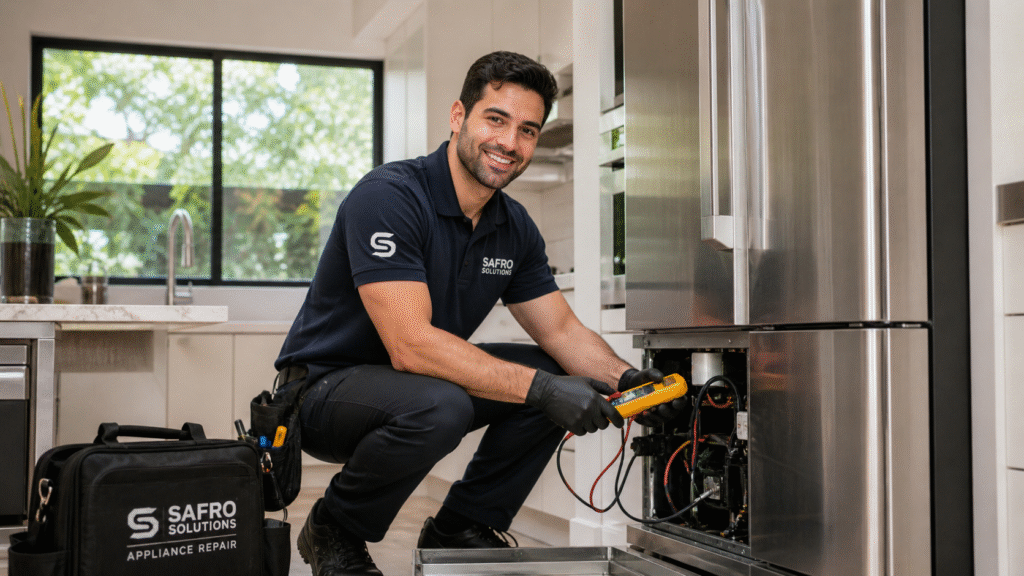
Why Is My Refrigerator Not Cooling?
A refrigerator usually stops cooling because of dirty condenser coils, blocked air vents, a bad evaporator fan, a loose door seal, thermostat problems, frost buildup, or compressor trouble. Some checks are simple, but electrical, refrigerant, and compressor repairs should be handled by a trained appliance technician.
Start with power, the temperature setting, clear vents, and a tight door gasket. If the light is on and the refrigerator is not cooling, the problem is often inside the cooling system, not the power supply.
Reviewed by the technicians at Safro Solutions — appliance repair experts serving Los Angeles homeowners.
Signs Your Refrigerator Is Not Cooling Properly
A refrigerator could lose consistent cooling when dust, a weak seal, or blocked airflow forces it to work harder. We recommend checking these basics before you replace parts.
If you find that your refrigerator feels warmer than normal, act early. Quick action can protect fresh food and prevent a larger repair.
| Sign you notice | Possible cause | Best next step |
| Food spoils faster than normal | Temperature is too high or airflow is weak. | Use a thermometer and check the controls. |
| Fridge not cooling but light is on | Power is present, but a cooling part may have failed. | Check vents, coils, and fan noise. |
| Fridge and freezer not cooling but light is on | Start relay, compressor, control board, or sealed system issue. | Call for diagnosis if basic checks pass. |
| Clicking, humming, or grinding noise | Fan motor, relay, or compressor problem. | Do not ignore the sound. |
| Frost buildup inside the freezer | Defrost failure or blocked airflow. | Avoid sharp tools; get the part tested. |
| Moisture around the door | Loose gasket or damaged seal. | Clean and inspect the gasket. |
What Temperature Should Your Refrigerator Be?
For food safety, FDA guidance says to keep the refrigerator at 40°F or below and the freezer at 0°F. Use an appliance thermometer because many models show a number setting, not the real refrigerator temperature.
A good target is about 37°F for the fresh food section and 0°F for the freezer. These temperature settings help keep milk, meat, eggs, leftovers, and drinks safe.
If the unit stays above 40°F, move perishable food to a cooler with ice. Warm food can become unsafe before it smells bad.
Safety Warning
If food has stayed above 40°F for more than 2 hours, do not take chances. Throw out unsafe items and focus on the repair.
Quick Checks Before Calling a Technician
Before you schedule service, troubleshoot the basics. These checks answer what to check first and how to reset a fridge that is not cooling.
Check the Power and Breaker Box
Open the door and look for the light. If the light is off, make sure the refrigerator is plugged in. Then check the circuit breaker. A trip at the breaker box can stop the power supply.
If the light works, the unit has power. Next, locate the cooling issue instead of resetting the outlet again.
Check the temperature setting.
Make sure the refrigerator and freezer controls were not bumped. On some models, an improper setting can make the appliance chill too little.
Adjust the control to the correct range and wait 12 to 24 hours. If the refrigerator still cannot maintain the proper temperature, move to the next check.
Make Sure Air Vents Are Not Blocked
Cold air must flow through the cabinet. If food blocks a vent, cool air cannot reach every shelf.
- Remove large containers from the back wall.
- Keep space around each vent.
- Do not stack boxes tightly against the freezer opening.
Make sure the refrigerator has room inside for air movement. A full appliance can operate normally only when air can move around the food.
Inspect the Door Gasket
The gasket is the rubber seal around the door. If it is cracked, loose, dirty, or stiff, warm air can leak inside your refrigerator.
Try the dollar bill test. Close the door on a bill and pull it out. If it slides out with no resistance, the seal may not be tight enough.
Listen for Clicking, Humming, or Fan Noise
Noise can reveal the issue. Repeated clicking can point to a relay. Grinding can point to a fan. A loud hum may mean the refrigerator’s compressor cannot cycle correctly.
Check your manual for basic sound instruction, but do not remove panels if you are not comfortable with electrical parts.
The 7 Most Common Causes of a Refrigerator Not Cooling
Most cooling problems come from airflow trouble, poor heat release, a failed control, or a sealed system issue. Here are the reasons why your refrigerator may not be cooling properly.
1. Dirty or Blocked Condenser Coils
Dirty condenser coils are a main cause of weak cooling. The condenser coils release heat from the refrigerant. When dust, grease, or pet hair covers them, the appliance cannot release heat well.
You may notice lower performance or long run times. On many models, the coils sit underneath the refrigerator or behind the lower rear panel.
How to fix it :
- Unplug the unit first.
- Use a vacuum and coil brush to clean the coils.
- Install the lower cover again after cleaning.
Tip: clean this area every 6 months, or more often if you have pets. If it still does not cool properly, the condenser fan or another internal part may need service.
2. Blocked Air Vents or an Overpacked Refrigerator
Blocked air vents stop cold air from reaching the fresh food section. This can make one area too cold while another area stays warm.
Do not force shelves full of food. The refrigerator and freezer need open space so air can move.
How to fix it :
- Move food away from each vent.
- Keep a small gap between containers.
- Wait several hours before checking the temperature again.
3. Faulty Evaporator Fan Motor
The evaporator fan pushes cold air from the freezer area into the refrigerator section. If this motor fails, the freezer may stay cold while the fresh food area gets warm.
You may hear squealing, scraping, or no fan sound. Testing matters because wiring, ice, or a control board can also stop the fan.
How to fix it : This is usually not a DIY repair. A professional can test voltage, inspect the blade, and replace the motor only when needed.
4. Damaged or Loose Door Gasket
A damaged gasket lets warm air enter the cabinet. The refrigerator may run longer and still fail to stay cold.
Look for gaps, cracks, moisture, mold, or a seal that pulls away from the liner. Even small damage can break the cooling cycle and raise the temperature.
How to fix it :
- Clean the gasket with mild soap and warm water.
- Inspect corners for gaps.
- Replace the gasket if it is torn or warped.
A correct gasket repair can protect the compressor and help the appliance cool properly again.
5. Bad Thermostat or Temperature Control Board
The thermostat tells the refrigerator when to cool. The temperature controls and control board send power to parts that start and stop cooling.
If the controls fail, the unit may ignore temperature changes. This is why a refrigerator that’s set to the coldest number isn’t cooling in some homes.
How to fix it : Do not replace control parts by guesswork. A technician can test sensors, wiring, and board output before recommending a solution.
6. Defrost System Failure or Frost Buildup
Modern cooling technology uses a defrost system to stop ice from coating the evaporator coils. If the heater, thermostat, timer, or board fails, frost can block airflow.
You may see freezing on the back panel, weak chill, or water after ice melts. This may not be cooling related at first glance, but it often is.
How to fix it : Do not chip ice with a knife. That can puncture tubing and cause a refrigerant leak. The safer fix is to thaw the unit and test the failed defrost part.
7. Compressor, Start Relay, or Refrigerant Problem
The compressor moves refrigerant through the sealed system. The start relay helps the compressor turn on. If either part fails, the unit may stop cooling completely.
A refrigerant leak can also cause weak cooling, especially after a gas refill. Adding refrigerant without fixing the leak is not a long-term fix.
Safety Warning : Do not open the sealed system. Compressor and refrigerant repairs require special tools, safe handling, and proper training. Call a professional for this repair.
DIY vs. Professional Refrigerator Repair
Some checks are safe. Others can create electrical damage, refrigerant leaks, or higher repair costs.
| Problem | Safe DIY check? | When to call for service |
| Dirty condenser coils | Yes | Cleaning does not restore cooling. |
| Blocked vents | Yes | Airflow stays weak after food is moved. |
| Door gasket issue | Yes | The gasket is cracked, loose, or warped. |
| Evaporator fan failure | No | Fan is silent, noisy, or not moving air. |
| Thermostat/control board | No | Temperature does not respond to the setting. |
| Defrost failure | No | Frost keeps returning on the freezer panel. |
| Compressor or refrigerant issue | No | You hear clicking or suspect a sealed system problem. |
Pro Tip
If the unit is running but not cooling, do not keep lowering the dial. Find the cause first.
Why Is My Freezer Cold but My Refrigerator Warm?
When the freezer is cold but the refrigerator is warm, the cooling system may still work. The problem is often that cold air cannot travel into the fresh food section.
Common possible causes include:
- Evaporator fan motor failure.
- Blocked air vents or packed shelves.
- Frost buildup on the evaporator coils.
- Defrost system failure.
- Air damper problem.
This problem can spoil food even when frozen items look fine. Check vents and fan noise early.
Cost of Refrigerator Repair in Los Angeles
Cost depends on the model, part, labor, and access. A gasket or thermostat repair usually costs less than compressor work.
Use this table as a planning guide. Final pricing should follow an inspection.
| Repair type | Typical Los Angeles range | Notes |
| Thermostat or control repair | $100 – $200 | Often needed when controls do not respond. |
| Fan repair | $100 – $250 | May include evaporator fan or condenser fan testing. |
| Door gasket replacement | $100 – $200 | Helps stop warm air leaks. |
| Defrost repair | $100 – $250 | Needed when frost blocks airflow. |
| Ice maker or water issue | $150 – $250 | Depends on valve, line, or assembly. |
| Compressor or sealed system | $200 – $450+ | Requires expert diagnosis first. |
Repair often makes sense when the unit is under 10 years old and the cabinet is in good shape. Older units with major compressor failure may be better to replace.
Refrigerator Brands We Service in Los Angeles
Different brands can show the same symptom in different ways. A Samsung unit may need a different diagnostic path than a Whirlpool, GE, LG, KitchenAid, Maytag, Bosch, or Sub-Zero model.
Safro Solutions services major brands commonly found in Los Angeles homes:
- LG
- Samsung
- Whirlpool
- GE
- KitchenAid
- Maytag
- Bosch
- Frigidaire
- Sub-Zero and other built-in models when parts are available
How to Prevent Refrigerator Cooling Problems
Simple maintenance can help the appliance run better, maintain efficiency, and last longer.
- Clean condenser coils every 6 months, or more often if you have pets.
- Keep air vents clear in both compartments.
- Do not overpack shelves or drawers.
- Inspect the door gasket every few months.
- Keep the unit level so doors close correctly.
- Do not install the unit next to ovens, sunny windows, or other heat sources.
- Use a thermometer to confirm the refrigerator temperature.
Many refrigerators are designed for indoor use and need space around the cabinet. In Los Angeles, warm kitchens and dusty floors can speed up small issues.
Need Refrigerator Repair in Los Angeles?
If your refrigerator is still warm after basic checks, Safro Solutions can help. We provide same-day in-home service across Los Angeles, including Valley Village, Sherman Oaks, Studio City, Burbank, Encino, Beverly Hills, Van Nuys, and Pasadena.
Our team focuses on clear diagnosis, upfront pricing, and no hidden fees. Need help now? Schedule refrigerator repair in Los Angeles with Safro Solutions or call (747) 250-6879 for same-day service.
We explain the problem in plain English, quote before work begins, and repair the issue with the right parts when possible.
Contact Safro Solutions for Refrigerator Repair in Los Angeles and Nearby Areas
Company Name : Safro Solutions
Address : 5331 Corteen Pl, Valley Village, CA 91607, USA
Phone : (747) 250-6879
Visit Our Google Business Profile
Frequently Asked Questions
Q1: What is the main cause of the refrigerator not cooling?
Dirty condenser coils are a common cause. Other issues include blocked air vents, a failed fan, a bad thermostat, frost buildup, relay failure, compressor trouble, or refrigerant leaks.
Q2: How do I reset a fridge that is not cooling?
Unplug the unit for about 5 minutes, then plug it back in. If it still does not cool after 12 to 24 hours, the problem is likely mechanical or electrical.
Q3: What causes a refrigerator to stop cooling suddenly?
A sudden cooling loss often points to a failed evaporator fan, a tripped compressor, or a refrigerant leak. These issues go beyond basic checks and need professional diagnosis.
Q4: Why is my refrigerator not cooling properly, and how can I fix it?
Check power, the temperature setting, blocked vents, dirty coils, and the door gasket first. If those items look normal, testing may require a pro.
Q5: Why is the fridge not cold but the freezer is?
This usually points to airflow. The evaporator fan may have failed, the damper may be stuck, the vents may be blocked, or frost may cover the coils.
Q6: Why is my fridge not cooling and making noise?
Grinding often points to a fan motor. Clicking can point to a relay or compressor issue. A loud hum can mean the compressor cannot start correctly.
Q7: Should I repair or replace a refrigerator that is not cooling?
Repair is often worth it for newer units and minor part failures. Replacement may make sense for older units with major sealed system failure.
Q8: What should I look for when hiring a refrigerator repair technician in Los Angeles?
Look for a licensed technician with experience in sealed system repairs, transparent pricing, and same-day availability. Local companies familiar with LA neighborhoods typically respond faster and understand regional service needs.