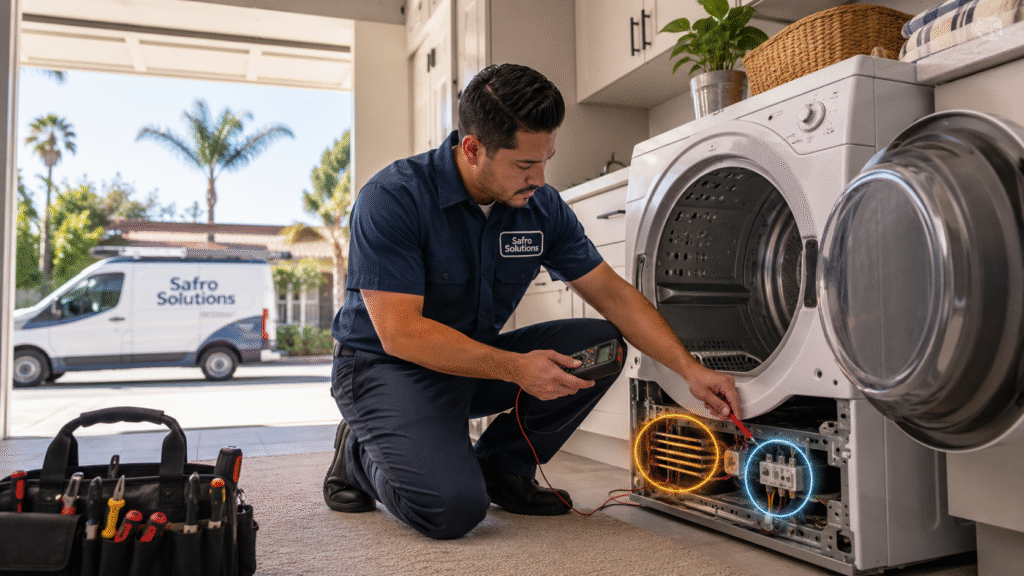
When a dryer runs but no heat , dryer starts, tumbles, and finishes the cycle but clothes stay cold or damp, the heating system is not doing its job. For Los Angeles homeowners, the cause may be a bad heating element, blown thermal fuse, clogged dryer vent, weak airflow, partial power problem, thermostat failure, or gas dryer ignition issue.
This guide is locally focused for homeowners who need practical answers before calling for
dryer repair in Los Angeles.
Quick Answer: Why Does My Dryer Run But Not Heat?
A dryer can tumble without producing heat because the motor and heating system work separately. The motor may still turn the drum while the heat circuit, burner system, thermostat, safety fuse, or airflow path fails.
In an electric dryer, no heat may come from a burned heating element, blown thermal fuse, tripped breaker, thermal cutoff, thermostat, wiring issue, or control board problem.
In a gas dryer, the drum can spin while the burner fails to ignite. Possible causes include a closed gas valve, bad igniter, weak gas valve coils, flame sensor issue, or thermal fuse failure. If you smell gas, stop using the appliance and
contact the proper gas emergency service.
Heating Element vs Thermal Fuse: What’s the Difference?
The heating element and thermal fuse are both involved in dryer heat, but they do opposite jobs. The heating element creates heat. The thermal fuse shuts the dryer down when unsafe heat builds up.
A dryer not heating problem should not be diagnosed by symptom alone. A bad heating element and a blown thermal fuse can both leave clothes damp.
- What the Heating Element Does
The heating element warms air in most electric dryers. When power passes through the element coil, the coil gets hot, and the blower moves warm air through the drum. If the coil burns out or breaks, the dryer may start normally but blow cool air. Common dryer heating element bad symptoms include cold air, weak heat, longer drying times, or heat that worked on and off before stopping.
A heating element can fail from age, heavy use, lint restriction, or overheating. If airflow is poor, a new element may not last.
- What the Thermal Fuse Does
The thermal fuse is a safety part that reacts to overheating. If the dryer temperature rises too high, the fuse opens the circuit to help prevent unsafe operation.
A dryer thermal fuse blown issue can look different by model. Some dryers will not start at all. Others may still run but stop heating.
The fuse usually cannot be reset. It must be replaced if it tests bad, but the reason it blew should also be found. In many cases, that reason is restricted airflow.
Heating Element vs Thermal Fuse Comparison
| Issue |
Heating Element |
Thermal Fuse |
| Main job |
Creates heat in an electric dryer |
Stops unsafe overheating |
| Common symptom |
Dryer tumbles but blows cool air |
Sudden no heat or dryer may not start |
| Common cause |
Burned coil, age, heat stress |
Clogged vent, lint buildup, poor airflow |
| Best clue |
Heat became weak before stopping |
Dryer ran very hot before failure |
| Applies mostly to |
Electric dryers |
Electric and many gas dryer circuits |
| Main warning |
High-voltage testing required |
New fuse may fail again if airflow is not fixed |
Signs Your Dryer Heating Element May Be Bad
A bad heating element is more likely when an electric dryer tumbles normally but does not warm the air. The cycle may finish, but laundry comes out damp.
Watch for these signs:
- Dryer blows cool air on a heated cycle
- Clothes stay wet after one full cycle
- Heat was weak before it stopped
- Dryer has power but no heat
- Air-only settings work the same as heated settings
These signs point toward the element, but they do not prove it. A technician should still test the element, fuse, thermostat, and airflow before replacing parts.
Signs Your Dryer Thermal Fuse May Be Blown
A blown thermal fuse is often linked to overheating. In Los Angeles homes, this may happen when the vent hose is crushed behind the dryer, the exterior vent is blocked, or lint has built up inside a long vent path.
Common signs include:
- Dryer suddenly stopped heating
- Dryer cabinet felt hotter than usual
- Clothes needed two cycles to dry
- Outside vent airflow felt weak
- Burning lint smell appeared
- Fuse or heating part failed again after replacement
If the dryer became very hot before the heat stopped, do not keep running it.
Electric vs Gas Dryer No-Heat Problems
Electric and gas dryers can both spin without heat, but they use different heating systems. Knowing which dryer type you have helps narrow the diagnosis.
• Electric Dryer Runs But Has No Heat
An electric dryer runs but no heat comes through when the heating circuit cannot work. Common causes include the heating element, thermal fuse, high-limit thermostat, thermal cutoff, control relay, wiring, or partial power supply.
A partial breaker issue can be confusing. The drum motor may run, but the element may not receive the power needed to heat. If the breaker trips again after one reset, stop using the dryer.
• Gas Dryer Runs But Has No Heat
A gas dryer does not use the same heating element found in an electric dryer. It uses a burner system to create heat.
If a gas dryer runs but has no heat, the issue may involve the igniter, gas valve coils, flame sensor, thermal fuse, control system, or gas supply. Gas odor should be handled as an emergency safety issue.
Other Reasons a Dryer Runs But Has No Heat
Not every no-heat problem comes from the element or fuse. A full diagnosis should include airflow, power, safety parts, burner parts, and controls.
• Clogged Dryer Vent or Lint Screen
A clogged dryer vent no heat problem often starts with long drying times. The dryer may still get warm, but airflow is too weak to remove moisture from clothes.
Signs of airflow restriction include:
- Clothes feel warm but stay damp
- Laundry room feels humid
- Dryer top or side feels too hot
- Outside vent flap barely opens
- Lint gathers near the vent outlet
Clean the lint screen after every load. Also check behind the dryer for a crushed or kinked vent hose. In many Los Angeles apartments, condos, and older homes, laundry areas are tight, so vent hoses can bend without being noticed.
• Partial Power Problem on Electric Dryers
Electric dryers usually need full power for heat. If one side of the breaker supply is lost, the motor may run while the heating element stays off.Reset the breaker only one time. Repeated breaker trips may point to wiring, element, or electrical problems that need professional testing.
• Faulty Thermostat or Thermal Cutoff
Dryers use thermostats and thermal cutoffs to control heat. If one fails, the dryer may stop heating, overheat, or shut heat off too early. Testing is better than guessing.
• Gas Supply or Igniter Problem
For gas dryers, no heat may happen when the burner never lights. The dryer may start and tumble normally, but the air stays cool.
Possible causes include a closed gas valve, weak gas valve coils, failed igniter, flame sensor issue, thermal fuse, or control problem.
• Timer or Control Board Issue
Modern dryers may use boards, relays, timers, and sensors to control heat. If these parts stop sending the right signal, the dryer may run without heat.
Why Dryer No-Heat Problems Are Common in Los Angeles Homes
Los Angeles homes often have laundry setups that make dryer airflow harder to maintain. Many apartments, condos, townhomes, and older homes have compact laundry closets, stacked units, long duct runs, or exterior vents that are hard to reach.
When a dryer sits close to the wall, the vent hose can get crushed. When a vent run has several bends, lint can collect inside. Pet hair, dust, and frequent family laundry can also reduce airflow faster.
This matters because heat needs airflow. If moisture cannot move out of the drum, clothes stay damp. If heat stays trapped inside the dryer, safety parts can fail. That is why local dryer repair in Los Angeles should include part testing and airflow inspection.
Safe Checks Before Calling for Dryer Repair
Try these safe checks before opening the dryer or ordering replacement parts:
- Clean the lint screen fully.
- Confirm the cycle is heated, not air fluff.
- Remove extra clothes from oversized loads.
- Check if washer spin leaves clothes too wet.
- Look behind the dryer for a crushed vent hose.
- Check outside vent airflow while the dryer runs.
- Reset the electric dryer breaker one time only.
- Stop immediately if you smell burning, gas, smoke, or electrical odor.
If these steps do not help, the issue is likely internal.
When You Should Not DIY a Dryer With No Heat
Do not DIY the repair when the problem involves internal electrical testing, gas ignition parts, repeated overheating, damaged wiring, or breaker trips.
Call a technician if:
- You need to test the heating element or thermal fuse
- The dryer overheats during normal use
- The breaker trips more than once
- You smell burning or see scorch marks
- The dryer is gas-powered and will not heat
- A replaced fuse or element failed again
- You are unsure whether the issue is airflow, power, or parts related
Replacing parts without testing can leave the root cause unresolved.
Should You Replace the Heating Element or Thermal Fuse First?
Do not replace the heating element or thermal fuse first without testing. Both parts can create a dryer runs but no heat complaint, but the repair path is different.
If the element is burned out, a new fuse will not restore heat. If the fuse is blown, a new element will not complete the circuit. If airflow is blocked, either replacement may fail again.
A better order is:
- Check airflow and lint restriction.
- Confirm the dryer is on the right cycle.
- Verify electric power or gas ignition conditions.
- Test the thermal fuse.
- Inspect the heating element.
- Test thermostats and thermal cutoffs.
- Review control board, timer, or burner parts if needed.
This approach avoids guesswork and repeat failures.
Need dryer repair in Los Angeles and nearby areas?
When your dryer runs but leaves clothes cold or damp,
Safro Solutions can inspect the real cause before any part is replaced. Our team checks the heating element, thermal fuse, airflow, vent blockage, thermostat, and power-related issues.
We help homeowners in Los Angeles, Valley Village, Burbank, Van Nuys,
Beverly Hills, etc., and nearby areas
Name: Safro Solutions
Address: Valley Village, CA 91607, USA
Phone Number: (747) 250-6879
Frequently Asked Questions about Dryer Runs But No Heat
Q1: Why does my dryer run but not heat?
Your dryer may run without heat because the drum motor works while the heat system fails. The cause may be the heating element, thermal fuse, vent, thermostat, power, or gas ignition.
Q2: Can a clogged dryer vent cause no heat?
Yes. A clogged vent can restrict airflow, trap heat, and cause overheating. That can lead to long drying times or part failure.
Q3: How do I know if the thermal fuse is blown?
A blown thermal fuse may cause sudden no heat, weak airflow, overheating, or a dryer that will not start.
Q4. Can an electric dryer run but not heat because of the breaker?
Yes. An electric dryer may tumble with partial power but fail to heat. If one reset does not solve it, stop and call a technician.
Q5: Does a gas dryer have a heating element?
No. A gas dryer uses a burner system instead of an electric heating element. No heat may come from the igniter, valve coils, flame sensor, thermal fuse, or gas supply.
Q6: When should I call a technician for dryer repair?
Call a technician if the dryer stays cold, overheats, smells burnt, trips the breaker, has weak airflow, or involves gas.