

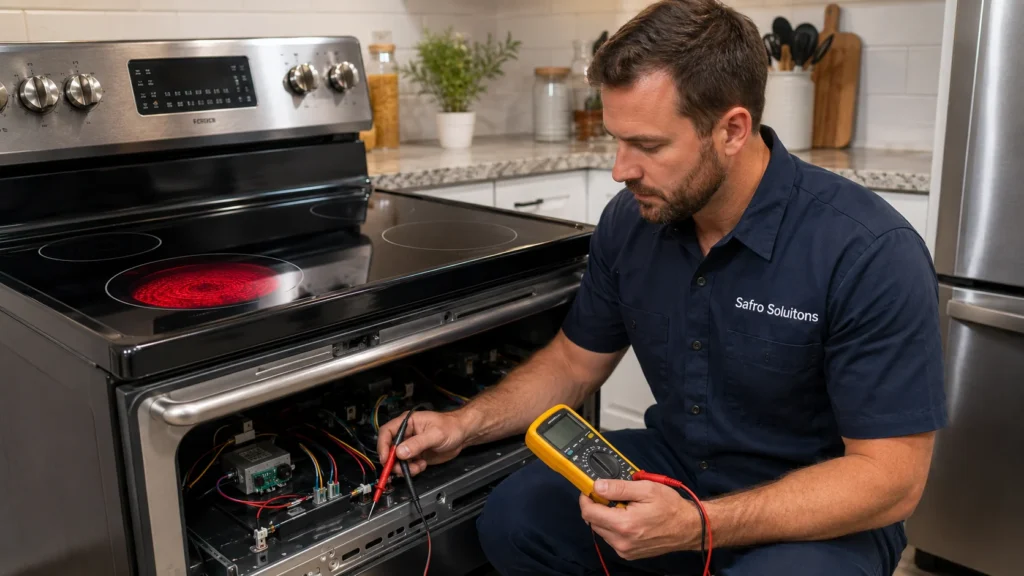
By the Safro Solutions Appliance Repair Team — licensed, family-owned appliance repair in Los Angeles (LIC# A 50901).
Why Is My Electric Range Not Heating?
When an electric range won’t heat, it’s almost always either a failed heating element or a bad control board. A dead element won’t glow and shows no continuity (a good bake element reads about 20–40 ohms). A bad control board is the likely cause when the element gets full 240-volt power but still won’t heat and you hear no relay “click.” This guide shows you how to tell which one — plus brand notes, costs, and when to call a Los Angeles technician.
Quick Checks Before You Diagnose
Most no-heat range calls in Los Angeles start with one of these five-minute checks.
- 240-volt power. Electric ranges need a full 240 volts (two 120-volt legs). If one leg is lost at the breaker, the display and lights work but nothing heats. Flip the range breaker fully OFF, then ON.
- Plug and outlet. Make sure the range is fully seated in its outlet and the cord isn’t scorched.
- Control Lock / Demo Mode. Many ranges have a Control Lock or showroom Demo Mode that disables heating — hold the lock pad about 3 seconds to clear it.
- Recent self-clean. A self-clean cycle that ran too hot often blows the thermal fuse, killing power to the elements.
How to Tell: Heating Element or Control Board?
This is the question most guides skip. Here’s the clean way to separate the two.
Signs the heating element is bad:
- The element doesn’t glow red when you set the bake or a burner too high.
- You see visible cracks, blisters, swelling, or burn spots on the element.
- A multimeter on the Ohms setting shows no continuity. According to repair specialists at Parts Dr, a healthy bake element reads roughly 20–40 ohms; zero or infinite resistance means it’s dead.
Signs the control board is bad:
- The element looks fine and tests good on ohms, but still won’t heat.
- You hear no faint “click” when you set the temperature — a working board sends power to the elements in short bursts you can hear.
- The element is receiving full 240 volts but stays cold (points to a failed relay or triac on the board).
- Burnt spots, discoloration, or intermittent “sometimes heats, sometimes doesn’t” behavior on the board.
Quick decision table:
Test | Element Bad | Control Board Bad |
| Element glows red | No | Sometimes |
| Continuity (ohms) | Fails (0 / infinite) | Passes (20–40 Ω) |
| “Click” when set | Present | Absent |
| 240V at element | Yes, but no heat → element | Yes, but no heat → board |
If the element fails the ohms test, replace the element. If it passes but the range still won’t heat with 240 volts present, the control board is the prime suspect.
Tools You’ll Need to Diagnose It
You won’t need all of these for every test, but a full range diagnostic calls for: a multimeter that reads voltage and continuity (nearly every test below uses it), a flathead screwdriver, needle-nose pliers, and a Phillips screwdriver or nut driver to remove the rear panel. Always disconnect power at the breaker before opening any panel.
7 Parts That Stop an Electric Range From Heating — and How to Test Each
Beyond the element-vs-board split, these are the components a technician checks, from easiest to hardest. Each has its own test.
1: Power supply (240V): Set the multimeter to AC volts and test each side of the unplugged outlet — each leg should read about 120V, ~240V combined (±10%). A reading well under 240V means a bad socket or breaker, not the range.
2: Thermal fuse: Found behind the rear access panel, usually round or rectangular with two terminals. Disconnect the wires and test for continuity; no continuity means it blew — common after a long self-clean cycle. If a new fuse blows again fast, another part is overheating.
3: Infinite switch (burner control): Test for continuity across L1–H1 and L2–H2. In the OFF position there should be no continuity; turned to HIGH, both pairs should show continuity. Failing either means the contacts are sticking — replace it.
4: Surface element receptacle: Pull the coil and drip pan, remove the mounting screw, and inspect the socket. Scorching, burn marks, or a burnt-plastic smell on the receptacle (or scorched terminals on the coil) mean it needs replacing.
5: Surface element (coil): Inspect for blistering, swelling, or holes, then test for continuity terminal-to-terminal. Quick confirm: plug the suspect coil into a known-good receptacle of the same size — if it still won’t heat, the coil is dead.
6: Bake element: The calrod heater at the oven bottom. Look for cracks or breaks (common after self-cleaning), then test continuity — clip a clothespin to each wire as you detach it so it can’t slip behind the oven wall.
7: Broil element: The top calrod heater, mounted with two-to-four screws. Inspect and test for continuity exactly like the bake element.
Find Your Model Number to Order the Right Part
Range parts are model-specific, so locate the model number before ordering. Check around the oven-door frame, inside the storage/broiler drawer, under the lifted cooktop, or on the back panel. Enter that number at a parts retailer (or give it to your technician) to match the exact OEM element, switch, or control board.
Oven Heats but Burners Don’t (or the Reverse)
Because the cooktop burners and the oven run on separate circuits, the symptom tells you where to look:
- Burners work, oven won’t heat: suspect the bake/broil element, oven thermal fuse, or the control board’s oven relay.
- Oven works, one burner won’t heat: the problem is isolated to that burner — usually its surface element, receptacle, or infinite switch. Swap the suspect coil into a known-good receptacle to confirm.
Brand-Specific Quirks: GE, Whirlpool, Samsung & LG
Safro Solutions services all major brands across Los Angeles, and each has a typical weak point for no-heat faults:
- GE / Hotpoint: Coil-top models often fail at the surface element receptacle from spill corrosion; on ranges with a relay (control) board, a stuck oven relay is a frequent no-bake cause. Rule out an accidental Sabbath mode, which disables normal heating.
- Whirlpool / Maytag: The bake element commonly cracks after a self-clean cycle, and the oven control board’s relay can fail while the broil element still works — test both elements before condemning the board.
- Samsung: Often a control-board relay or sensor fault rather than the element; confirm the unit isn’t in Demo/Showroom mode, which mimics a no-heat failure.
- LG: A range that powers on but won’t heat is frequently a single 120V leg lost at the cord or a sensor fault — verify full 240V before ordering an element or board.
What Does Electric Range Repair Cost in Los Angeles?
Knowing the numbers helps you decide between a part swap and a service call:
Problem | Typical Repair Cost | Replace Unit? |
| Bake / broil / surface element | $100–$250 | No |
| Infinite switch / receptacle / thermal fuse | $120–$300 | No |
| Control board | $250–$450 | Maybe |
| Range 12+ years with multiple faults | — | Often yes |
At Safro Solutions, the Los Angeles service-call fee is $69–$129 and is waived when you proceed with the repair, with a 60-day parts-and-labor warranty.
Repair-vs-replace rule: replace the range when the repair cost exceeds 50% of a new unit’s price, or when a range older than 12 years needs a control board plus another major part.
When Can You Fix It Yourself — and When Should You Call a Pro?
The low-risk steps are safe to try: resetting the range breaker, clearing a Control Lock, reseating a coil burner, and confirming a dead coil by swapping it into a known-good receptacle of the same size. Replacing a visibly burned-out surface coil — or a bake/broil element you’ve already confirmed with a multimeter — is a reasonable DIY job if you work with the power fully disconnected.
Call a licensed Los Angeles technician once the fault moves past a simple part swap: testing a 240-volt outlet, diagnosing a control board’s relays or triacs, reaching an infinite switch behind the live control panel, or replacing a melted terminal block or scorched receptacle that involves rewiring. One rule technicians live by — if you replace a thermal fuse and it blows again quickly, stop. Another component is overheating and needs a professional diagnosis. Electric ranges carry lethal 240-volt current, so always disconnect power at the breaker before opening any panel, the basic precaution urged by the U.S. Consumer Product Safety Commission.
Get Same-Day Electric Range Repair in Los Angeles
If your element tests good on the multimeter and the range still won’t heat with full 240 volts present, you’re most likely looking at a control-board relay or triac — a diagnosis best left to a technician with the right meter and parts on the truck. Safro Solutions is a licensed, family-owned team that repairs electric ranges, cooktops, and ovens of every major brand across Los Angeles, usually the same day. We test both the element and the board on-site, quote the exact part before we touch it, and stand behind the work with a 60-day parts-and-labor warranty.
Book stove and range repair in Los Angeles; for an oven that won’t bake while the burners still work, see our oven repair page, and for a single dead burner our cooktop repair page.
Service areas: Valley Village, Sherman Oaks, Studio City, Encino, Beverly Hills, Tarzana, Woodland Hills, Burbank, Van Nuys, Northridge, Pasadena, and all of greater Los Angeles.
Safro Appliance Repair
Valley Village, Los Angeles, CA 91607
Call or text (747) 250-6879 or schedule service online.
Find Us On Google Maps: https://maps.app.goo.gl/Tdof4dD9BS5Tk1i2A
Frequently Asked Questions
Q1: How do I know if it’s my heating element or control board?
Test the element first. On a multimeter’s ohms setting, a good bake element reads about 20–40 ohms; zero or infinite means the element is dead. If the element passes, looks fine, and receives 240 volts but still won’t heat — and you hear no relay click when setting the temperature — the control board is the likely culprit.
Q2: Why is my oven not heating but the stove burners work?
The oven and cooktop run on separate circuits, so working burners point to an oven-only fault. The usual causes are a failed bake or broil element, a blown oven thermal fuse, or a bad oven relay on the control board. Test the bake element for continuity before replacing the board.
Q3: How much does it cost to replace an oven heating element?
A bake, broil, or surface element typically runs $100–$250 installed in the Los Angeles area, while a control board can reach $250–$450. Safro Solutions charges a $69–$129 service-call fee that is waived when you proceed with the repair. If the total exceeds half a new range’s price, replacement is smarter.
Q4: Can a bad control board stop the oven from heating?
Yes. The control board sends timed bursts of power to the elements through relays or triacs. If a relay fails or a circuit trace burns, the element gets no power and stays cold even though it tests good. A telltale sign is no audible click when you set the temperature.
Q5: How do I test an electric range element with a multimeter?
Disconnect power at the breaker, remove the element, and set the multimeter to ohms. Touch a probe to each terminal. A bake element should read roughly 20–40 ohms; a surface coil should show continuity. No reading means the element has failed and needs replacement.
Q6: Why does my range have power but won’t heat?
If the display and lights work but nothing heats, one 120-volt leg of the 240-volt supply is often missing at the breaker or outlet. Reset both poles of the range breaker first. If full 240 volts reaches the element and it still won’t heat, the element or control board has failed.