If your washing machine is full of water and won’t drain, stop the cycle and switch it to a drain or spin setting first. If that does nothing, the cause is almost always a clogged drain pump filter, a kinked or blocked drain hose, or a failed drain pump. Most of these you can check yourself in about 20 minutes. This guide walks you through exactly what to do right now, in order, from the fastest fixes to the point where you should call a technician.
Last updated: September 21, 2026 · Written by the licensed technician team at Safro Solutions (CA Contractor License #A 50901), Valley Village, CA.
In this guide
- Why your washer is full of water and won’t drain
- How to fix a washing machine that is not draining
- How to manually drain a washer that won’t drain
- Front-load vs top-load: where the problem usually hides
- The drain pump filter (coin trap): the #1 fix people miss
- Washer won’t drain but still spins (or drains but won’t spin)
- Washer won’t drain or spin: what it means
- Is standing water in a washer dangerous?
- Repair or replace a washer that won’t drain?
- When to stop DIY and call Safro Solutions in Valley Village
- Frequently asked questions
The short answer: A washer full of standing water that won’t drain is usually caused by a clogged pump filter, a blocked or kinked drain hose, or a failed drain pump. Cancel the cycle, run a separate drain/spin cycle, and if the water stays put, clean the filter and check the hose before calling for repair.
TL;DR
- Do this first: cancel the wash, select drain/spin, and make sure the lid or door is fully shut. Many washers won’t drain until the cycle is reset or the lid switch engages.
- Most common culprit: a clogged drain pump filter (coin trap) or a kinked drain hose. Both are homeowner-fixable in 15 to 20 minutes.
- Still full of water? Call Safro Solutions in Valley Village at 747-250-6879 for same-day washer repair across the San Fernando Valley.
Why your washer is full of water and won’t drain
A washer drains by using an electric pump to push water out of the drum, up through the drain hose, and into your home’s standpipe or drain. When water stays in the drum, one part of that path is blocked or one part has failed. In a washing machine, that breaks down to six usual suspects.
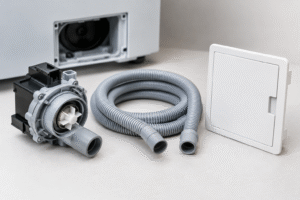
- A clogged drain pump filter (coin trap). This is the single most common reason a washer won’t drain. The filter catches lint, hair, coins, and bits of fabric so they don’t reach the pump. Once it packs full, water can’t get past it. Front-load washers almost always have one behind a small access panel at the bottom front. Many top-load models have a version of it too.
- A kinked or blocked drain hose. The drain hose runs from the back of the washer to your standpipe or under-sink connection. If it’s kinked behind the machine, clogged with gunk, or pushed too far down the standpipe, water backs up and sits in the drum.
- A failed drain pump. If the filter and hose are clear and water still won’t move, the pump itself is often the problem. A small object can jam the impeller, or the pump motor can burn out. You’ll sometimes hear it humming without moving water, or hear nothing at all during the drain step.
- A bad lid switch or door lock. Most top-load washers won’t drain or spin unless the lid switch tells the machine the lid is shut. Front-loaders use a door lock the same way. If that switch fails, the washer thinks the door is open and stops before draining.
- A standpipe or home plumbing clog. Sometimes the washer is fine and the house drain is the problem. If your standpipe or the drain line it feeds is clogged, water has nowhere to go and either backs up into the drum or overflows the pipe.
- An unbalanced load or too much detergent. A single heavy item or a tangled load can throw off balance and stop the spin and drain. Too much detergent creates excess suds the pump struggles to clear, which the machine reads as a fault.
For most Valley Village homeowners who call Safro Solutions with a washer full of water, the cause turns out to be one of the first three: filter, hose, or pump. The good news is that you can check all three yourself, and the next section shows you how to get the water out first so you can work safely.
How to fix a washing machine that is not draining
To fix a washing machine that is not draining, work through six steps in order: reset the cycle, drain the water by hand, clean the pump filter, check the drain hose, test the lid switch or door lock, and check the drain pump. Most drain problems are solved by step three or four.
- Reset the cycle. Cancel the wash, select drain/spin and make sure the lid or door is fully closed.
- Drain the water by hand. Unplug the washer and empty the drum using the steps in how to manually drain a washer that won’t drain.
- Clean the drain pump filter. This is the most common fix on front-load washers. Follow the drain pump filter (coin trap) section.
- Check the drain hose. Look for a kink behind the machine, a clog inside the hose, or a hose pushed too far down the standpipe.
- Test the lid switch or door lock. If the washer will not drain or spin, the machine may think the door is open.
- Suspect the drain pump. If the filter and hose are clear and the water still will not move, a jammed or burned-out pump needs a technician.
How to manually drain a washer that won’t drain
Before you inspect anything, you need to get the standing water out, and you do that with gravity and a few towels. Never reach into the drum or open a front-load door while it’s full. Here’s the safe way to drain it by hand, with separate steps for front-load and top-load machines.
First, every machine: unplug the washer or switch off its breaker. Lay old towels around the base, and have a shallow baking pan and a bucket ready. The drain hose at the back sits below the water line, so the water comes out fast once you release it.
Front-load washers
- Open the small access panel at the bottom front of the machine. It usually pops off by hand or with a flat screwdriver.
- Behind it you’ll find the drain pump filter and often a short black drain tube. Put the shallow pan under it.
- Pull the tube’s cap or slowly turn the filter knob about a quarter turn. Let water fill the pan, push the cap back on, empty the pan, and repeat until it stops flowing.
- Once empty, fully unscrew the filter and clear out whatever is trapped inside. This step alone fixes a large share of front-load drain problems.
Top-load washers
Top-load machines rarely give you a filter tube, so you drain through the main drain hose instead.
- Pull the washer away from the wall and find the drain hose clipped to the back.
- Unhook it, keeping the end higher than the water level until you’re ready, then lower it into the bucket below the level of the drum so gravity pulls the water out.
- If water comes out slowly or not at all, the clog is in the hose or pump, not the standpipe. A wet/dry shop vacuum on the hose end can pull a stubborn clog free.
Once the drum is empty, you can safely check the filter, hose, and pump. The part most people overlook is the drain pump filter, so that’s where to look first, and it’s covered next.
Front-load vs top-load: where the problem usually hides
The type of washer you own tells you where to look first, because front-load and top-load machines fail in different spots. Front-loaders trap debris in an accessible pump filter, so a clog there is the usual cause. Top-loaders rarely have an easy filter, so their drain problems lean toward the hose, lid switch, or pump.
| What’s likely wrong |
Front-load washer |
Top-load washer |
| Most common cause |
Clogged drain pump filter (coin trap) |
Drain hose clog or kink |
| Second most common |
Object jamming the pump |
Failed lid switch |
| Where to access it |
Panel at bottom front |
Hose at the back; switch under the lid |
| DIY difficulty |
Easy, filter is designed to open |
Moderate, less direct access |
| Won’t drain and won’t spin? |
Check the door lock |
Check the lid switch first |
One pattern Safro Solutions sees often in the San Fernando Valley: high-efficiency front-load washers that never get their filter cleaned. Manufacturers recommend cleaning that filter every few months, but most homeowners don’t know it exists until water won’t drain. If you have a front-loader and have never touched that bottom panel, that filter is your prime suspect, which is exactly what the next section covers.
The drain pump filter (coin trap): the #1 fix people miss
If you own a front-load washer and water won’t drain, clean the drain pump filter before anything else, because a clogged filter is the most common cause and the easiest to fix. This small filter, sometimes called a coin trap, sits behind the access panel at the bottom front of the machine. Its whole job is to catch the things that would otherwise wreck your pump.
Here’s what Safro Solutions technicians routinely pull out of these filters: coins, hair ties, lint mats, bra underwires, buttons, baby socks, and the occasional screw. Any one of these can choke off the flow enough to leave the drum full of water.
To clean it:
- Unplug the washer and lay down towels, since residual water will spill out.
- Open the bottom front panel and place a shallow pan under the filter.
- Drain the remaining water using the steps from the manual-drain section above.
- Unscrew the filter fully, counterclockwise, and pull it out.
- Rinse it under a faucet, clear the lint and debris, and check the empty housing for anything stuck inside.
- Screw it back in snugly, close the panel, plug in, and run a short drain or rinse cycle to confirm the water clears.
Cleaning this filter every few months prevents most repeat clogs. The U.S. Environmental Protection Agency’s ENERGY STAR program also recommends running a monthly maintenance cycle on front-load washers, which keeps the drum, gasket, and drain path free of the buildup that contributes to drainage and odor problems. Treat the filter and a monthly cleaning cycle as routine, and you’ll avoid most standing-water calls.
A clean filter that still won’t drain points to a different problem, and one of the most confusing is when the washer won’t drain but still spins, which is next.
Washer won’t drain but still spins (or drains but won’t spin)
These two symptoms point to different parts, so the direction of the failure tells you where to look. If your washer spins but won’t drain, the drum is moving but the water isn’t, which almost always means the drain pump, filter, or hose is blocked or dead. If your washer drains but won’t spin, the water leaves fine but the motor, belt, or lid mechanism isn’t completing the spin.
Use this to narrow it down fast:
- Spins but won’t drain: the spin proves the motor and lid switch work. The problem is downstream in the drain path. Check the pump filter, then the hose, then the pump itself, in that order.
- Drains but won’t spin: the pump works. Suspect a worn drive belt, a failed motor coupler, a lid switch that engages for draining but not spinning, or an unbalanced load that the machine refuses to spin for safety.
- Won’t drain and won’t spin: this points to a single shared cause, usually a failed lid switch or door lock, a control board fault, or a load so unbalanced the machine has paused the whole cycle.
For a washer that spins but won’t drain, the fixes in the earlier sections (filter, hose, pump) handle most cases. A washer that drains but won’t spin usually needs a belt or coupler, which is an internal repair where Safro Solutions in Valley Village can diagnose the exact part rather than guessing. Either way, once you know which side of the cycle is failing, you’re no longer working blind, and you can decide whether standing water is something to worry about while you sort it out.
Washer won’t drain or spin: what it means
When a washer will not drain or spin, the machine has usually stopped the cycle on purpose. The common triggers are a lid switch or door lock that is not registering as closed, an unbalanced load, too many suds, or a drain pump fault. Reset the cycle, redistribute the load and check the lid switch before calling for repair.
| What you notice |
Likely cause |
Try this |
| Won’t drain or spin, lid or door feels loose |
Lid switch or door lock |
Close firmly, listen for the click, check the switch |
| Won’t drain or spin, all the wet laundry is on one side |
Unbalanced load |
Redistribute the clothes, then run drain/spin |
| Drum full of suds |
Too much detergent |
Run a rinse, use less HE detergent next time |
| Fault code on the display |
Drain fault |
Look up the code in the manual (codes differ by brand) |
| Nothing works, no display |
Control board or power issue |
Check the outlet and breaker, then call |
Many front-load washers show a drain-fault code when the water will not leave. On LG models this is often OE, and on Samsung models 5C or SC. Codes differ by model, so match the code to your manual before buying a part.
Is standing water in a washer dangerous?
Standing water in a washer isn’t an immediate safety hazard, but you shouldn’t leave it sitting for long. Water trapped in the drum for more than a day or two starts to grow mold and bacteria, which is where the musty smell comes from. In a front-load machine, that water also sits against the rubber door gasket, the spot most likely to develop black mildew.
The bigger risks are practical. Wet laundry left in standing water sours quickly and may need to be rewashed. If the water came from a backed-up standpipe, it can overflow onto the floor and reach cabinets or subflooring. And electrically, a washer that won’t drain because of a pump or control fault should be unplugged rather than left powered with water inside.
So treat it as urgent, not an emergency. Drain the water using the steps above, pull the wet laundry out, and leave the door or lid open so the drum can dry. If you’ve cleared the filter and hose and the washer still fills and won’t drain, or if water is coming up from the standpipe, that’s the point to bring in a professional. Whether it is worth repairing is the next thing to know before you call.
Repair or replace a washer that won’t drain?
Here’s the honest line on repair versus replace: if your washer is under about eight years old and the drain problem is a pump, hose, or filter, repair almost always makes sense. The drain components are a small fraction of what a new washer costs. When the machine is older and the repair starts climbing toward half the price of a replacement, that’s when it’s worth a conversation. Safro Solutions gives Valley Village homeowners a straight diagnosis and price before any work starts, which is the right moment to decide, and the next section covers when that call is the smart move.
When to stop DIY and call Safro Solutions in Valley Village
Stop the DIY troubleshooting and call a technician when you’ve cleaned the filter, cleared the hose, and the washer still won’t drain, or when the problem points to the pump, the lid switch, the control board, or your home’s plumbing. Those repairs need testing tools and replacement parts, and guessing at them usually costs more than getting it diagnosed once. You should also call right away if water is backing up out of the standpipe, since that’s a plumbing issue, not a washer issue.
A recent example from the San Fernando Valley shows how this plays out. A Valley Village homeowner with a front-load washer cleaned the pump filter twice and still found the drum full of water after every cycle. When Safro Solutions came out, the filter was spotless, but a child’s sock had slipped past it and lodged in the pump impeller, stalling the motor. It was a 40-minute fix that no amount of filter cleaning would have solved, because the blockage was past the filter. That’s the kind of call where a professional diagnosis saves a homeowner from replacing a washer that only needed a small repair.
Safro Solutions has handled washer drain failures across Valley Village and the wider San Fernando Valley for five years. If your washer is still full of water after the steps in this guide, you can book a same-day visit through our appliance repair scheduling page, learn more about our washing machine repair service, or see the full list of neighborhoods on our Valley Village service area page before you call. We diagnose the exact cause, quote the price up front, and most drain repairs are done in a single visit. Every repair comes with a 90-day warranty on parts and labor.
Call Safro Solutions at 747-250-6879 for same-day washer repair in Valley Village and across the San Fernando Valley. Bring the water back where it belongs, and skip the guesswork.
Frequently asked questions
Why won’t my washer drain but it still spins?
If your washer spins but won’t drain, the drain path is blocked while the motor still works. Start with the drain pump filter, then the drain hose, then the pump itself. The spinning proves the lid switch and motor are fine, so the fault is almost always a clog or a failed pump downstream.
Is a little water left in the washer normal?
A small amount of water in the bottom of the drum or the rubber gasket is normal and nothing to worry about. A drum that stays full of standing water after a complete cycle is not normal and means the washer failed to drain. The difference is a cupful versus several inches of water.
Can too much detergent cause standing water?
Yes. Too much detergent, or regular detergent in a high-efficiency washer, creates excess suds that the drain pump struggles to clear. The machine reads the suds as a problem and can stop before fully draining. Use the correct amount of HE detergent to avoid it.
How often should I clean the washer drain pump filter?
Clean the drain pump filter every few months, and more often if you wash pet bedding, kids’ clothes, or items with loose change. On most front-load washers it sits behind the bottom front panel. Regular cleaning is the single best way to prevent a washer from filling with water and refusing to drain.
Can I run a washer with standing water in it?
No, don’t run a wash cycle while the drum still holds standing water. Drain the water first, either by clearing the clog or draining it manually, then run a drain or rinse cycle to confirm it empties. Running it full can overflow and won’t fix the underlying clog.
Why does my washer fill with water and then not drain?
A washer that fills normally but won’t drain has a working water inlet and a blocked or failed drain side. The most common causes are a clogged pump filter, a kinked or blocked drain hose, or a dead drain pump. A failed lid switch or door lock can also stop the drain step entirely.
How do I fix a washing machine that is not draining?
Work through the fixes in order: cancel the cycle and run drain/spin, drain the water by hand, clean the drain pump filter, check the drain hose for kinks or clogs, then test the lid switch or door lock. If the water still won’t leave, the drain pump has likely failed and needs a technician.
Why won’t my washer drain or spin?
When a washer won’t drain or spin, the machine has usually stopped the cycle on purpose. The common triggers are a lid switch or door lock that isn’t registering as closed, an unbalanced load, too many suds, or a drain pump fault. Reset the cycle, redistribute the load, and check the lid switch before calling for repair.
Need it fixed today? Call Safro Solutions at 747-250-6879 for same-day washer repair in Valley Village and across the San Fernando Valley.