

Author: Safro Solutions Appliance Repair Team | Licensed Technicians, CA LIC# A 50901 | Los Angeles, CA
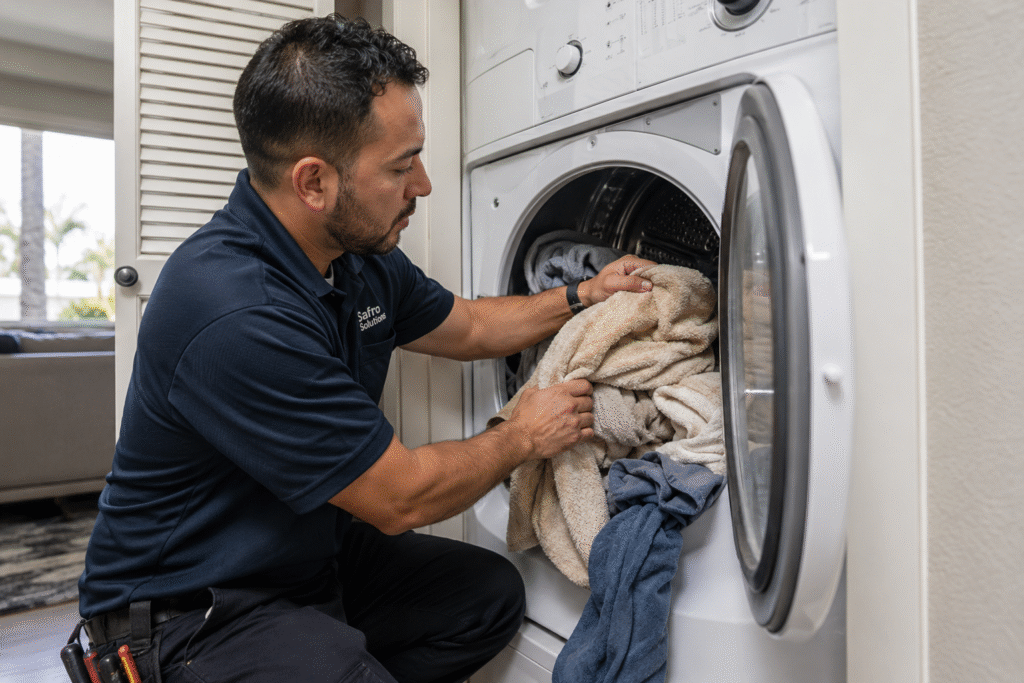
Clothes wet after dryer? Your dryer runs the full cycle. The timer hits zero. You open the door and the clothes at the top feel warm and dry, but reach into the middle of the pile and they’re still damp—sometimes even soaking. Before you assume the heating element is failing or the machine needs replacing, there’s a much simpler explanation behind more service calls than almost any actual mechanical failure: the load was too big for the drum to dry properly.
Clothes coming out wet after a full cycle are caused by overloading in most cases, not a broken dryer. A dryer dries by tumbling clothes through hot, moving air, and packing the drum past about three-quarters full leaves no room for that tumbling, so heat never reaches the fabric buried in the center. If a properly sized, loosely packed load still comes out cold and damp, the cause shifts to something mechanical: a clogged vent, a failed heating element, a blown thermal fuse, or a moisture sensor reading the load wrong.
TL;DR
- Most “clothes still wet after the dryer” complaints in Los Angeles homes trace back to an overloaded drum, not a broken part.
- Run the checks and the 2-minute test below before you replace parts or call anyone.
- If a properly sized load still comes out cold and wet, call Safro Solutions at (747) 250-6879 for a same-day diagnosis in Los Angeles.
Quick checks before you troubleshoot anything
Rule out the obvious before you dig into load size or parts. Confirm the dryer is fully plugged in and the breaker hasn’t tripped, since a dryer needs two separate circuits (one for the motor, one for the heating element) and a single tripped breaker can let the drum spin while the heat stays off. Next, check which cycle you selected. Sensor-dry cycles end automatically once the sensor bars detect dry fabric, so a bulky-item cycle or a low-heat delicate setting run on a heavy towel load will end “on time” while the load is still damp, and that’s a settings problem, not a dryer fault. Whirlpool’s own guidance recommends grouping towels and heavier cottons into a separate load from lighter fabrics for this exact reason, since mixed loads confuse both the cycle length and the moisture sensor.
If power and settings both check out, the next question is whether the load itself was too big, and that’s where the two-minute test comes in.
The 2-minute self-test: is it overloading or a real dryer problem?
Stop the dryer mid-cycle and open the door, then reach into the center of the load, not just the top. If the outer layer is dry but the core is still wet and the load felt tightly packed when you loaded it, that’s overloading. If clothes anywhere in the load, top or center, come out cold rather than warm and damp, that points to a heating problem, not a load-size problem.
Overloading and a heating fault feel different to the touch, and that difference is the fastest way to know which direction to troubleshoot before you spend money on parts or a service call.
How full is too full? Reconciling the load-size rule
The honest answer is that “how full” depends on load size, not one flat rule. Whirlpool’s own product guidance breaks it down by load, not a single percentage:
| Load size | How to load it |
| Small load | 3 to 4 items, no more than 1/4 full |
| Medium load | Fill the drum up to about 1/2 full |
| Large load | Fill the drum up to about 3/4 full |
Source: Whirlpool Product Help, “Properly Loading a Dryer”
This is why you’ll see “half full” in one place and “three-quarters full” in another online: both are correct, for different load sizes. The rule that matters more than any percentage is movement. Whirlpool’s guidance is blunt about it: don’t tightly pack the dryer, clothes need to move freely. If you can’t close the door without pressing laundry down, or the load doesn’t tumble and fall when you watch it through the door for a few seconds, it’s overloaded regardless of what percentage you’d estimate by eye.
Signs your dryer is overloaded, not broken
An overloaded dryer usually announces itself through the drum, not the heat. Watch for the load shaking, vibrating, or rattling harder than usual, clothes at the edge of the drum staying dry while the center stays damp, the cycle running its full time without finishing the job, or the door barely latching without you pushing fabric back in first. These are load-size symptoms, and they show up even when the heating element, thermal fuse, and vent are all working fine.
The distinction matters because a good part replaced on an overloaded dryer will look like it “didn’t fix it,” when the real fix was splitting the load into two smaller ones.
The moisture sensor gap almost everyone misses
A dryer can misread a fully dry load as damp, or a damp load as dry, when the moisture sensor bars inside the drum get coated in a thin film. That film comes from fabric softener and dryer sheet residue building up over repeated cycles, and it insulates the metal sensor strips so they stop reading moisture accurately. The fix is simple: wipe the sensor bars, usually two thin metal strips inside the drum wall, with a cloth dampened with rubbing alcohol.
This is a real, distinct cause from both overloading and a mechanical fault, and it’s easy to miss because the dryer still runs, still heats, and still finishes a cycle. It just ends the cycle at the wrong time. The U.S. Department of Energy’s own laundry guidance points in the same direction, noting that if your machine has a moisture sensor, using it properly (rather than defaulting to a fixed timed-dry cycle) is part of getting a full, even dry.
Is some dampness after drying actually normal?
Slight dampness in specific fabrics isn’t automatically a fault. Heavier items like jeans, towels, and bedding naturally hold more moisture through a standard cycle than t-shirts and underwear, which is exactly why grouping loads by weight matters. If a mixed load of light and heavy fabrics finishes with only the heavy pieces damp, that’s a loading and settings issue, not a sign your dryer needs repair. What’s not normal is a load that’s uniformly cold and wet throughout, or a load that stays damp even after you’ve corrected for size and settings. That distinction is what the rest of this guide helps you make.
Signs it’s NOT overloading, a real dryer fault
A handful of symptoms point away from load size and toward the machine itself. A heating element that has burned out will let the dryer tumble normally while blowing cool air the entire cycle. A blown thermal fuse, a safety device that trips when the dryer overheats (often from a clogged vent), will cut heat entirely and sometimes stop the dryer from starting at all; we cover this comparison in more depth in our guide to heating element versus thermal fuse problems. A clogged exhaust vent traps hot, moist air inside the drum instead of venting it outside, which we break down fully in our clogged dryer vent guide. Gas dryers have their own failure point: if the drum spins and the air stays cool, a failing gas valve solenoid or igniter is often the cause, not the heating element you’d find in an electric model.
A few less common but real culprits round out the list. A door latch or door switch that isn’t sensing the door as fully closed can shut the dryer off early or prevent it from heating at all, and it’s worth checking if the door doesn’t click firmly shut. A worn drive belt can let the motor run while the drum barely turns, which starves the load of the tumbling motion it needs. A failing blower wheel or, less commonly, a control board or start switch problem can also interrupt airflow or the heat cycle. These deeper electrical and mechanical issues need a multimeter and safe disassembly, and that’s where a licensed technician earns their keep instead of a guess-and-replace approach.
Could it be the washer, not the dryer?
Sometimes the dryer is working exactly as designed, and the laundry arrived too wet to begin with. A washing machine’s spin cycle is what removes the bulk of the water before clothes ever reach the dryer, and a weak spin setting, a stuck water inlet valve, or a drainage problem can leave a load soaked well beyond what a normal drying cycle is built to handle. If you notice water pooling in the washer drum after a cycle, or the washer seems to run longer than usual without fully draining, the wet-clothes problem may start one machine earlier than you think. A quick check: run an extra spin cycle on the washer before drying and see if the same load dries normally the next time.
Overloading vs. mechanical fault vs. moisture sensor: how to tell them apart
| Symptom | Overloading | Mechanical fault | Moisture sensor issue |
| Where dampness shows up | Center of load only, edges dry | Anywhere, often uniform | Unpredictable, load may look fully dry or fully wet |
| Temperature of damp clothes | Warm | Cold (heating fault) or normal (vent/airflow fault) | Normal to warm |
| Cycle behavior | Full cycle runs, doesn’t finish the job | May shut off early, trip breaker, or run cold throughout | Cycle ends too early or too late for the actual load |
| Load movement | Doesn’t tumble freely, door hard to latch | Tumbles normally (unless belt/blower failure) | Tumbles normally |
| Fix | Split into smaller loads, follow load-size table above | Needs parts testing: element, fuse, vent, belt, or gas valve | Wipe sensor bars with rubbing alcohol |
Why towels, blankets, and mixed loads fail even at a “normal” fill level
Heavy, absorbent fabrics hold more water per pound than lightweight clothing, so a load that looks like a normal fill by volume can still be an overload by weight. Towels and blankets mixed in with t-shirts also throw off the moisture sensor specifically, because the sensor can register the lighter, drier fabric on the outside of the tumble while the heavier items at the core are still soaked, ending the cycle before the real job is done. Whirlpool’s own loading guidance calls this out directly: sort by fabric type and weight, and dry heavier cottons separately from lighter fabrics.
Why ignoring this costs more than a re-run cycle
Running a damp load through the dryer a second or third time isn’t just an annoyance, it adds real wear. The Department of Energy notes that cleaning the lint screen after every load and keeping the vent clear both protect against fire hazards and cut wasted energy, since a struggling dryer runs its heating element and motor longer than it should for the same result. The U.S. Consumer Product Safety Commission goes further on the fire-risk side: lint buildup restricts airflow and drives excess heat buildup, which is why they recommend cleaning the lint screen before or after every load and periodically inspecting the vent and exhaust duct. One CPSC note that’s specific and easy to miss: clothes soiled with volatile chemicals like gasoline, cooking oils, or finishing oils should be washed more than once, dried on the lowest heat setting with a cool-down cycle, or air-dried instead, and never left piled up warm after drying.
[ADD REAL JOB STORY: a specific Safro Solutions call in Los Angeles where an overloaded dryer, a bad moisture sensor, or a mechanical fault was diagnosed. Include the neighborhood, what the technician found, and how it was resolved.]
Why this shows up more often in Los Angeles laundry setups
Los Angeles homes push people toward overloading in ways a lot of other markets don’t. Compact laundry closets in apartments and condos across Valley Village, Sherman Oaks, Studio City, and Encino often come with smaller-capacity stacked units, but families still wash the same weekly volume of towels and bedding they would in a larger home, which means more temptation to cram one big load in rather than run two normal ones. Add in stacked units where reaching the vent for a quick lint check is awkward, and small overloading habits go unnoticed for months. It’s a pattern our technicians see across the greater Los Angeles area on calls that turn out to be load size or a dirty sensor, not a part that needs replacing.
What to do next, and when to call a technician
Start with the free fixes: confirm power and breaker, match the cycle to the load, run the two-minute test, split oversized loads using the table above, and wipe the moisture sensor bars with rubbing alcohol. If a properly sized, loosely packed load still comes out cold and wet, or the dryer trips a breaker more than once, smells like burning, or won’t heat at all, stop troubleshooting on your own. Testing a heating element, thermal fuse, gas valve, or control board safely requires disassembly and a multimeter, and Safro Solutions handles that same-day across Los Angeles. You can also see our full breakdown of dryer repair services in Los Angeles for what a typical visit covers.
Fix it today, call Safro Solutions
If you’ve run through the checks above and a properly sized load is still coming out cold and wet, don’t keep re-running the same cycle. Safro Solutions provides same-day dryer repair across Los Angeles, Valley Village, Sherman Oaks, Studio City, Encino, Burbank, Van Nuys, and nearby areas, with licensed technicians who test the actual part before replacing anything.
✅ Licensed & Insured (CA LIC# A 50901) | ✅ Same-Day Service | ✅ 60-Day Warranty on Parts and Labor | ✅ Diagnostic Fee Waived With Repair
Valley Village, Los Angeles, CA 91607
Call or text: (747) 250-6879
Find us on Google Maps: https://maps.app.goo.gl/Tdof4dD9BS5Tk1i2A
Frequently asked questions: About Clothes wet after dryer? Is it overloading or a real dryer problem
Q1: Why are my clothes still wet after being in the dryer?
Clothes staying wet after a full cycle are caused by overloading in most cases, which blocks the tumbling motion that carries heat through the load. When a properly sized load still comes out wet, the cause is usually a clogged vent, a failed heating element, a blown thermal fuse, or a moisture sensor that’s misreading the load.
Q2: Can overloading damage a dryer?
Yes. Overloading forces the motor to work against a load that can’t move freely, which strains the motor and drive belt over time, and it can also affect the drum bearings and door latch mechanism with repeated heavy loads.
Q3: How full should a dryer be?
It depends on load size, not a single number: Whirlpool’s own guidance recommends no more than 1/4 full for a small load, about 1/2 full for a medium load, and up to 3/4 full for a large load, with the load always able to tumble freely regardless of size.
Q4: What does an overloaded dryer look like?
An overloaded dryer often shakes, vibrates, or rattles more than usual, the door is hard to latch without pressing clothes back in, and the load comes out with the outer layer dry while the center is still damp.
Q5: Can overloading a dryer cause a fire?
Overloading itself isn’t the primary fire cause, lint buildup is, according to the Consumer Product Safety Commission. But an overloaded dryer restricts airflow further, and restricted airflow combined with lint buildup is exactly the combination that raises fire risk, so cleaning the lint screen every load matters more, not less, with bigger loads.
Q6: Why is my dryer shutting off before the load is dry?
This is often the moisture sensor ending the cycle early because it’s coated in dryer sheet residue and misreading the load as dry, or because a bulky-item or delicate cycle was selected for a load that needed a longer, hotter setting.
Q7: Is it okay if my clothes are slightly damp after drying?
Some dampness in heavier items like towels or jeans mixed into a lighter load is normal, since heavy fabrics hold more moisture through a standard cycle. It’s not normal when the whole load, or the same items every time, comes out uniformly cold and wet.
Q8: Why does my dryer take two or more cycles to dry the same load?
This points to either an overloaded drum blocking airflow, a moisture sensor that isn’t reading correctly, or a mechanical airflow problem like a clogged vent, and the two-minute test above is the fastest way to tell which one you’re dealing with.