

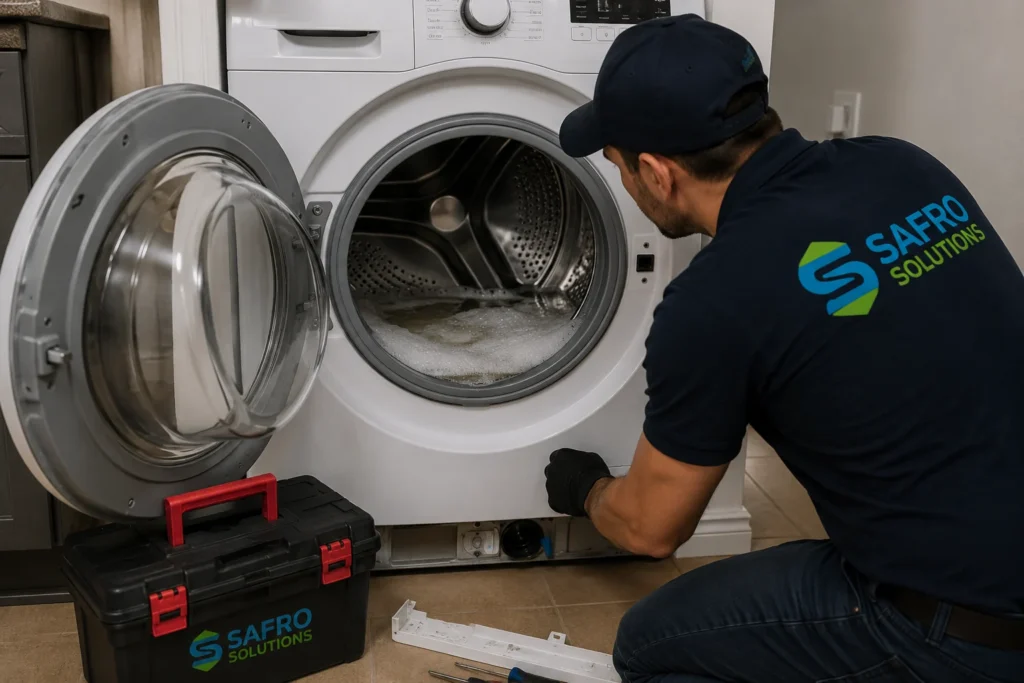
A washer leaving a little water behind and a washer sitting in a full tub are two different problems with two different fixes. Partial drain (some water left, clothes damp not soaked) usually traces back to hose height, a partial clog, or the wrong spin setting. Complete no-drain (tub still full) almost always means the drain pump has failed, the lid switch is broken, or something is fully blocking the line.
TL;DR
- Some water left after the cycle → check hose height and spin setting first, usually a 15-minute fix
- Tub still full of water → stop running cycles, the pump or switch has likely failed
- Not sure which one you have? Use the table below to match your symptom to the cause
📞 Not draining either way? Call Safro Solutions at (747) 250-6879 for same-day diagnosis across Los Angeles.
Partial drain vs no drain: match your symptom
What you see | Likely cause | Severity |
| Thin layer of water, clothes damp not soaked | Drain hose too high or too low (siphoning) | Low — DIY fix |
| Drains slowly over several minutes | Partial clog in hose or filter, or excess suds | Low to moderate |
| Water left on a delicate/hand-wash cycle | Wrong spin speed for the load | Low — setting change |
| Tub still full, no change from mid-cycle | Drain pump failed | High — call a technician |
| Tub full, washer won’t restart, door locked | Lid switch or door lock not engaging | High — call a technician |
| Humming during drain, water level doesn’t drop | Pump jammed or line fully blocked | High — call a technician |
If you’re on the low-severity side, try the fixes below first. High-severity side — skip to when to call a technician, since running more cycles on a dead pump usually makes the repair cost more, not less.
Why partial drain happens
Four causes, none of them require opening the machine:
- Hose height (siphoning): hose sits too low or too deep in the standpipe, so water siphons back into the tub as fast as the pump removes it
- Partial clog: lint or a small object slows the flow without stopping it, so some water gets through before the cycle times out
- Wrong spin setting: delicate and hand-wash cycles leave more moisture on purpose — check the setting before assuming a fault
- Excess detergent: too much soap (or regular detergent in an HE machine) triggers suds-lock, which shortens the drain step
Why complete no-drain happens
Three causes, and none of them are DIY:
- Drain pump failed — motor burned out or impeller jammed, so no water moves at all
- Lid switch or door lock broken — washer can’t confirm it’s closed, so the drain step never starts
- Full blockage — hose or pump completely clogged, not just restricted
Quick checks before you call anyone
- Unplug the washer and have towels ready
- Check the drain hose isn’t kinked and sits at the right height (30–96 inches, only a few inches into the standpipe)
- Open the pump filter (front-load, bottom panel) and clear any debris
- Confirm the lid or door is closing and latching fully
- Try a Drain & Spin cycle after a 60-second unplug reset
If you’ve done all five and water is still sitting there, the cause is on the high-severity list above.
Error codes that confirm a no-drain problem
Brand | Code | Meaning |
| LG | OE | Drain error — check filter and hose first |
| Samsung | 5C / 5E | Clogged filter or drain failure |
| Whirlpool / Maytag | F9 E1 | Long drain — water not out in time |
| Electrolux / Frigidaire | E21 | Drain restriction detected |
A code confirms the machine sees a drain fault — it doesn’t always tell you if it’s a $0 filter cleaning or a failed pump. That’s what a diagnostic is for.
When to call Safro Solutions
Call rather than keep troubleshooting if: the pump hums but water doesn’t move, the door stays locked on an empty drum, you smell burning, or you’ve done the quick checks above and nothing changed. Safro Solutions offers same-day washer repair across Los Angeles and the San Fernando Valley, with a 60-day warranty on parts and labor. For the full list of what we fix, see our washer repair services in Los Angeles.
If your washer is fully flooding rather than partially draining, our guide on a washer full of water and won’t drain walks through manual draining step by step. For the complete list of causes beyond drainage, see washer not draining — 7 most common causes.
Safro Solutions
Valley Village, Los Angeles, CA 91607
Call or text: (747) 250-6879
Find us on Google Maps: https://maps.app.goo.gl/Tdof4dD9BS5Tk1i2A
📞 Same-day washer repair across Los Angeles and the San Fernando Valley · 60-Day Warranty on Parts and Labor · Book Online
Frequently asked questions
Q1: Why won’t my washer drain all the way?
Usually a hose positioned too high or low, a partial clog, or a low-spin cycle setting. None of these need a technician — check hose height and cycle setting first.
Q2: My washer is not draining completely — what’s wrong?
If some water is left but the tub isn’t full, it’s a partial-drain issue: hose height, minor clog, or suds buildup. If the tub is still full, it’s likely a failed pump or switch.
Q3: Is it safe to manually drain a washer?
Yes, if you unplug it first. Lower the drain hose into a bucket below tub level, or open the pump filter access panel on front-load models with a shallow pan ready.
Q4: Can too much detergent cause drainage issues?
Yes. Excess suds can trigger the washer’s suds-lock protection, which shortens or slows the drain step and leaves water behind.
Q5: What does error code F21 or OE mean?
Both indicate a drain fault. F21 (Whirlpool/Maytag) means a long drain was detected; OE (LG) is a general drain error. Check the filter and hose before calling for service.
Q6: How much does washer drain repair cost in Los Angeles?
Costs depend on the cause — a filter cleaning is often free to DIY, while a full pump replacement is a parts-and-labor job. Safro Solutions provides a free estimate before any repair begins.