

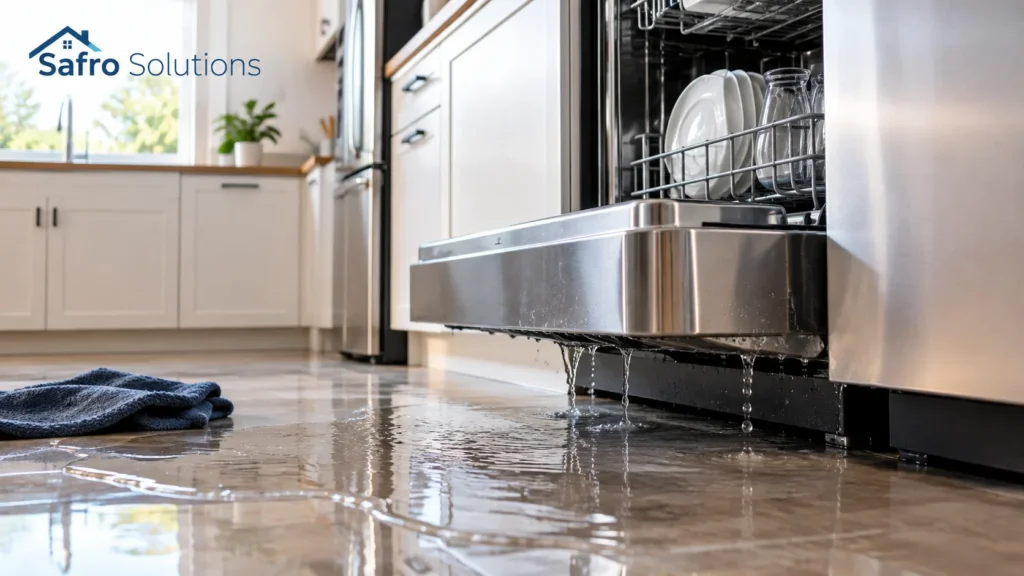
A flooding dishwasher is almost always a worn door gasket, a clogged filter, or a stuck float switch letting in too much water — not a sign the whole unit is failing. Stop the cycle first, then check these three causes in order before assuming you need a replacement.
Key takeaways
- The first thing to do the moment you notice flooding: stop the cycle and shut off the water supply if it keeps coming in.
- The two most common causes, in that order: a worn door gasket or a clogged filter, not a failing dishwasher.
- A stuck float switch causes overfilling, not underfilling — it fails to tell the unit when to stop adding water.
- Check causes in order of how often they’re actually the culprit, not in random order.
- The exact repair cost depends on which part failed; Safro’s own diagnostic visit confirms it before any work starts.
- Standing water near an electrical connection, or water pooling in the tub with a visible crack, is a stop-and-call moment.
- Safro Solutions repairs dishwashers same-day across Los Angeles and the San Fernando Valley — call (747) 250-6879.
What should I do right now if my dishwasher is flooding?
- Stop the cycle and open the door if it’s safe to do so — this cuts off the fill and drain functions immediately.
- Shut off the water supply valve under the sink if water keeps coming in after the cycle stops.
- Contain the spill with towels before it reaches cabinets or flooring. Standing water left sitting against wood cabinetry is what causes warping, so speed matters more than figuring out the exact cause right away.
Once the immediate mess is under control, you can work through the causes below calmly instead of guessing while water is still spreading.
Why is my dishwasher flooding the kitchen floor?
Where the water shows up tells you a lot about what’s failing. Use this table to match what you’re seeing to the likely cause before you start taking anything apart.
What you notice | Likely cause | How common |
| Water pools under the door while the cycle runs | Worn or torn door gasket | Very common |
| Suds or water back up and spill over the top | Clogged filter or drain, or too much/the wrong detergent | Very common |
| Dishwasher keeps filling and doesn’t stop on its own | Stuck or failed float switch | Common |
| Water under the unit even when it’s off | Cracked hose, loose fitting, or a failing pump seal | Less common |
| Water pooling in the tub after a full cycle, plus a visible crack | Cracked tub or pump housing | Rare |
Safro’s own technicians see the door-gasket and hose/pump-seal patterns most often on service calls: a leak from the door usually means a worn gasket, and a leak from underneath usually means a cracked hose or a failing pump seal. Maytag’s own guidance confirms two of the less obvious contributors in this table — using the wrong detergent creates a thick foam that spills out around the door, and a dishwasher that isn’t sitting level can let water collect underneath the tub.
Which cause should I check first?
Check these in the order they’re actually likely to be the problem, not in the order you’d think to look:
- Door gasket and filter first. These are the fastest to check and the most common culprits. Run a finger around the rubber door seal for tears or a gap, and pull the bottom filter to check for clogs.
- Float switch second. If the gasket and filter both look fine but the unit keeps filling past where it should stop, the float switch is the next place to look.
- Hoses and fittings third. Check under the unit for a cracked drain hose or a loose fitting if water is showing up underneath rather than around the door.
- Tub or pump housing last. Only suspect a cracked tub or pump housing if everything above checks out clean — this is the rarest cause and usually means calling a technician rather than DIY troubleshooting.
Checking in this order saves you from taking the unit apart looking for a cracked tub when the real problem is a $10 gasket.
What does the float switch do, and how do I know if it’s broken?
The float switch is a small mechanical sensor that sits inside the tub and rises as water fills the dishwasher. When it reaches a set height, it tells the unit to stop adding water. When the float gets stuck — usually from debris underneath it, or the switch itself failing — the dishwasher keeps filling well past where it should stop, which is what causes overflowing and flooding rather than a slow drip.
You can often check this yourself: locate the float (usually a small dome near the front of the tub floor) and lift it by hand. It should move freely and spring back down. If it’s stuck in the down position, debris underneath is usually the cause and can sometimes be cleared without a technician. If it moves freely but the dishwasher still overfills, the switch itself has likely failed electrically and needs replacement.
How much does it cost to fix a flooding dishwasher?
The exact cost depends entirely on which part failed — a door gasket replacement is far less expensive than a pump or control board repair. Safro Solutions doesn’t publish a single flooding-specific price because that number genuinely varies by cause, but the dishwasher repair service starts with a $69-129 service call fee that’s waived and applied toward the total if you move forward with the repair. A technician gives you a flat quote after diagnosing the actual failed part, before any work starts, so you’re never guessing at cost after the fact.
When should you call a professional?
If the door gasket and filter both check out clean and the float switch still seems stuck after checking it by hand, or if you see a cracked tub or pump housing, that’s a repair call rather than something to keep working around. Water pooling near any electrical connection at the base of the unit is also a stop-and-call situation — don’t keep running the dishwasher to see if it clears up on its own.
The bottom line
A flooding dishwasher almost always comes down to one of three things: a worn door gasket, a clogged filter, or a stuck float switch — not a dishwasher that’s failing completely. Stop the cycle first, contain the water, then check the door gasket and filter before anything else, since those two causes explain most flooding on their own.
If you’re in Los Angeles or the San Fernando Valley — Valley Village, Sherman Oaks, Studio City, Encino, Burbank, Van Nuys, or nearby — and want it confirmed and fixed rather than guessed at, Safro Solutions can get a technician out same-day.
Get your dishwasher repair scheduled today
A flooding dishwasher doesn’t mean you need a new one. Safro Solutions can confirm exactly which part failed and fix it same-day across Los Angeles and the San Fernando Valley, with a 90-day warranty on the part and the labor.
Call (747) 250-6879 now or schedule your dishwasher repair online — mention this article and your technician will bring the right parts for your brand.
Safro Solutions
5331 Corteen Pl, Valley Village, CA 91607
Call: (747) 250-6879
Find us on Google Maps: https://share.google/x0w7LKq8nk9yGxPvk
Frequently asked questions
Q1: Can too much detergent cause a dishwasher to overflow?
Yes. Using the wrong type of detergent, like regular dish soap instead of dishwasher detergent, creates a thick foam that has nowhere to go but out around the door. Maytag notes this specifically as a common cause of leaks that looks like a mechanical failure but isn’t one.
Q2: Is it safe to run my dishwasher again after it floods once?
Not until you’ve identified the cause. Running another cycle before checking the door gasket, filter, and float switch risks flooding again, and if the cause is electrical (a failing float switch or control issue), repeated cycles can create a safety risk rather than just a mess.
Q3: Why is my dishwasher still full of water after the cycle ends?
This is usually a drainage problem rather than a flooding problem — a clogged filter, a kinked drain hose, or a failed drain pump can all leave standing water in the tub. It’s a related but different issue from water escaping onto the floor.
Q4: Can a dishwasher leak cause damage to my kitchen floor or cabinets?
Yes, and quickly. Standing water left against wood cabinetry or under flooring for even a few hours can cause warping and swelling, which is why containing the spill immediately matters more than diagnosing the exact cause in the first few minutes.
Q5: Is it better to repair or replace a dishwasher that keeps flooding?
Most flooding causes — a worn gasket, a clogged filter, a stuck float switch — are inexpensive, straightforward repairs on an otherwise healthy dishwasher. Replacement usually only makes sense if the tub itself is cracked or the unit is already old enough that a major component failure isn’t worth repairing.
Q6: Does an unlevel dishwasher cause flooding?
It can contribute to it. Maytag’s guidance points out that a dishwasher that isn’t sitting level lets water collect underneath the tub instead of draining properly, which can look like a leak even when every part is working correctly.