

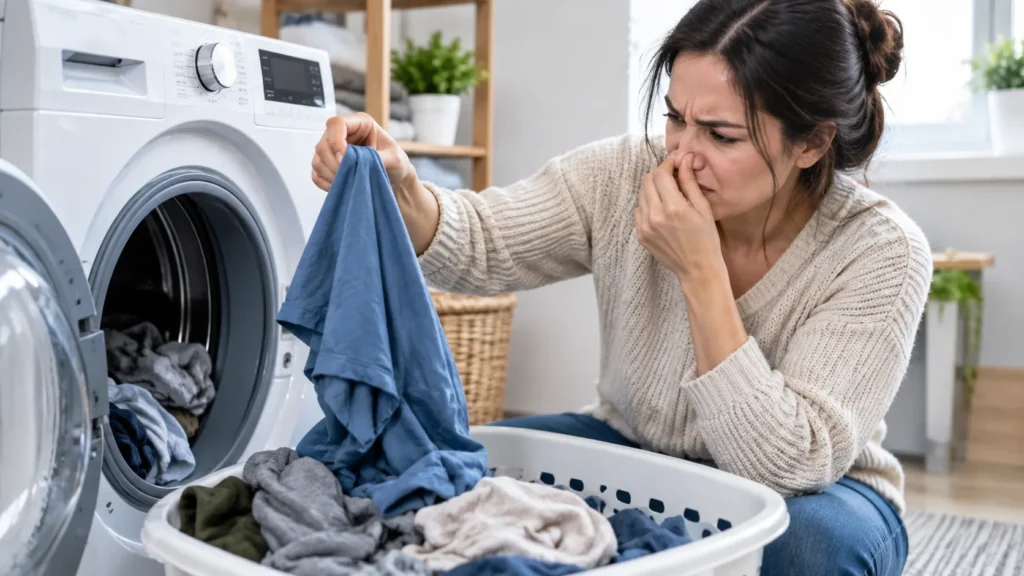
Clothes coming out of the washer smelling worse than before is usually caused by mold or mildew in the door seal, detergent residue buildup, or wet clothes left sitting in the drum too long — not a sign of a broken machine. If there’s standing water in the tub too, that points to a drainage problem instead.
Key takeaways
- Clothes smelling worse after washing is almost always mold/mildew, detergent buildup, or wet clothes left sitting too long — not a sign the washer is broken.
- Front-load washers are more prone to this than top-load, because the sealed door traps moisture that a top-load’s open design lets evaporate.
- The type of smell matters: sour/damp usually means clothes sat too long, musty/mildew points to the door seal or drum, and a chemical or burning smell is a different issue that needs a technician, not a cleaning cycle.
- If there’s standing water in the tub along with the smell, that’s a drainage problem, not a cleaning problem — a clogged drain pump or filter is the likely cause.
- Overloading the drum and using too much detergent both leave residue behind that feeds odor-causing bacteria.
- Safro Solutions’ own repair data shows drain-related fixes for this issue typically run $150 to $400, with the $69–$129 diagnostic fee waived if you move forward with the repair.
- Safro Solutions repairs washers same-day across Los Angeles and the San Fernando Valley — call (747) 250-6879.
Why do my clothes smell worse after washing than before?
A washing machine is supposed to remove dirt and odor from clothes, not add to it. When that happens anyway, it means moisture, detergent residue, or bacteria have built up somewhere inside the machine itself — and every load that goes through picks up that odor instead of losing one.
Two questions determine what’s actually going on, and they’re the same two questions worth asking before you assume the worst: what kind of washer do you have, and what does the smell actually smell like? Front-load and top-load machines fail differently, and a sour smell, a musty smell, and a chemical smell all point to different causes. The rest of this guide walks through both, starting with the washer type.
Does it matter if I have a front-load or top-load washer?
Yes — front-load washers are meaningfully more prone to smell problems than top-load washers, and the reason comes down to design rather than brand or price. A front-loader’s door has to seal tightly to keep water from leaking out mid-cycle. That airtight seal is great for performance but terrible for airflow: moisture pools in the folds of the rubber door gasket after every wash, and if the door gets closed right away, that moisture has nowhere to go. Front-loaders also typically run on less water and cooler cycle temperatures to save energy, which cleans clothes fine but doesn’t rinse out residue as aggressively or get hot enough to kill mold spores.
Top-load washers don’t face the same combination. They generally use more water per cycle, don’t rely on an airtight door seal, and the open top lets the drum air out between loads. That doesn’t mean top-loaders never smell — detergent buildup and a closed lid between uses can still cause odor — but the underlying mechanism is different, and the fix is usually simpler: just leave the lid up.
What kind of smell is it — and what does that tell you?
The type of smell you’re noticing is one of the fastest ways to narrow down the cause, and it’s worth checking before doing any cleaning:
| Type of smell | Likely cause | DIY-cleanable or call a technician? |
| Sour or “wet towel” smell | Clothes left sitting in the drum too long after the cycle ended | DIY — rewash and remove promptly next time |
| Musty or mildew smell | Mold or mildew in the door seal, drum, or detergent drawer | DIY in most cases — deep clean the seal and dispenser |
| Smell plus standing water in the tub | Drainage problem — clogged pump or filter, not a cleaning issue | Often needs a technician if cleaning the filter doesn’t clear it |
| Chemical or burning smell | Electrical or motor issue, unrelated to cleaning | Call a technician — stop using the washer |
| Smell that returns within days of cleaning | Mold embedded in the seal rubber rather than sitting on the surface | Call a technician — seal may need replacement |
A sour smell almost always traces back to a timing issue rather than a dirty machine — even a couple of hours of damp clothes sitting in a closed drum is enough for bacteria to start multiplying. A musty or mildew smell points to the machine itself rather than any one load, which is why rewashing alone doesn’t fix it. And a chemical or burning smell is in a different category entirely: that’s not a cleanliness issue, and running more cycles on it risks making a mechanical or electrical problem worse.
What’s actually causing my washer to make clothes smell worse?
Beyond the quick diagnostic above, here’s the full list of causes, in roughly the order Safro’s technicians see them:
Mold and mildew in the door seal, drum, or detergent drawer is the most common cause, especially on front-load washers. According to Martha Stewart’s own laundry-care coverage, cleaning expert Stephanie Phillips notes that “front-load washers are especially prone to mildew because they seal so tightly — that trapped humidity is perfect for growing yucky stuff, especially around the rubber gasket.”
Detergent and fabric softener buildup is a close second. Using more detergent than needed doesn’t clean better — it leaves a sticky residue behind. Phillips explains that “the leftover suds can cling to fibers and trap moisture, which starts to smell sour almost immediately.”
Wet clothes left sitting in the machine after the cycle ends is the fastest way to create a sour smell, and it happens quicker than most people expect. Per Phillips, “within just a few hours, bacteria start feeding on the tiny bits of organic material that remain in the fabric.”
Overloading the drum prevents water and detergent from circulating properly, which means clothes don’t fully rinse — the same residue-buildup problem as excess detergent, just caused by a packed load instead.
Hard water and mineral buildup round out the list, and this one has a real local angle: much of the San Fernando Valley, including Valley Village, Sherman Oaks, Studio City, and Encino, sits on notably hard water. Mineral deposits from hard water accelerate residue buildup inside a washer the same way they leave spots on dishes and glassware, giving odor-causing bacteria more surface area to grow on between cleanings.
Is this a cleaning problem or a drainage problem?
Everything above assumes the tub is empty when the cycle ends — a cleaning-habit issue you can fix yourself. If there’s standing water in the tub along with the smell, that’s a different problem entirely, and no amount of vinegar or cleaning cycles will fix it, because the actual cause is a blocked drain pump or filter rather than buildup inside the machine.
If that’s what you’re seeing, these guides cover it directly:
- If the tub is full of water and won’t drain at all: see Washer Full of Water and Won’t Drain: What to Do Right Now
- If drainage is only partial, with some water left behind after the cycle: see Washer Not Draining Completely? Partial Drain vs No Drain Explained
If there’s no standing water and the smell is sour or musty, keep reading — the fixes below apply to you.
How do I clean my washer to stop the smell for good?
- Wipe the door seal dry after every load. This matters most for front-load owners, since the sealed gasket is the single biggest source of trapped moisture.
- Leave the door and detergent drawer open between loads. Letting the drum air out instead of staying sealed shut is the single most effective habit change for preventing mildew.
- Cut back on detergent. Use the amount the high-efficiency (HE) line on the cap indicates, not the higher cup-marking amount — especially in a front-loader.
- Run an empty hot-water cycle once a month with a washing-machine cleaner or 2 cups of white vinegar to dissolve residue before it has a chance to build up.
- Don’t leave finished loads sitting. Remove and dry clothes promptly, or rewash with an extra rinse if they’ve already picked up a sour smell.
How much does it cost to fix a washer that’s making clothes smell bad?
Most causes on this list — mold on the seal surface, detergent buildup, overloading — are free to fix with the cleaning habits above; no repair is needed. When the cause turns out to be drainage-related instead, like a clogged pump or filter, Safro Solutions’ washer repair technicians in Los Angeles typically see repairs run $150 to $400, with the $69–$129 diagnostic fee waived if you move forward with the repair, plus a 90-day warranty on parts and labor. A technician confirms the exact cause and cost at the diagnostic visit rather than guessing over the phone.
When should you call a professional washer repair technician?
Call a technician rather than keep cleaning if any of these apply: the smell comes back within a few days of a thorough cleaning, which usually means mold has worked its way into the seal rubber rather than sitting on the surface; there’s standing water along with the odor and the pump filter is already clear; or the smell is chemical or burning rather than musty or sour, which points to an electrical or motor issue rather than anything a cleaning cycle can address. In that last case, stop using the washer and unplug it rather than running it again.
The bottom line
Clothes coming out of the washer smelling worse than before almost always comes down to mold, detergent buildup, or wet clothes left sitting too long — identifiable by checking your washer type and the kind of smell you’re noticing. Most causes are a free habit fix rather than a repair; standing water alongside the smell is the one sign that points to drainage instead.
If you’re in Los Angeles or the San Fernando Valley — Valley Village, Sherman Oaks, Studio City, Encino, Burbank, Van Nuys, or nearby — and cleaning hasn’t solved it, Safro Solutions can get a technician out same-day to confirm the real cause.
Get your washer’s smell problem fixed today
If cleaning your washer doesn’t stop the smell, or there’s standing water along with the odor, that’s not a habit problem anymore — it’s a repair. Safro Solutions’ same-day washer repair service in Los Angeles can confirm exactly what’s causing it — a clogged drain pump, a failing seal, or something else — and fix it same-day across Los Angeles and the San Fernando Valley, with a 90-day warranty on parts and labor.
Call (747) 250-6879 now or schedule your washer repair online — mention this article and your technician will bring the right diagnostic tools for your brand.
Safro Solutions
5331 Corteen Pl, Valley Village, CA 91607
Call: (747) 250-6879
Find us on Google Maps: https://share.google/x0w7LKq8nk9yGxPvk
Frequently asked questions
Q1: Can I use bleach to get rid of the smell in my washer?
Yes, in most machines, but with care. Add no more than the amount your washer’s manual recommends to the bleach dispenser compartment, not directly into the drum, and never mix bleach with vinegar in the same or a following cycle — the combination produces harmful fumes. Bleach helps with drum odor but doesn’t reach mold hiding in the folds of the door seal, which still needs to be wiped manually.
Q2: Why does the smell come back a few days after I clean my washer?
If a thorough cleaning — seal wiped, drawer cleaned, hot cycle run — doesn’t stop the smell from returning within a few days, the mold has likely grown into the rubber of the door seal rather than sitting on its surface. Surface cleaning can’t remove embedded mold, and that’s a sign the seal may need professional replacement rather than another cleaning attempt.
Q3: Does a top-load washer need the same cleaning routine as a front-load?
Not quite as often. Top-load washers use more water and don’t seal shut the way front-loaders do, so they’re naturally less prone to trapped moisture. Wiping down the detergent dispenser and running an occasional hot cleaning cycle is usually enough, versus the more frequent seal-wiping a front-load washer needs.
Q4: Can hard water make my washer smell worse?
Yes. Mineral deposits from hard water — common across much of the San Fernando Valley — build up inside the machine and give odor-causing bacteria more surface area to grow on between cleanings, the same way hard water leaves visible spots on dishes and glassware.
Q5: Is it safe to keep wearing clothes that came out of the washer smelling bad?
an occasional sour smell, yes, though most people choose to rewash rather than wear it. If clothes consistently pick up a musty or chemical smell, that points to an ongoing machine problem worth addressing rather than something to work around load after load.
Q6: How often should I clean my washing machine to prevent smell?
Once a month is the general guideline for a hot empty cleaning cycle, with door-seal wiping and leaving the door ajar as an after-every-load habit rather than a monthly one. Front-load owners in hard water areas may want to clean slightly more often than that.