

A clogged dryer vent shows up as longer dry times, a hot laundry room, a burning or musty smell, visible lint around the vent, and clothes that still feel damp after a full cycle. Left alone, it strains the motor, wastes energy, and is one of the leading causes of home dryer fires. Most clogs clear with a duct cleaning, though a stuck-open vent flap or a vertical vent run need a different fix. If your dryer is already not drying clothes properly and you want the full symptom-by-symptom breakdown, that guide walks through it in more depth. This article focuses on catching the problem early and knowing which fix you actually need.
TL;DR
- Watch for 7 signs: longer dry times, a hot dryer or laundry room, burning or musty smells, visible lint, weak or no airflow at the exterior vent, early shutoffs, and a spike in your utility bill.
- A stuck-open vent flap and a vertical vent run cause the same symptoms as a clog but need different fixes, so check which one you actually have before you start.
- If a duct cleaning does not fix it, or your dryer is gas-powered, call a licensed technician. Safro Solutions offers same-day appliance repair across Los Angeles with a 90-day warranty on parts and labor. Call (747) 250-6879.
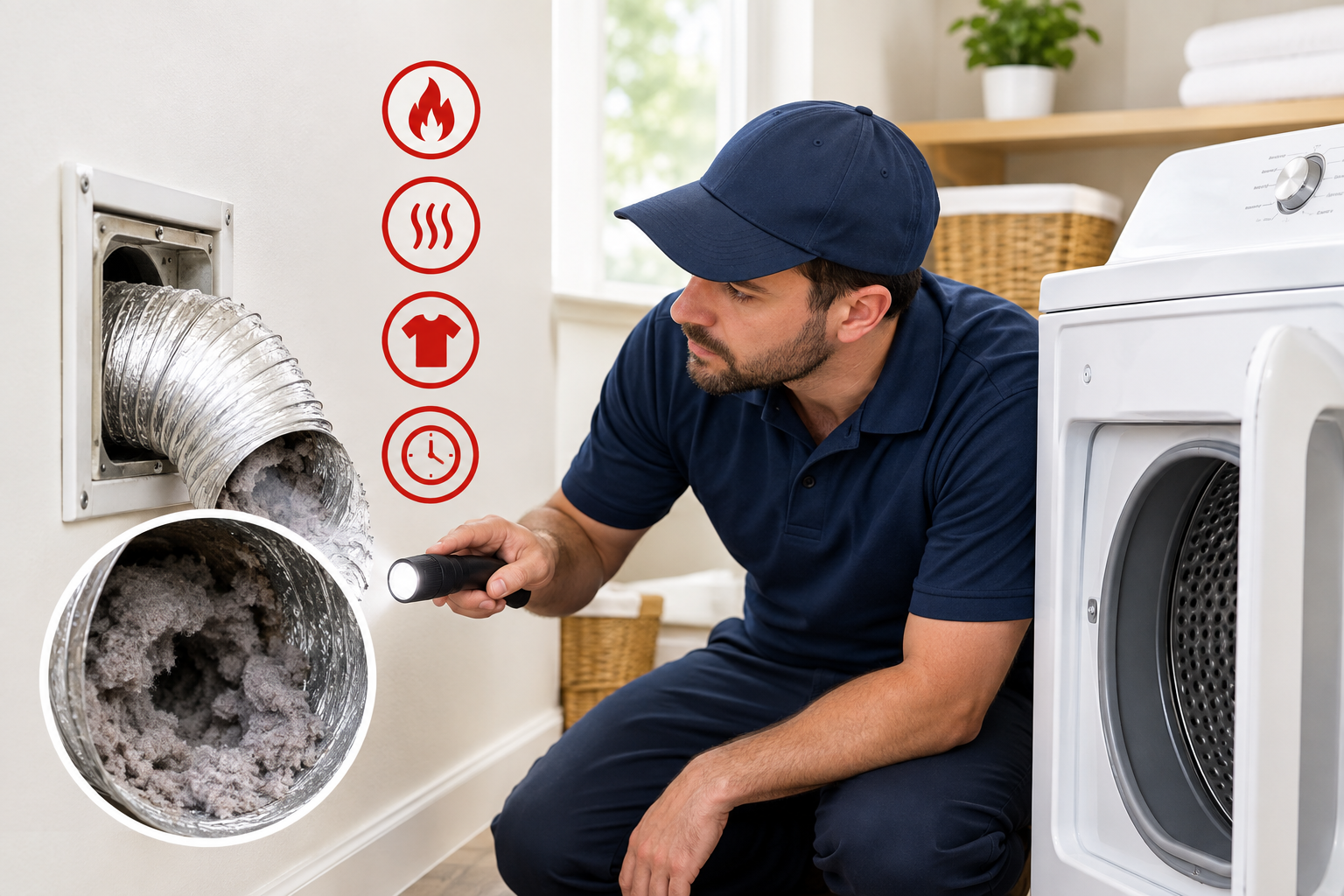
7 warning signs of a clogged dryer vent
A clogged dryer vent restricts the airflow your dryer needs to push hot, moist air outside. Watch for these seven signs.
1. Drying takes longer than it used to. A normal cycle runs about 40 minutes. If the same load now takes 60 to 90 minutes, or you’re running clothes through twice, restricted airflow is the most common cause.
2. The dryer or laundry room feels hot. Blocked exhaust air has nowhere to go, so heat backs up into the dryer cabinet and the room around it. If you can feel heat radiating off the dryer’s front panel mid-cycle, that’s a sign air isn’t escaping the way it should.
3. You smell burning or something musty. A burning smell means lint near the heating element is overheating, which is a fire risk and worth shutting the dryer off immediately. A musty smell usually means moisture is trapped in the duct instead of venting outside.
4. Lint collects where it shouldn’t. Check behind the dryer, around the exhaust port, and on your clothes after a cycle. Lint building up outside the lint trap means the vent isn’t pulling it through and out.
5. The exterior vent flap barely moves, or doesn’t move at all. Step outside while the dryer runs. You should feel a steady rush of warm air and see the flap swing open. Weak airflow or a flap that stays shut points to a blockage further down the line, or a flap that’s stuck (more on that below).
6. The dryer shuts off before the cycle ends. Most dryers have a thermal safety switch that cuts power if internal temperatures climb too high. Repeated early shutoffs are the dryer protecting itself from a vent that can’t keep up.
7. Your utility bill has crept up. A dryer fighting a clogged vent runs its heating element longer to compensate, which uses more energy for the same result. If your gas or electric bill has risen without a change in laundry habits, a vent check is worth ten minutes of your time.
According to the U.S. Consumer Product Safety Commission, clothes dryers are associated with an estimated 15,500 fires a year, and the duct or vent system is the single most common place those fires start. Signs 3 and 6 in particular are your dryer telling you not to wait.
Before you assume the whole duct is clogged, though, it’s worth ruling out two specific causes that look identical from inside the laundry room: a stuck vent flap, and a vertical vent run.
A 30-second test to check your airflow
You don’t need tools to get a first read on how blocked your vent is.
- Start a load with the dryer set to a normal heat cycle.
- Go to the exterior vent hood and hold a single paper towel or a light piece of tissue a few inches from the opening (don’t touch the vent, it will be hot).
- Watch what happens. Strong, steady airflow should pull the paper towel toward the vent and hold it there for most of the cycle.
What the result means:
- Paper towel pulls in firmly and stays: Your airflow is close to normal. A clog is less likely to be the issue, so a persistent problem may point to the dryer itself.
- Paper towel moves weakly or only in short bursts: Partial blockage. Lint has built up enough to restrict flow but not seal it off completely.
- Paper towel doesn’t move at all: Full or near-full blockage. The duct, the vent hood, or both need to be cleared before you run another load.
- The flap doesn’t open even though you can feel some warm air: This points to the flap itself, not the duct. See the next section.
This test tells you how bad the blockage is, but not where it’s coming from or why. That matters, because a stuck vent flap and a vertical vent run both choke off airflow the same way a straightforward lint clog does, and each one needs a different fix.
Is your dryer vent flap stuck open?
A stuck-open vent flap is not the same problem as a clogged duct, even though both cause weak airflow and a hot laundry room. The vent flap is the small hinged door on the outside wall cap that’s supposed to swing open only while the dryer runs, then snap shut the rest of the time.
Why it gets stuck. Lint that escapes the duct settles on the flap’s hinge and edges. Over months, that buildup either wedges the flap open so it never fully closes, or cakes it shut so it can barely move at all. Either way, the flap stops doing its job.
Why a stuck-open flap is its own problem. When the flap won’t close, outside air, dust, and even pests have a direct path into your vent duct and, eventually, your laundry room. You’ll notice it as drafts near the dryer when it’s not running, a bigger swing in the room’s temperature, and a slow climb in your utility bill from conditioned air leaking out.
How to check it. With the dryer off, go outside and look at the vent hood. Push the flap gently with your fingers. It should move freely and spring back to fully closed. If it’s crusted with lint, stiff, or hanging open on its own, that’s your answer.
How to fix it. For light buildup, scrape the lint off the flap and hinge with a stiff brush or an old toothbrush, then test that it closes on its own. If the flap is warped, cracked, or the spring has given out, the hood assembly needs to be replaced. That’s a low-cost part, and most homeowners can swap it in under an hour with basic tools.
A stuck flap is a duct-cap problem, not a full-duct problem, so clearing it won’t fix a separate clog further back in the line. If your airflow test in the last section showed weak or no airflow even after the flap moves freely, the blockage is inside the duct itself.
One duct layout makes that kind of blockage far more common in Los Angeles homes: a vertical run.
Why vertical dryer vents clog faster
A vertical dryer vent, one that runs straight up through an attic or a second story instead of straight out through an exterior wall, clogs faster because lint doesn’t just float through it. Lint settles with gravity, and a vertical run gives it a ledge to land on at every seam and elbow instead of a straight shot outside.
Attic space also runs cooler than the duct’s exhaust air, especially overnight and during Los Angeles’s milder winter months. That temperature difference causes the moisture in the exhaust to condense on the duct’s inner walls. Wet duct walls are sticky duct walls, and lint that would normally blow straight through instead adheres to the damp surface and builds up layer by layer.
This layout shows up often in two-story homes and homes with an upstairs laundry closet, which is common across neighborhoods Safro Solutions serves like Sherman Oaks, Valley Village, Studio City, and Woodland Hills. If your washer and dryer are on a second floor, or your duct run includes any stretch of upward travel through an attic, you’re dealing with a setup that clogs faster than a simple wall vent and needs to be checked more often, not just when symptoms show up.
What to do about it:
- Have the full vertical run cleaned on a shorter interval, since lint collects there faster than in a horizontal duct.
- Ask about switching to rigid metal duct if any section is still flexible foil hose. It gives lint fewer ridges and seams to catch on (more on duct material below).
- If leak stains or a musty smell show up on the ceiling below the attic run, that’s condensation escaping at a joint, not just a clog, and it’s worth a technician’s inspection sooner rather than later.
Rigid metal vs. flexible foil duct: which one clogs less
| Rigid metal duct | Flexible foil/vinyl duct | |
|---|---|---|
| Interior surface | Smooth | Ridged, with grooves lint catches on |
| Clog risk | Lower | Higher, especially on vertical runs |
| Fire safety | Meets code for dryer venting | White vinyl flex does not meet UL safety standards |
| Best for | Any run, especially vertical or long horizontal runs | Not recommended for dryer exhaust |
| Cost to replace a section | Low | Low |
The ridges inside flexible duct exist to let it bend around tight spaces, but those same ridges are exactly what catches lint as it travels through. On a vertical run, where lint is already settling with gravity, a ridged interior turns a slow buildup into a fast one. Rigid metal duct, by contrast, gives lint nothing to grab onto, which is why it’s the standard both plumbing codes and manufacturers like Whirlpool specify for dryer exhaust runs. The U.S. Department of Energy’s dryer venting guidance recommends rigid or corrugated semi-rigid metal duct over plastic or foil flex hose for exactly this reason, and sets limits on how long a run can be before airflow suffers even in a clean duct.
If any part of your vent line between the dryer and the outside wall or roof is still flexible foil or plastic hose, that section is worth swapping for rigid metal, particularly if it’s on a vertical stretch. It’s a small material cost against a real fire-risk reduction.
How to clear a clogged dryer vent
Clearing a straightforward lint clog is a job most homeowners can do in under an hour with basic tools.
- Unplug the dryer (or shut off the gas supply if it’s a gas dryer) and pull it away from the wall far enough to reach the duct connection.
- Disconnect the duct from the back of the dryer, usually held on with a clamp or foil tape.
- Vacuum the first few feet of duct and the dryer’s exhaust port using a vacuum with a hose attachment.
- Run a vent brush kit through the full duct length. These flexible rod brushes are sold at most hardware stores and are built to reach lint a vacuum can’t.
- Clean the exterior vent hood and flap from outside, clearing any caked lint and confirming the flap swings freely.
- Reconnect the duct, checking that the connection is sealed with a clamp, not just tape, and that no section is crushed or kinked.
- Run a test cycle and repeat the paper-towel airflow check from earlier to confirm the fix worked.
When to stop and call a professional instead:
- Your dryer is gas-powered. A gas line disconnection or reconnection done wrong is a safety hazard, not a DIY step.
- The duct run goes through the attic, a wall cavity, or requires roof access. Vertical runs in particular often need equipment a vent brush kit can’t reach.
- You’ve cleaned what you can reach and the paper-towel test still shows weak or no airflow.
- You smell burning, see scorch marks near the vent connection, or the dryer has tripped its thermal shutoff more than once.
When to call a professional
A vertical vent run, a gas dryer, a duct that goes through the attic or requires roof access, or a blockage that doesn’t clear after a full cleaning are all reasons to bring in a licensed technician rather than keep working at it yourself.
Safro Solutions handles dryer repair and dryer vent service across Los Angeles, including the vertical and attic-run duct configurations common in two-story homes throughout Sherman Oaks, Valley Village, Studio City, Encino, and the rest of the San Fernando Valley. A technician can clear the full duct length with commercial-grade equipment, inspect the vent flap and exterior hood, and check whether your duct material and routing are contributing to repeat clogs, not just treat the symptom this time around.
Every repair comes with a 90-day warranty on parts and labor. If the same problem comes back within that window, we come back at no charge.
Call (747) 250-6879 for same-day dryer vent service in Los Angeles, or schedule your appointment online in under two minutes.
Preventing future clogs
Every load: Clean the lint trap before you start the dryer, not after. A trap with even a thin layer of lint already restricts airflow before the exhaust reaches the duct.
Every few months: Run the paper-towel airflow test from earlier in this guide. It takes 30 seconds and catches a building clog long before you notice longer dry times.
Once a year, for single-story homes with a short, straight wall vent: A full professional duct cleaning once a year is usually enough, since gravity and a short run both work in your favor.
Twice a year, for homes with a vertical or attic vent run: Given how much faster lint collects on a vertical stretch, homes with second-floor laundry rooms or attic-routed ducts should have the vent cleaned on a shorter interval, closer to every six months.
Anytime, regardless of schedule: Check the exterior vent hood monthly for nests, debris, or a flap that’s stopped moving freely. This takes less time than starting a load of laundry and catches the two problems covered earlier in this guide before they become a full blockage.
A clean vent only solves half the picture, though. If drying times are still long after you’ve ruled out a clog, an overloaded dryer is the other common cause, and it’s worth checking your load size before assuming the vent is to blame again.
Frequently asked questions
How do I know if my dryer vent is clogged? The clearest signs are clothes that take noticeably longer to dry, a dryer or laundry room that feels hot to the touch, lint collecting outside the lint trap, and weak or no airflow at the exterior vent when the dryer is running. The 30-second paper-towel test earlier in this guide gives you a quick read.
What causes a dryer vent blockage? Lint is the main cause. Small fibers shed from clothing during every cycle, and while the lint trap catches most of it, some always escapes into the duct. Over time it builds up at bends, seams, and especially on vertical runs, until airflow is restricted.
Why won’t my dryer vent flap close? Lint buildup on the flap’s hinge and edges is the usual reason. It either wedges the flap open or cakes it shut so it can’t move. A stuck flap is a separate problem from a clogged duct, even though both weaken airflow the same way.
Why do vertical dryer vents clog more often? Lint settles with gravity, so a vertical run gives it more surfaces to land on than a straight horizontal shot outside. Vertical runs through an attic also cool the exhaust air enough to cause condensation, and wet duct walls trap lint instead of letting it blow through.
How often should I clean my dryer vent? Once a year for a short, straight wall vent. Every six months if your vent runs vertically through an attic or a second floor, since lint collects faster on that kind of run.
Can a clogged dryer vent cause a fire? Yes. The U.S. Consumer Product Safety Commission estimates 15,500 dryer-related fires a year, and the duct or vent system is the most common place they start. A burning smell or a dryer that keeps shutting off early are warning signs worth acting on right away, not waiting out.
Can I clean a dryer vent myself, or do I need a professional? A short, accessible duct is a reasonable DIY job with a vacuum and a vent brush kit. Call a professional if you have a gas dryer, the duct runs through an attic or needs roof access, or you’ve cleaned what you can reach and airflow is still weak.
Is a clogged vent the same as a broken heating element? No, though both can leave clothes still damp after a cycle. A clogged vent traps heat and moisture inside the duct, so the dryer runs hot and the laundry room warms up. A failed heating element does the opposite, the dryer runs but never gets properly hot. The paper-towel airflow test helps tell them apart: weak airflow points to a vent problem, while normal airflow with cool air coming out points to the heating element.