

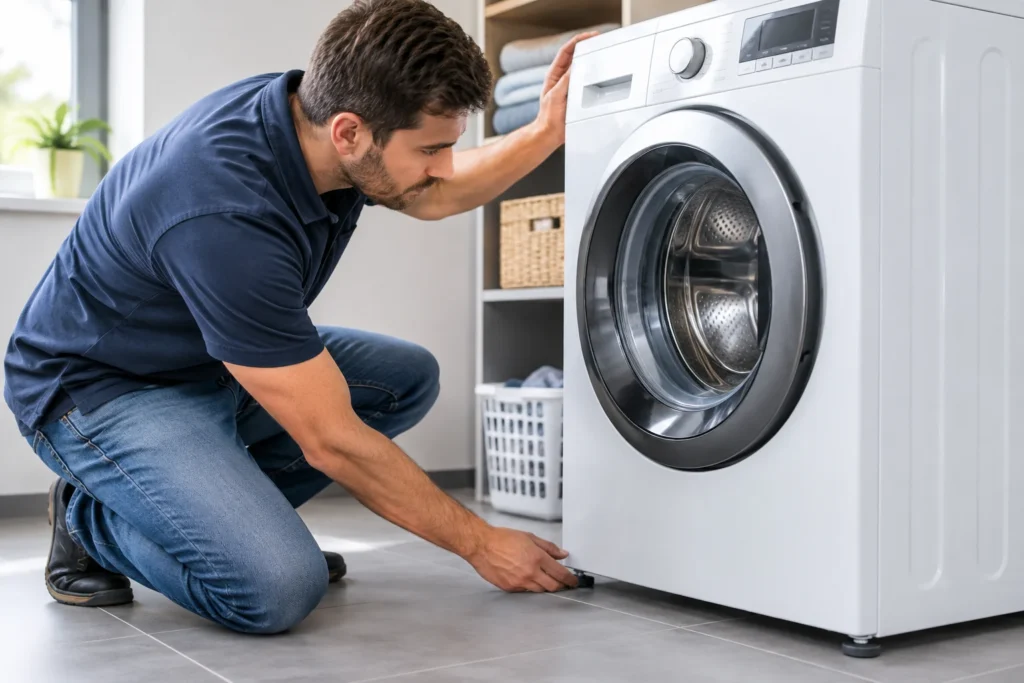
Most washing machine shaking comes from an unbalanced load, an unlevel machine, or shipping bolts that were never removed after installation. Loud grinding, banging, or clicking that doesn’t go away during the spin cycle usually points to one specific worn part, the drum bearing, a suspension rod, or a shock absorber, and which one it is often depends on whether your washer is top-load or front-load.
Key takeaways
- Unbalanced loads, unlevel feet, and leftover shipping bolts cause most shaking in the first few weeks after a new washer is installed.
- A specific sound (grinding, banging, clicking, humming) points to a specific failing part, not just general wear.
- In Los Angeles, repairing a worn bearing, suspension rod, or shock absorber typically runs $120 to $520 depending on the part. Call Safro Solutions at (747) 250-6879 for a same-day diagnosis.
What the noise is actually telling you
The sound your washing machine makes during a cycle is a diagnosis, not just background noise. Grinding or rumbling during the spin cycle almost always means a worn drum bearing, the part that lets the inner drum spin smoothly inside the outer tub. Banging, or a washer that walks across the floor, usually means an unbalanced load or a suspension rod that has lost its tension. Clicking is trickier: a short series of clicks right at the start of a cycle is normal (that’s the lid lock engaging), but clicking that continues through the whole wash or spin points to a worn spider arm, the X-shaped bracket that connects the drum to the drive shaft. Humming or buzzing that doesn’t fade usually means the drive motor or the drain pump is struggling.
Three parts rarely get named directly, even though they’re often the real cause of stubborn shaking: the spider arm, the balance ring (a fluid or solid weight built into the drum that offsets uneven loads), and the counterweight bolted to the top or front of the tub. If your washer bangs hardest right as it ramps up to spin speed, one of these three is a likely culprit, especially on a machine past the five-year mark.
If the problem is actually that your washer won’t drain at all rather than just making noise, that’s a different repair with its own set of causes, covered in why your washer isn’t draining completely.
Top-load vs. front-load: why the fix is different
Front-load washers shake harder than top-load washers because they spin much faster. A front-load drum typically spins at 1,000 to 1,600 RPM to wring water out before the dryer, while a top-load drum usually tops out around 700 to 900 RPM. That higher spin speed puts far more stress on the suspension system, which is why front-loaders tend to show worn suspension rods and shock absorbers sooner, often within five to eight years of regular use.
Top-load washers shake for different reasons. Without a front-load-style suspension system, a top-loader relies more on the spider arm, the drive block, and the balance ring to keep the drum centered. When one of those wears out, a top-loader is more likely to bang or walk across the floor than to develop the deep rattling hum a failing front-load shock absorber produces. That’s also why a top-load washer that’s suddenly noisy after years of running quietly often has a different repair bill than a front-load washer with the same symptom, even though the complaint sounds identical on the phone.
If your washer is shaking but still runs through a full cycle without stopping, that’s a separate issue from a washer that agitates but won’t finish, which is covered in common causes of a washer that won’t agitate.
Quick, safe fixes before you call anyone
Unplug the washer before you inspect or touch anything mechanical, especially if you’re checking the back panel or underneath the tub. Once it’s unplugged, three checks solve shaking more often than any part replacement.
First, redistribute the load. A single heavy item, like a comforter or a pair of jeans bunched on one side, throws the drum off balance enough to cause violent shaking during spin. Pause the cycle, open the door, and spread the laundry evenly around the drum.
Second, check that the washer is level. Set a bubble level on top of the machine and adjust the front leveling feet until it sits dead center, then make sure all four feet have firm contact with the floor. A washer that rocks when pushed from the corner isn’t level yet.
Third, if the washer is new or was recently moved, confirm the shipping bolts are out. According to Whirlpool’s own installation support page on removing shipping bolts, these bolts secure the drum during transport and must be removed before the washer runs, since leaving them in causes exactly the kind of violent shaking and banging this article is about, and can also damage the machine.
If you’ve checked all three and the washer still shakes or makes noise, the cause is likely mechanical rather than something you can fix by hand. A licensed washer repair technician in Los Angeles can pinpoint which part has failed in about the time it takes to run a load.
Not sure if it’s worth the service call yet, or want a second opinion on the cost before booking? Safro Solutions offers same-day diagnostic visits across Los Angeles and the San Fernando Valley. Call (747) 250-6879 to get a technician out today.
What it costs to fix a shaking or noisy washer in Los Angeles
Repairing a shaking or noisy washer in Los Angeles typically costs between $120 and $520, depending on which part has failed and whether it’s a top-load or front-load machine. The table below breaks down what Los Angeles appliance repair companies are currently charging for each part, based on published pricing from local competitors and Google’s own AI-generated cost summaries for these exact repairs.
Part | Typical LA repair cost | Notes |
| Suspension rod (front-load) | $130 to $350 | Lower end is parts-only DIY; professional installs run closer to $200 to $280 |
| Shock absorber (front-load) | $120 to $360 | Usually replaced as a set of two or four, not one at a time |
| Drum bearing | $250 to $520 | Highest labor cost; requires disassembling the outer tub |
| Diagnostic visit | Often $65 to $100, sometimes waived if you approve the repair | Confirms the exact part before you pay for a fix |
These figures line up closely with what two real Los Angeles competitors are currently charging for the same repairs: SoCal Appliance Repair Pros lists vibration and shaking repairs starting around $190 with drum bearing work at $280, and lgdryer.repair prices shock absorber replacement at $280 to $360 and bearing replacement at $320 to $420. Safro Solutions quotes against this same local market and confirms the exact part and price during the diagnostic visit, not after the repair is already underway.
If you want an exact quote for your washer’s brand and symptom before deciding anything, book a same-day diagnostic visit and a technician will confirm the part and the price in person.
Is it worth repairing, or time to replace?
Whether a shaking or noisy washer is worth repairing comes down to three things: the machine’s age, whether the drum and tub can actually be opened for a repair, and how the repair cost compares to a new washer. According to the University of Illinois Extension’s appliance lifespan guidance, a washing machine’s typical useful life runs 5 to 7 years, shorter than most homeowners expect. A $280 bearing repair on a 3-year-old washer is usually worth it. The same repair on a 9-year-old washer competing against other aging parts is a closer call.
The bigger factor is often the tub design, not the age. Many modern washers, especially front-load models, glue or weld the outer tub together instead of bolting it, which makes a bearing replacement far more labor-intensive and sometimes not cost-effective at all, since the technician has to replace the entire tub assembly rather than just the worn bearing. A top-load washer with a bolted, serviceable tub is usually the more repair-friendly machine of the two.
If you’re on the fence, a same-day diagnostic visit settles it quickly. A technician who opens the machine can tell you within minutes whether you’re looking at a simple part swap or a repair that starts to approach the cost of a new washer, so you’re not guessing.
Need a washer technician in Los Angeles today?
If your washer is still shaking, banging, or making a noise you can’t place after trying the fixes above, Safro Solutions offers same-day washer repair across Los Angeles and the San Fernando Valley, including Valley Village, Sherman Oaks, Studio City, Encino, and Burbank. A technician will confirm the exact cause, give you a firm price before any work starts, and fix it the same visit in most cases. Schedule a same-day repair visit or call the number below, and if you want to see the full range of washer issues the team handles, the washer repair services page covers everything beyond shaking and noise too.
Safro Solutions
5331 Corteen Pl, Valley Village, CA 91607
Call: (747) 250-6879
Find us on Google Maps: https://share.google/x0w7LKq8nk9yGxPvk
Frequently asked questions
Q1: How do I fix a washing machine that shakes violently?
Start by unplugging the washer, then redistribute the laundry load evenly, check that all four feet sit level and firm on the floor, and confirm any shipping bolts are removed if the machine is new. If the washer still shakes violently after all three checks, a worn suspension rod, shock absorber, or drum bearing is the likely cause, and that needs a technician to confirm and replace.
Q2: Why is my washing machine so loud and shaking?
A washing machine that’s both loud and shaking usually has two things happening at once: an unbalanced or overloaded drum causing the shaking, and a worn part, most often a suspension rod, bearing, or spider arm, causing the noise. Fixing the balance issue first often makes it easier to tell whether a real mechanical repair is still needed underneath.
Q3: How do I rebalance my washer drum?
Pause the cycle, open the door or lid, and manually spread the laundry around the drum so no single area is bunched up or overloaded with one heavy item. Close the door and restart the cycle. If the washer still shakes after rebalancing the load and checking that the machine itself is level, the imbalance is likely mechanical rather than caused by the laundry.
Q4: Is it worth fixing a washing machine if the bearings have gone?
It depends on the washer’s age and whether the tub is bolted or sealed shut. A bearing repair on a washer under five years old with a serviceable, bolted tub is usually worth it, since the repair cost stays well below a replacement washer. On an older machine with a glued or welded tub, the labor to access the bearing can push the cost close to buying new, which makes replacement the more practical choice.
Q5: Do front-load washers shake more than top-load washers?
Yes. Front-load washers spin at 1,000 to 1,600 RPM to extract more water, compared to roughly 700 to 900 RPM for top-load washers, and that higher spin speed puts more stress on the suspension system. This is also why front-load washers tend to develop worn suspension rods and shock absorbers sooner than top-load washers develop comparable wear.
Q6: What do shipping bolts do, and do I need to remove mine?
Shipping bolts hold the washer’s drum firmly in place during transport so it isn’t damaged while the machine is being moved. They have to be removed before you run the washer for the first time, since leaving them in causes severe shaking, banging, and potential damage to the suspension system, and most manufacturers note that running the washer with the bolts still in can also affect the warranty.