

By the Safro Solutions Team — Licensed technicians serving Los Angeles, the San Fernando Valley, Beverly Hills, Pasadena, and surrounding areas. Call Us Today for same-day service.
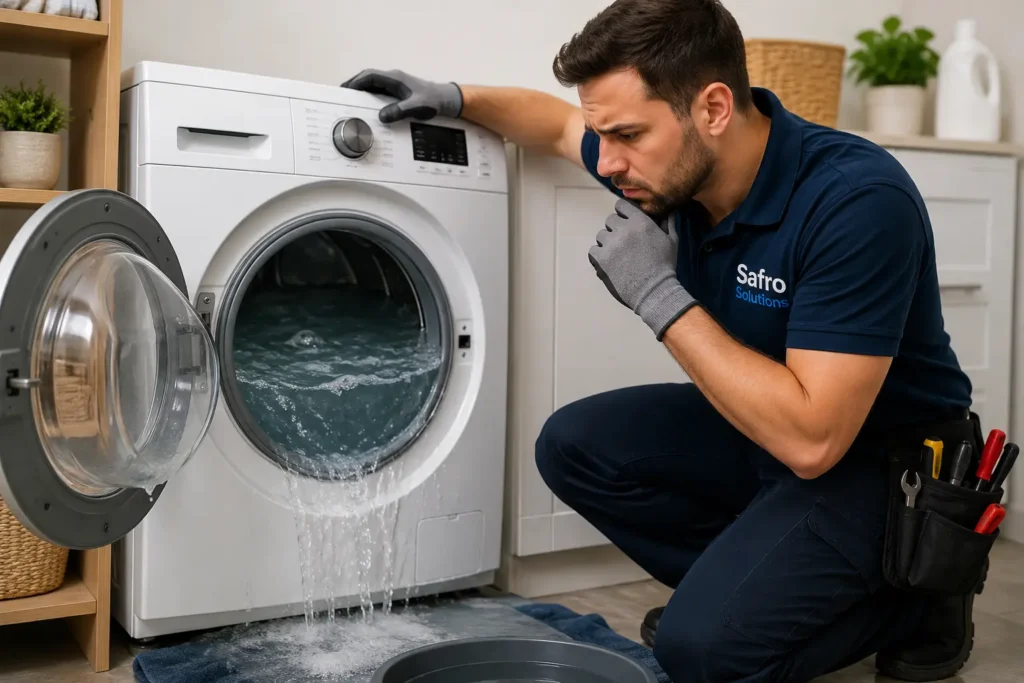
The cycle ends. You open the lid — or try to open the door — and the drum is sitting full of murky water. Your clothes are soaked, the machine won’t move, and now you have gallons of water with nowhere to go
Quick answer: First try a Drain & Spin cycle, then a 60-second power reset. If water still won’t move, drain the machine manually using the drain hose or the pump filter’s emergency drain tube. The cause is almost always one of five things: a clogged pump filter, a kinked or blocked drain hose, a failed drain pump, a faulty lid switch, or a clogged house drain.
A washing machine full of water that won’t drain is one of the most common emergency calls we get across Los Angeles. Here’s exactly what to do, in order — and call (747) 250-6879 if you’d rather we handle it today.
Do These 4 Things Right Now (Before Anything Else)
Standing water gets worse the longer it sits. Work through these four steps first — two of them solve the problem with no tools at all.
- Run a Drain & Spin (or Spin Only) cycle. Washers sometimes stall between the wash and drain stages. Manually selecting Drain & Spin forces the machine to attempt draining again. This alone clears the problem more often than people expect.
- Unplug the machine for 60 seconds, then retry. A full unplug resets the control board and clears temporary electronic glitches. Plug it back in and run Drain & Spin once more.
- Cut the power and protect your floor. If the water still won’t move, unplug the washer (or switch off the breaker) and lay towels around the base. In LA apartments and homes with upstairs laundry, an overflow doesn’t just ruin your floor — it can damage the ceiling below you. This is why standing water is an emergency, not a “later” problem.
- Do not force a locked front-load door. Front-loaders lock the door whenever water is detected in the drum — on purpose, to prevent a flood. Forcing it can snap the latch and dump gallons onto your floor. Drain the water first (next section), and the door will release.
How to Drain a Washing Machine Full of Water — 3 Manual Methods
Before you can diagnose anything, the water has to come out. Pick the method that fits your machine. For all three: unplug the washer first and keep towels and a shallow pan ready.
- Method 1 — Drain Hose + Bucket (Easiest, Works on Most Washers)
- Pull the washer away from the wall.
- Find the drain hose — the largest hose, usually gray or black, running into a standpipe or utility sink.
- Hold the hose above the tub level, then wiggle it free from the standpipe.
- Lower the end into a bucket placed on the floor. Gravity does the rest.
- When the bucket fills, lift the hose above tub level to pause the flow, empty, and repeat.
Water draining freely here is a clue: the hose is fine, and the problem is likely the pump or the house drain.
- Method 2 — Pump Filter / Emergency Drain Tube (Front-Loaders)
Most front-load washers have a small access panel at the bottom front corner. Behind it sits the pump filter — and on many models, a thin emergency drain tube.
- Open the access panel (a coin or flathead screwdriver helps).
- Pull out the small drain tube, hold a shallow pan underneath, and remove its cap. Let the water run out; you’ll refill the pan several times.
- No drain tube? Turn the round filter knob counterclockwise slowly — a quarter turn at a time — to control the flow.
- Once empty, unscrew the filter fully and clear out lint, coins, and debris. Spin the pump propeller behind it with a finger; it should turn freely.
Caution: water from a hot or sanitised cycle can scald. Samsung’s official emergency drain guide warns about this — let the drum cool first.
- Method 3 — Wet/Dry Vacuum at the Hose End (Fastest)
If you own a shop vac, press its hose against the end of the disconnected drain hose and let it pull the water out. This is the fastest method, it empties water sitting below the hose line that gravity can’t reach, and the suction often pulls out the clog itself.
Front-load door locked with water inside? Draining by Method 2 releases the lock on most machines. If it stays locked after draining, look for a manual release tab behind the bottom kick plate (common on LG and GE models) and pull it gently. Whirlpool models showing an F8 E1 or LO FL code will run a forced 8–10 minute drain routine on their own — let it finish. A door that stays locked on an empty drum usually means a faulty pressure switch or latch — that’s a repair call.
Why Your Washer Won’t Drain or Spin — 5 Real Causes
Drain and spin failures are usually one problem, not two: modern washers refuse to spin while they detect water in the drum. Match your symptoms first, then jump to the cause.
| Symptom | Most Likely Cause | DIY Difficulty |
| Water drains fine into a bucket via hose | House drain / standpipe clog | Moderate |
| Humming noise, but no water moves | Drain pump (jammed or failed) | Hard |
| Drains slowly or stops mid-drain | Clogged pump filter or hose | Easy |
| Won’t drain and lid/door feels loose | Lid switch / door latch | Moderate |
| Started after moving or new install | Kinked hose | Easy |
- Cause 1 — Clogged Pump Filter (DIY)
The pump filter catches lint, coins, hair ties, and detergent sludge before they reach the pump. When it packs full, water simply can’t exit.
Safro field note: this is our #1 drain call in Los Angeles. LA’s hard water reacts with detergent to form a scale-and-lint paste that cakes the filter — we see it constantly in Sherman Oaks and Van Nuys units that have never had the filter opened. Clean it (Method 2 above shows how) and test. Doing this every 2–3 months prevents most repeat clogs.
- Cause 2 — Kinked or Clogged Drain Hose (DIY)
A hose pinched behind the washer, pushed too far down the standpipe, or blocked inside stops everything. The classic culprit: a sock or baby item that slipped past the drum and lodged in the hose.
Straighten any visible kinks first. Then disconnect the hose (Method 1) and sight through it — or flush it with water outside. Clear what you find and reattach. - Cause 3 — Failed Drain Pump (Call a Pro)
The pump is the motor that actively pushes water up and out. When it jams or burns out, you’ll often hear a humming or grinding noise during the drain stage while no water moves — the telltale symptom.
A pump jammed by debris can sometimes be cleared through the filter opening. A burned-out pump needs replacement, which means opening the cabinet and working around water and wiring. This is the point where our washer repair in Los Angeles team takes over — it’s typically a same-day fix. - Cause 4 — Lid Switch or Door Latch
Top-loaders won’t drain or spin unless the lid switch confirms the lid is closed. Press the switch by hand — no click usually means it’s dead. On front-loaders, a failed door latch or its wiring does the same thing, and often triggers a door-lock error code.
These are cheap parts, but they’re safety components tied into the control system, so we recommend professional replacement. - Cause 5 — Clogged House Drain or Standpipe
Here’s the test that tells you whether to call an appliance tech or a plumber: drain the washer into a bucket using Method 1. If water flows freely from the hose, your washer is fine — the blockage is in your home’s standpipe or drain line. Water backing up out of the standpipe during a cycle confirms it.
One thing we’re seeing more in 2026: older LA homes with standpipes sized for vintage washers can’t handle the higher drain flow of new high-efficiency machines. If the problem started right after a new washer was installed, mention that when you call.
Washer Error Codes That Mean “Drain Problem”
If your washer is flashing a code, it’s usually telling you exactly where to look:
| Brand | Code | Meaning |
| LG | OE | Drain error — check pump filter and hose |
| Samsung | 5C / 5E (older: nd) | Clogged pump filter or drain failure |
| Whirlpool / Maytag | F9 E1 | Long drain — water not out in time |
| Whirlpool | F8 E1 / LO FL | Water issue — door locks, forced drain runs |
| GE | Drain light / 1E | Drain restriction detected |
| Bosch | E18 | Drain pump or filter blockage |
Codes point to the symptom, not always the exact part — a 5C can be a $0 filter cleaning or a failed pump. We covered Bosch’s similar sensor logic in our dishwasher not filling with water guide.
What It Costs to Fix in Los Angeles (2026)
Real-world ranges for drain-related washer repairs in the LA area:
| Repair | Typical LA Cost |
| Diagnostic visit | Free estimate with Safro before any repair |
| Pump filter / hose clog cleaning | $90 – $150 |
| Drain hose replacement | $95 – $170 |
| Drain pump replacement | $180 – $320 |
| Lid switch / door latch replacement | $120 – $180 |
Repair or replace? Our rule: if the washer is under 8 years old and the repair costs less than half of a comparable new unit, repair wins. A drain pump on a 4-year-old machine is absolutely worth fixing; the same pump on a 14-year-old washer with bearing noise may not be. We’ll tell you honestly either way — schedule a repair and we’ll give you the numbers before any work starts.
When to Stop DIY and Call a Professional
DIY ends and a service call begins when you notice any of these:
- A burning smell or any electrical odor — stop using the machine immediately
- Water leaking near outlets, cords, or the machine’s electronics
- Humming with no drainage (failed pump) after the filter is clean
- Water returns after every “fix” — there’s a root cause you’re not seeing
- A door that stays locked on an empty drum
We offer same-day washer repair across Los Angeles and the Valley, and our technicians carry common drain pumps on the truck.
How to Prevent It From Happening Again
Five small habits stop most drain failures before they start:
- Clean the pump filter every 2–3 months — monthly if you have pets.
- Check pockets. Coins, hair ties, and guitar picks are what we pull out of pumps.
- Use HE detergent, measured. Oversudsing confuses sensors and gums up the drain path — a real issue with LA hard water.
- Don’t overload. Strained loads stall spin cycles and leave water behind.
- Run a monthly hot maintenance wash to dissolve detergent and scale buildup.
Washer Full of Water in Los Angeles? Safro Can Drain and Fix It Today
You don’t have to bail water by the bucket. Safro Solutions handles washer drain emergencies across LA — usually the same day you call.
Call or text: (747) 250-6879 Email: services@safroappliancerepair.com Schedule a Repair Online
Brands we service: Bosch, Samsung, LG, Whirlpool, GE, KitchenAid, Maytag, Frigidaire, and all major brands.
Service area: Los Angeles, Sherman Oaks, Studio City, Beverly Hills, Encino, Tarzana, Woodland Hills, Burbank, Van Nuys, Northridge, Pasadena, Valley Village, and surrounding communities. See our full service area.
Licensed technicians. Free estimate before any repair. For other appliances, see our refrigerator repair Los Angeles page.
Safro Solutions is a licensed appliance repair service operating throughout Los Angeles County. Our technicians are factory-trained on all major residential appliance brands. Content reviewed by our lead service technician.
Frequently Asked Questions
Q1: Why is my washing machine full of water and not draining?
The most common causes, in order: a clogged pump filter, a kinked or blocked drain hose, a failed drain pump, a faulty lid switch or door latch, or a clog in your home’s standpipe. Try a Drain & Spin cycle and a 60-second power reset before anything else.
Q2: How do I get water out of a washer that won’t drain?
Unplug the machine, then either lower the drain hose into a bucket and let gravity empty the tub, or open the pump filter access panel and use the emergency drain tube. A wet/dry vacuum at the hose end is the fastest option.
Q3: Can I open my front-load washer when it’s full of water?
Not safely — the door locks on purpose to prevent flooding. Drain the water through the pump filter’s emergency tube first; the door releases once the machine no longer detects water.
Q4: What does the OE or 5C error code mean?
LG’s OE code and Samsung’s 5C both mean a drain error. Start by cleaning the pump filter and checking the drain hose. If the code returns, the drain pump itself is the likely fault.
Q5: How much does washer drain repair cost in Los Angeles?
Most drain-related repairs in LA run $90–$320. A simple clog cleaning sits at the low end; a drain pump replacement typically costs $180–$320. Safro provides a free estimate before any repair.
Q6: Is standing water in the washer an emergency?
Treat it as one. Standing water can overflow onto flooring, leak toward electrical components, and grow mold within days — and in multi-story LA homes, it can damage the ceiling below. Drain it the same day.