

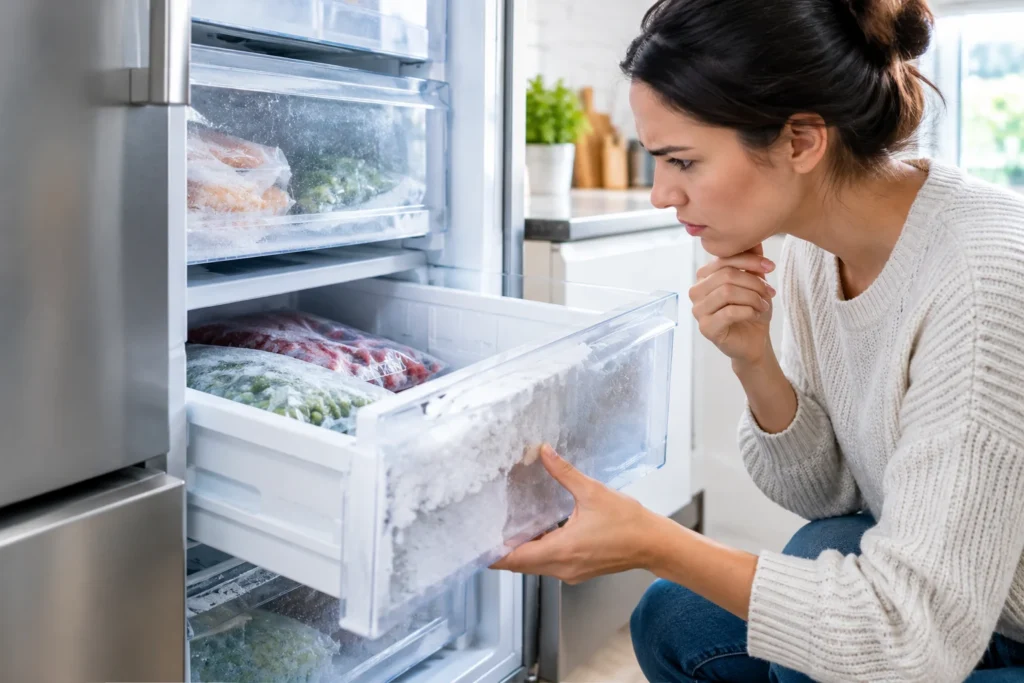
Food freezes in the fridge drawers before anywhere else because cold air sinks and pools at the bottom near the damper, so a stuck damper, a humidity slider set too low, or a blocked vent above the drawer is almost always the cause, not a fridge that’s failing completely. Check the humidity slider and the vent first before assuming you need a repair.
Key takeaways
- Fridge drawers freeze before the rest of the fridge because cold air sinks, and the damper — the flap that lets cold air in from the freezer — usually sits low, close to the drawers.
- The two fastest things to check first: the humidity slider on the drawer and whatever’s blocking the vent above it.
- A stuck damper causes freezing that’s isolated to the drawers, not the whole fridge — that distinction matters for diagnosis.
- Check causes in this order: humidity slider and vent first, then temperature setting, then damper, then sensor or door gasket, then control board last.
- A little frost after loading cold produce is normal; food freezing solid repeatedly across weeks is not.
- Safro Solutions’ own repair data shows most fixes run $120 to $400 or more depending on the part, with the diagnostic fee waived if you proceed.
- Safro Solutions repairs refrigerators same-day across Los Angeles and the San Fernando Valley — call (747) 250-6879.
Why do my fridge drawers freeze before the rest of the fridge?
Cold air is denser than warm air, so it naturally sinks and pools at the bottom of the fridge, exactly where the crisper drawers sit. The damper, a small flap that controls how much cold air moves from the freezer into the fridge compartment, is usually positioned low and close to the drawers, so it’s the first thing that cold air passes on its way in.
When the damper sticks open, or when the fridge is fairly empty and that cold air has nothing to mix with and warm slightly before it settles, the cold concentrates right where the drawers are before it ever reaches the middle shelves. That’s why you can have perfectly normal temperatures on the shelves above while the vegetables in the drawer below are frozen solid.
What’s causing food to freeze in my fridge drawers?
Where the freezing shows up and how it started both point toward a different likely cause. Use this table to match your situation before you start taking anything apart.
What you notice | Likely cause | How common |
| Only the drawers freeze, rest of the fridge is fine | Stuck or faulty damper, or humidity slider set too low | Very common |
| Vegetables freeze but the drawer feels sealed shut | Overpacked drawer or shelf above blocking the vent | Very common |
| Freezing started suddenly after months of normal use | Temperature sensor (thermistor) misreading the compartment | Common |
| Everything in the fridge is cold, not just the drawers | Door gasket leak, dirty condenser coils, or a failing evaporator fan | Less common |
| Freezing plus a very old fridge, ice buildup elsewhere | Aging unit, multiple components wearing out together | Rare |
Safro’s own technicians confirm the damper, dirty condenser coils, and a failing evaporator fan as the most common causes behind food spoiling or freezing on refrigerator service calls, alongside the thermistor (temperature sensor) when a unit that ran fine for months suddenly starts overcooling.
Which cause should I check first?
Check these in the order they’re actually likely to be the problem, not in the order you’d think to look:
- Humidity slider and vent first. These take thirty seconds to check and are the most common culprits — slide the humidity control toward “high” or “more airflow,” and make sure nothing on the shelf above is blocking the vent that feeds the drawer.
- Temperature setting second. Confirm the fridge itself isn’t set colder than the recommended range; a dial nudged too low affects the drawers first since that’s where cold air already concentrates.
- Damper third. If the humidity slider and temperature both check out but only the drawers are affected, the damper is the next place to look.
- Sensor or door gasket fourth. A freezing pattern that started suddenly points to the temperature sensor; a leaky door seal usually shows up as freezing plus condensation elsewhere too.
- Control board or aging unit last. Only suspect this if everything above checks out clean — it’s the rarest cause and usually means calling a technician rather than continuing to troubleshoot.
Is a little frost in the crisper drawer normal, or a real problem?
A little frost on the back wall of a drawer during colder months, or right after loading in a lot of cold produce from the store, is often temporary and clears on its own within a day as the fridge cycles. Food actually freezing solid, and doing it repeatedly across multiple weeks, is not normal and points to one of the causes above rather than something to just wait out.
How much does it cost to fix a fridge that’s freezing food?
Safro Solutions’ refrigerator repair technicians in Los Angeles typically see repairs for this issue run $120 for minor parts up to $400 or more for major work, with the diagnostic fee waived if you move forward with the repair and a flat-rate quote given before any work starts. Where your repair falls in that range depends entirely on which part failed: a damper fix or a condenser coil cleaning sits at the low end, while a control board or evaporator fan replacement sits at the high end. A technician confirms the exact number at the diagnostic visit rather than quoting blind over the phone.
The bottom line
Fridge drawers freeze before the rest of the fridge because cold air sinks toward the damper, which usually sits low and close to where the drawers are. Checking the humidity slider and the vent above the drawer first solves most cases before you need to assume a bigger part has failed.
If you’re in Los Angeles or the San Fernando Valley — Valley Village, Sherman Oaks, Studio City, Encino, Burbank, Van Nuys, or nearby — and want the exact cause confirmed rather than guessed at, Safro Solutions can get a technician out same-day.
Related reading: If your refrigerator isn’t cooling enough instead of overcooling, that’s a different problem — see How to tell if your refrigerator compressor is failing for that diagnosis.
When should you call a professional?
If the humidity slider and vent check out clean but the drawers keep freezing, or if the freezing has spread from just the drawers to the whole fridge, that’s a repair call rather than something to keep working around.
Get your refrigerator diagnosed today
Food freezing in the drawers doesn’t mean your fridge is dying. Safro Solutions’ refrigerator repair technicians in Los Angeles can confirm exactly which part is causing it — damper, sensor, or humidity slider — and fix it same-day across Los Angeles and the San Fernando Valley, with a 90-day warranty on the part and labor.
Call (747) 250-6879 now or schedule your refrigerator repair online — mention this article and your technician will bring the right diagnostic tools for your brand.
Safro Solutions
5331 Corteen Pl, Valley Village, CA 91607
Call: (747) 250-6879
Find us on Google Maps: https://share.google/x0w7LKq8nk9yGxPvk
Frequently asked questions
Q1: Why is my fridge freezing up at the back instead of just the drawers?
Freezing at the back wall usually points to a different cause than drawer-specific freezing — it’s often a blocked rear vent or a spot where the evaporator coil sits closest to the wall, rather than the damper issue that typically affects the drawers specifically.
Q2: Can a bad temperature sensor cause a fridge to freeze food?
Yes. The temperature sensor, or thermistor, gauges the interior temperature and tells the cooling system when to stop running. When it misreads the compartment as too warm, the fridge keeps cooling well past where it should stop, which shows up as sudden freezing after months of normal operation.
Q3: Could frost in the freezer cause freezing in the fridge below it?
It can contribute to it. If the freezer’s defrost system isn’t cycling properly, excess frost buildup can affect how the damper and airflow between the two compartments behave, indirectly making the fridge side run colder than it should.
Q4: Is it safe to eat food that froze in the fridge?
Generally yes, according to the USDA Food Safety and Inspection Service, which confirms that “frozen foods remain safe indefinitely” and food stored at proper freezer temperatures “will always be safe,” though texture and quality may suffer over time. The bigger concern is repeated freeze-thaw cycles on the same item, not a one-time freeze.
Q5: Why is my milk freezing but nothing else in the fridge?
Milk and other liquids in thin containers freeze faster than solid foods at the same temperature, so a milk carton freezing while everything else looks fine can be an early warning sign of drawer- or shelf-specific overcooling before it becomes obvious elsewhere.
Q6: Why does my fridge freeze everything even on the warmest setting?
If food is freezing on the warmest setting, the problem isn’t the dial — it’s a stuck damper, a failed temperature sensor, or a control board issue overriding the setting entirely. This is one of the clearer signs that a repair, not an adjustment, is what’s needed.