

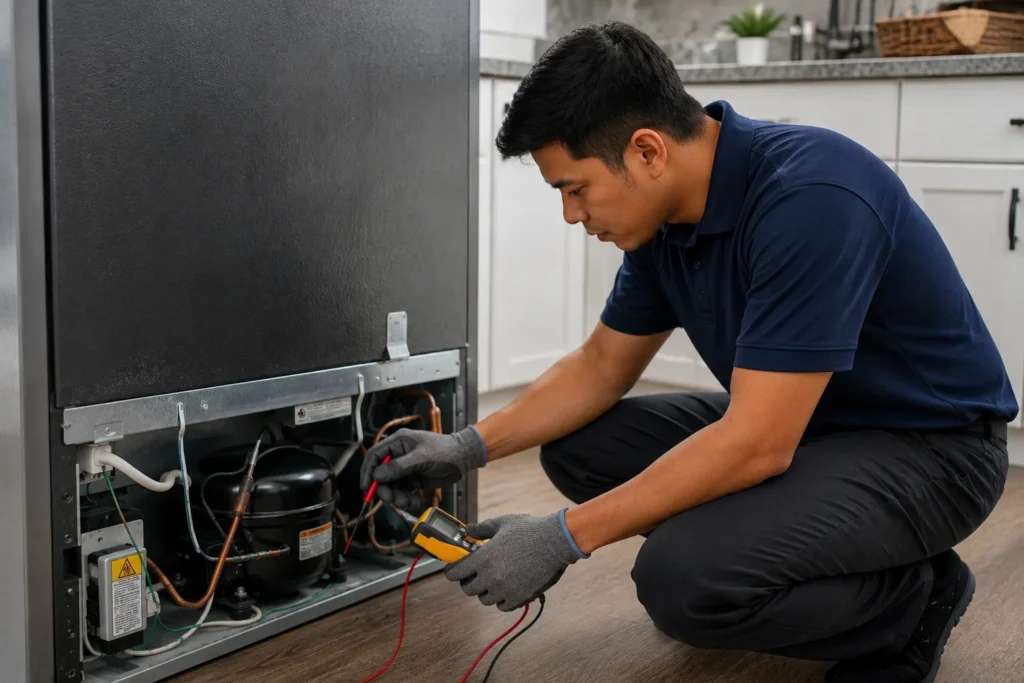
A failing refrigerator compressor almost always announces itself one of three ways: it clicks repeatedly without ever starting, it runs nonstop without the fridge actually getting cold, or it runs hot and shuts itself off. You can confirm which is happening with a multimeter test across the compressor’s three terminals in about five minutes, or with a simple shake-and-listen test if you don’t own one.
Last updated: September 21, 2026 · Written by the licensed technician team at Safro Solutions (CA Contractor License #A 50901), Valley Village, CA.
Key takeaways
- A failing compressor shows up as one of three patterns: repeated clicking without starting, constant running without cooling, or a compressor that’s hot to the touch and shuts off on its own.
- A multimeter test across the compressor’s three terminals (Start, Common, Run) confirms a bad compressor in about five minutes.
- No multimeter? A listen test and a shake test give a strong read without tools, though they can’t tell a bad compressor apart from a bad start relay as precisely.
- The start relay, overload protector, and run capacitor sit right next to the compressor electrically and cause nearly identical symptoms — they’re also far cheaper to replace.
- Compressor replacement is a major repair, and it’s usually worth it if the refrigerator is under 8 years old and the cost stays under half the fridge’s value.
- Replacing a compressor means recovering and recharging refrigerant, which requires EPA Section 608 certification, so it is a job for a licensed technician.
- Dirty condenser coils are the most common reason a compressor fails years before its typical 14-year lifespan — cleaning them every six months prevents the overheating that causes it.
- Safro Solutions offers same-day compressor diagnosis across the Los Angeles / San Fernando Valley area at (747) 250-6879.
Jump to a section
- Why does “the compressor” get blamed for problems it didn’t cause?
- What are the real signs your refrigerator compressor is failing?
- How do you test a refrigerator compressor with a multimeter?
- How do you test a compressor without a multimeter?
- What parts are often mistaken for a bad compressor?
- Is it worth repairing or replacing a refrigerator compressor?
- Can you replace a refrigerator compressor yourself?
- How do you avoid a repeat compressor failure?
- When should you call a professional?
- Frequently asked questions
Why does “the compressor” get blamed for problems it didn’t cause?
The compressor is the loudest, most expensive-sounding part of a refrigerator, so it’s the first thing people suspect when something goes wrong. But the compressor shares its electrical circuit with three smaller, much cheaper parts — the start relay, the overload protector, and the run capacitor — and any one of them can produce symptoms that look exactly like a dead compressor from the outside. A clicking noise every few minutes, for instance, is more often a failing start relay trying and failing to kick the compressor on than the compressor itself.
This distinction matters because the fix is night-and-day different. A compressor is the single most expensive component in the refrigerator to replace. Before you assume the worst, it’s worth ruling out the cheaper explanations first — which is exactly what the tests in this guide are for.
If your fridge is running but the freezer and fridge just aren’t holding temperature the way they used to, the more likely culprits are covered in our guide to the 7 most common causes of a refrigerator not cooling — dirty coils, a bad door seal, and a stuck air damper account for a lot of “not cooling” calls that have nothing to do with the compressor at all.
What are the real signs your refrigerator compressor is failing?
Four patterns point specifically at the compressor rather than a supporting part.
It clicks or hums, but never actually starts
You hear a click, a pause, another click, on a loop — but the compressor never catches and starts running. This can be the compressor’s windings failing internally, though as noted above it’s just as often the start relay refusing to hand off power. The multimeter test below is what tells them apart.
It runs constantly and the fridge still isn’t cold
A healthy compressor cycles on and off in response to the thermostat. A compressor that’s lost its ability to build pressure will run non-stop, working hard, and never bring the interior down to temperature, because it mechanically can’t anymore.
It’s hot to the touch and shuts off on its own
Compressors run warm normally, but a compressor that’s noticeably hot, sometimes hot enough that you can smell a faint burning odor, and that shuts off repeatedly on thermal overload, is failing internally. This is different from a fridge where the interior light works but nothing runs at all — that’s a distinct symptom with its own set of causes, which we break down separately in our fridge-not-cooling-but-light-is-on guide.
It’s unusually loud — a new buzz, rattle, or grinding sound
A compressor makes a steady, low hum when healthy. A new buzzing, rattling, or grinding sound, especially one that gets louder over days or weeks, usually means internal wear or a mounting issue and is worth testing before it fails completely.
How do you test a refrigerator compressor with a multimeter?
This is the test a repair technician actually runs, and it takes about five minutes. You’ll need a multimeter set to the ohms (resistance) setting.
- Unplug the refrigerator. Always disconnect power before touching any electrical component.
- Find the compressor at the back-bottom of the fridge and remove the plastic terminal cover protecting its three prongs.
- Pull the start relay and overload protector off the three terminals so the meter reads only the compressor windings. Note where each wire sits before you remove it, or take a photo.
- Identify the three terminals — Start (S), Common (C), and Run (R). They’re usually arranged in a triangle and may be labeled on the compressor housing or in your model’s wiring diagram.
- Test resistance between each pair of terminals: Start-to-Common, Run-to-Common, and Start-to-Run. You should get three different but related readings, where the Start-to-Run reading is roughly the sum of the other two.
- Read the result using the table below.
Reading | What it means | What to do next |
| A reading on all three pairs, with Start-to-Run equal to Start-to-Common plus Run-to-Common | The windings are intact — the compressor itself is likely fine | Check the start relay, overload protector, or run capacitor next |
| “OL” (open line/infinite resistance) on any pair | That winding is broken internally — a failed compressor | Move to the repair-vs-replace decision |
| Continuity between any terminal and the bare metal compressor housing | A short to ground — a clear sign of internal failure | Compressor needs replacement regardless of other readings |
If you get an OL reading or a short to ground, stop there — you’ve confirmed the compressor is bad, and the next step is a repair-vs-replace decision rather than more testing.
How do you test a compressor without a multimeter?
Most homeowners don’t own a multimeter, and you don’t strictly need one to get a strong read on what’s happening.
The listen test
To tell if a fridge compressor is running, listen at the back-bottom of the fridge. You should hear a steady hum, and the compressor housing should feel warm, not cold. Clicking that repeats, a buzz that cuts out after a few seconds, or silence with the light on means it is not running properly.
With the fridge plugged in, put your ear near the compressor compartment at the back-bottom of the unit. A healthy compressor produces a steady, even hum. A repeating click-pause-click pattern that never resolves into a running hum points to a start failure, either the compressor’s windings or, more likely, the start relay. A loud buzz that continues without ever smoothing into a hum, or a sound that cuts off abruptly after a few seconds every time, both suggest the compressor is trying to start and failing on overload, consistent with internal winding damage.
The shake test
Unplug the fridge, and gently rock or nudge it (carefully, without forcing anything). Some technicians listen for a loose rattle from inside the compressor shell, which can indicate a broken internal mounting or damaged components, versus a fridge that stays solid and quiet. This test is far less precise than the multimeter test and shouldn’t be used on its own to make a repair decision — treat it as a supporting clue, not a diagnosis.
Neither of these no-tool checks tells you definitively whether it’s the compressor or the start relay behind it. For that distinction, the multimeter test above, or a Safro Solutions technician’s visit, is what actually settles it.
What parts are often mistaken for a bad compressor?
Three parts sit right next to the compressor electrically and fail far more often than the compressor itself does.
Part | What it does | Symptom when it fails |
| Start relay | Sends the initial jolt of power to start the compressor | Clicking that never resolves into running |
| Overload protector | Cuts power if the compressor draws too much current or overheats | Compressor runs briefly, shuts off, repeats |
Run capacitor | Helps the compressor maintain a steady run once started | Compressor starts, then struggles or stalls under load |
If your multimeter test on the compressor itself comes back normal — real resistance readings, no OL, no short to ground — one of these three is almost certainly the actual problem, and all three are inexpensive to diagnose and replace compared to the compressor.
It’s also worth ruling out the thermostat and sealed system more broadly if your fridge is cooling inconsistently rather than not at all. We cover how to tell those apart in our guide on refrigerator not maintaining temperature — thermostat or sealed system issue.
Is it worth repairing or replacing a refrigerator compressor?
If the compressor tests bad, the next question is whether it’s worth fixing. A full compressor replacement is the most expensive fridge repair, and the total depends on the refrigerator’s make, model, and your region (Liberty Home Guard, refrigerator compressor replacement guide).
That same source suggests a useful rule of thumb: repair generally makes sense if the cost stays under about half the refrigerator’s current value, and the unit is less than roughly 8 years old. A high-end refrigerator with a compressor still under manufacturer’s parts warranty is almost always worth repairing. A basic refrigerator already at 10+ years old, with a compressor replacement quoted near the top of that range, is often a case where replacement is the more economical call — a comparison we also cover, from the cost side, in 7 most common causes of a refrigerator not cooling.
For an accurate number on your specific refrigerator, the technician can confirm the compressor diagnosis and give you an exact parts-and-labor quote for your model on the spot rather than a generic range.
Can you replace a refrigerator compressor yourself?
Practically, no. It is a job for a certified technician. Replacing a compressor means opening the sealed refrigerant system, which requires recovering and recharging refrigerant. Under EPA regulations, “technicians who maintain, service, repair, or dispose of equipment that could release ozone depleting refrigerants into the atmosphere must be certified” under Section 608 of the Clean Air Act (U.S. EPA, Section 608 Technician Certification). That certification requirement exists specifically to prevent refrigerant from being vented into the atmosphere during exactly this kind of repair — it’s a federal requirement tied to the tools and refrigerant a compressor swap requires, not optional paperwork.
Beyond the legal requirement, compressor replacement involves brazing copper refrigerant lines, evacuating the system to remove moisture and air, and precisely recharging it with the correct refrigerant charge. Get any of those wrong and you risk a repeat failure within months, or a refrigerant leak you can’t easily detect. This is one of the few appliance repairs where calling a licensed technician isn’t just the easier option, it’s the only safe and legal one.
How do you avoid a repeat compressor failure?
A compressor that fails once from normal wear is one thing. A compressor that keeps failing, or that dies well before the refrigerator’s expected life, usually points to something forcing it to overwork. Refrigerator replacement cycles have stayed close to 14 years on average even as the appliances themselves have gotten more efficient, according to research from the University of Michigan’s Center for Sustainable Systems (life-cycle refrigerator replacement research, css.umich.edu) — a compressor failing at year 3 or 4 is a red flag, not bad luck.
The single most common accelerant is dirty condenser coils. The U.S. Department of Energy notes that cleaning your condenser coils regularly “can help regulate your fridge temperature” (Department of Energy, cleaning the refrigerator for health and efficiency). Dirty coils force the compressor to run longer and hotter to hit the same target temperature, and sustained overheating is exactly what burns out a compressor’s windings prematurely.
- Vacuum the condenser coils behind or underneath your fridge every six months.
- Keep at least a couple of inches of clearance around the unit for airflow.
- Don’t push the fridge flush against the wall.
When should you call a professional?
Call a technician as soon as you get an OL or short-to-ground reading on the multimeter test, or if you’re hearing the clicking or overheating pattern and don’t own a multimeter to check further. Waiting rarely helps — a compressor limping along on a failing start relay or overload protector will eventually take a full stop, usually with a fridge full of food on the line.
If you’re anywhere in the Los Angeles / San Fernando Valley area — Valley Village, Sherman Oaks, Studio City, Encino, Beverly Hills, Tarzana, Woodland Hills, Burbank, Van Nuys, Northridge, or Pasadena — Safro Solutions offers same-day refrigerator repair with a technician who can confirm the compressor diagnosis on-site rather than guess from a phone description.
Get your refrigerator compressor diagnosed today
Guessing at a compressor problem risks a fridge full of spoiled food. A Safro Solutions technician can run the multimeter test on-site, confirm whether it’s the compressor or a cheaper part like the start relay, and give you an exact repair-or-replace quote — same day, in most cases.
Safro Solutions
Valley Village, Los Angeles, CA 91607
Call or text: (747) 250-6879
Find us on Google Maps: https://maps.app.goo.gl/Tdof4dD9BS5Tk1i2A
Serving Valley Village, Sherman Oaks, Studio City, Encino, Beverly Hills, Tarzana, Woodland Hills, Burbank, Van Nuys, Northridge, and Pasadena.
Call (747) 250-6879 now or schedule your refrigerator repair online — mention this article and your technician will come ready to test the compressor first.
Frequently asked questions
Q1: How do I test my refrigerator compressor?
Unplug the fridge, expose the compressor’s three terminals (Start, Common, Run), and use a multimeter set to ohms to test resistance between each pair. Real, consistent readings across all three mean the windings are intact; an “OL” reading on any pair means an open winding, and continuity between any terminal and the metal housing means a short to ground — both confirm a failed compressor.
Q2: Is it worth replacing a compressor on a refrigerator?
Usually yes if the refrigerator is less than about 8 years old, is a mid-range or premium model, and the replacement cost stays under roughly half the fridge’s current value. For an older, budget refrigerator already near the end of its typical 14-year lifespan, replacing the whole unit is often the more economical choice.
Q3: Can I replace a refrigerator compressor myself?
No. Compressor replacement requires opening the sealed refrigerant system, which under EPA Section 608 legally requires a certified technician to recover and recharge refrigerant. It also involves brazing and precise system evacuation — mistakes here can cause an immediate repeat failure or an undetected refrigerant leak.
Q4: What causes a refrigerator compressor to fail early, before its expected lifespan?
The most common accelerant is a compressor running constantly against a restriction — most often dirty condenser coils, but also blocked airflow around the unit. Forcing the compressor to work overtime for months causes it to overheat repeatedly, which burns out its internal windings well ahead of schedule.
Q5: How can I tell if it’s the compressor or just the start relay?
The multimeter test on the compressor terminals is the definitive way to tell. If the compressor’s own resistance readings are normal, the clicking or failure-to-start symptom is almost certainly the start relay, overload protector, or run capacitor — all inexpensive parts to replace compared to the compressor itself.
Q6: Is it normal for a refrigerator compressor to be hot?
A compressor running warm to the touch is normal. A compressor that’s hot enough to feel uncomfortable, especially paired with a faint burning smell or repeated shutoffs from thermal overload, is not — that combination points to internal failure rather than normal operation.
Q7: What are the symptoms of a failing refrigerator compressor?
The main symptoms of a failing refrigerator compressor are repeated clicking without starting, running nonstop while the fridge stays warm, and a compressor that is too hot to touch and shuts itself off. New buzzing or grinding is a fourth sign. A bad start relay can look identical, so test before you replace anything.
Q8: What happens when a fridge compressor fails?
When a fridge compressor fails, the fridge stops cooling, the freezer warms up and food starts to spoil within hours. The light and controls usually still work, because they run on a separate circuit. You may hear clicking, humming or nothing at all from the back of the fridge.
Q9: How can I tell if my fridge compressor is running?
Listen at the back-bottom of the fridge. A running compressor makes a steady, even hum and the area around it feels warm. If you hear only clicking, a buzz that stops after a few seconds, or silence with the light on, the compressor is not running properly.