

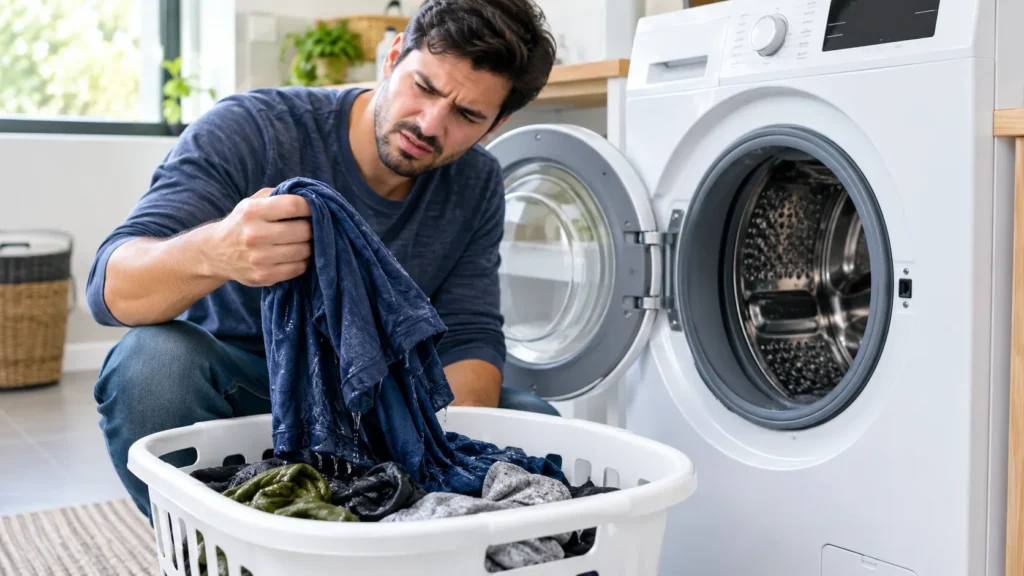
Clothes come out soaking wet after the wash cycle almost always because of a spin problem, not a drainage problem — the drum empties fine, but the spin cycle isn’t removing enough water from the load. Check for an unbalanced load and the correct spin setting first before assuming a part has failed.
Key takeaways
- Clothes coming out soaking wet after the wash cycle is almost always a spin problem, not a drainage problem — the drum is emptying fine, but the spin cycle isn’t removing enough water.
- Check for standing water in the drum first: if there’s none, drainage is working and the cause is spin-specific.
- The two fastest things to check: an unbalanced or overloaded load, and the correct spin setting.
- If those check out, a faulty lid switch or door lock is the next most common cause — the washer won’t spin at all if it thinks the lid is open.
- A worn or broken drive belt, or a failed motor coupler, is the next likely mechanical cause.
- Safro Solutions’ own repair data shows most washer fixes for this issue run $150 to $400, with the $69–$129 diagnostic fee waived if you move forward with the repair.
- Safro Solutions repairs washers same-day across Los Angeles and the San Fernando Valley — call (747) 250-6879.
Why are my clothes still soaking wet after the wash cycle?
A washing machine removes water from a load two separate ways: it drains the wash and rinse water out of the tub, then spins the drum at high speed to fling the remaining water out of the fabric itself. When clothes come out soaking wet, most people assume the machine failed to drain — but far more often, the tub is completely empty and it’s the spin step that didn’t reach full speed, or didn’t run at all.
That distinction matters because the fix is completely different depending on which one actually happened. A drainage failure means water is sitting in the tub and the pump or hose is blocked. A spin failure means the tub is empty, but the fabric itself never got wrung out — usually because of a load imbalance, a setting, or a worn mechanical part.
This is a genuinely common complaint, and it’s easy to misdiagnose from the symptom alone since “soaking wet clothes” describes both situations. The rest of this guide walks through how to tell the two apart in seconds, then ranks the actual spin-specific causes by how likely each one is.
Is this a drainage problem or a spin problem?
Here’s the fastest way to tell: open the lid right after the cycle ends and look at the tub.
Standing water in the tub means drainage is the problem — the pump or hose isn’t clearing water out, and spin never got the chance to run properly because most washers won’t spin until the tub is empty. An empty tub with clothes that are still dripping or soaked means drainage worked fine, and the spin step itself is what’s failing. That second case is what the rest of this article covers.
If your washer matches the drainage pattern instead, you’re better served by one of these more specific guides:
- If there’s standing water and the machine seems to run but never clears it: see Washer Full of Water and Won’t Drain: What to Do Right Now
- If drainage is only partial or intermittent — some water left, but the tub isn’t full: see Washer Not Draining Completely? Partial Drain vs No Drain Explained
- If the drum isn’t moving or mixing at all during the wash portion of the cycle, separate from spin: see Washer Not Agitating? Causes & Easy Fixes
If your tub is empty and your clothes are still soaked, keep reading — that’s a spin-extraction issue, and it has its own short list of causes.
What’s actually causing my washer to leave clothes soaking wet?
The table below matches what you’re noticing to the most likely cause, ranked by how often Safro’s technicians actually see each one on service calls for this exact complaint.
| What you notice | Likely cause | How common |
| Load is bunched to one side, machine stops or slows during spin | Unbalanced or overloaded load | Very common |
| Spin setting accidentally set to low, delicate, or no-spin | Wrong cycle or spin setting selected | Very common |
| Lid or door doesn’t latch fully, or spin starts then stops | Faulty lid switch or door lock | Common |
| Washer hums or strains during spin but the drum doesn’t turn fast | Worn or broken drive belt | Common |
| Washer drains fine, spin barely starts or grinds | Failed motor coupler | Common |
| Washer rocks or walks during spin | Washer not level on the floor | Less common |
Whirlpool’s own laundry troubleshooting guidance backs up several of these from the manufacturer side. On the load-and-setting causes, Whirlpool notes that “if you accidentally select a Delicate Cycle for a heavy load, the low spin speed may not remove excess water,” and that when a washer “is set to a low spin speed, it may remove less water than cycles with high spin speeds.” On the leveling cause specifically, Whirlpool states that “if your washer isn’t level, it may struggle to spin properly, which can lead to extra water in the drum.”
Which cause should I check first?
Check these in the order they’re actually most likely to be the problem — this saves you from assuming a part has failed when the fix might take ten seconds.
- Rebalance the load first. Redistribute bunched clothes evenly around the drum and restart the spin. This alone resolves a large share of cases immediately, since a lopsided load is enough to trigger most washers’ safety systems to slow or stop the spin.
- Check the spin or cycle setting second. Confirm it wasn’t accidentally left on delicate, hand-wash, or a low-spin setting — Whirlpool’s own guidance points to this as one of the most common causes, and it takes seconds to check against your washer’s owner’s manual.
- Lid switch or door lock third. If the lid doesn’t latch solidly, or a top-load lid switch has failed, most washers won’t spin at all as a built-in safety measure — even if the rest of the cycle ran normally.
- Drive belt fourth. A humming or straining sound during spin, paired with little or no drum movement, points to a worn or broken belt rather than a setting issue.
- Motor coupler or control board last. This is the rarest cause on this list, and the one that needs a technician rather than continued troubleshooting — especially if the washer drains normally but spin barely starts or grinds.
If your washer isn’t level on the floor, that can compound any of the above — an unlevel machine makes an already-marginal load imbalance worse, so it’s worth checking with a level across the top of the washer front-to-back and side-to-side if the problem is intermittent.
How much does it cost to fix a washer that’s leaving clothes soaking wet?
Safro Solutions’ washer repair technicians in Los Angeles typically see repairs for this issue run $150 to $400 depending on the part involved, with the $69–$129 diagnostic fee waived if you move forward with the repair, plus a 90-day warranty on parts and labor. A lid switch replacement or a drive belt swap sits toward the lower end of that range; a motor coupler or control board replacement sits toward the higher end. A technician confirms the exact number at the diagnostic visit rather than quoting blind over the phone, and if the first repair doesn’t resolve it, Safro returns at no charge.
When should you call a professional washer repair technician?
If rebalancing the load and checking the spin setting don’t fix it, or if the washer hums or strains during spin without the drum reaching full speed, that’s a component failure rather than something to keep working around. Continuing to run cycles on a washer with a failing belt or motor coupler risks turning a moderate repair into a bigger one, since the drive system keeps absorbing strain every time it’s forced to try. At that point, a technician can confirm the exact cause with the right diagnostic tools rather than replacing parts by guesswork.
The bottom line
Clothes coming out soaking wet after the wash cycle is almost always a spin problem once drainage has been ruled out — the tub empties fine, but the spin step isn’t removing enough water from the load. Rebalancing the load and checking the spin setting resolves most cases immediately; if those don’t fix it, a lid switch, drive belt, or motor coupler is the next most likely cause, in that order.
If you’re in Los Angeles or the San Fernando Valley — Valley Village, Sherman Oaks, Studio City, Encino, Burbank, Van Nuys, or nearby — and want the exact cause confirmed rather than guessed at, Safro Solutions can get a technician out same-day.
Get your washer fixed today
Clothes coming out soaking wet after every wash usually means a simple fix — not a dying washer. Safro Solutions’ same-day washer repair service in Los Angeles can confirm exactly which part is causing it — load balance, spin setting, lid switch, drive belt, or motor coupler — and fix it same-day across Los Angeles and the San Fernando Valley, with a 90-day warranty on parts and labor.
Call (747) 250-6879 now or schedule your washer repair online — mention this article and your technician will bring the right diagnostic tools for your brand.
Safro Solutions
5331 Corteen Pl, Valley Village, CA 91607
Call: (747) 250-6879
Find us on Google Maps: https://share.google/x0w7LKq8nk9yGxPvk
Frequently asked questions
Q1: Can an unbalanced washer be fixed without calling a technician?
Yes, in almost every case. Open the lid, redistribute the load evenly around the drum, close it, and restart the spin cycle. If the washer keeps stopping on the same load no matter how it’s arranged, that points to a mechanical cause further down this list rather than a one-time imbalance.
Q2: Does it matter if I have a top-load or front-load washer?
The core causes are the same for both, but the details differ slightly. Top-load washers rely on a lid switch that’s more prone to wear over time, while front-load washers depend more heavily on a properly sealed door lock and tend to be more sensitive to being unlevel.
Q3: Why did this start suddenly after months of my washer working fine?
Sudden onset after normal use points toward a part that’s worn out gradually and just crossed a failure threshold — most often a drive belt or a lid switch. A setting change, by contrast, usually happens the moment someone (including a young family member) touches the controls, so if nothing changed on the dial, suspect the mechanical causes first.
Q4: Is it safe to run the spin cycle a second time on already-wet clothes?
Yes. Running an extra spin-only cycle is a normal troubleshooting step and won’t damage the washer or the clothes. If the second spin also fails to remove the water, that’s a stronger sign of a mechanical cause rather than a one-time fluke.
Q5: Can too much detergent affect the spin cycle?
Yes — excess detergent or the wrong type for your machine can create excess suds, which some washers detect as a fault and respond to by cutting the spin cycle short to protect the machine. Using the amount recommended on the detergent packaging, and an HE-specific detergent in a high-efficiency machine, avoids this.
Q6: Can I fix a broken drive belt or lid switch myself?
Both are technically DIY-accessible on many washer models, but they involve partially disassembling the cabinet and working near a motor and pulley system. Most homeowners without appliance repair experience are better off having a technician handle these two specifically, since a misaligned belt replacement can cause a bigger problem than the one it was meant to fix.