

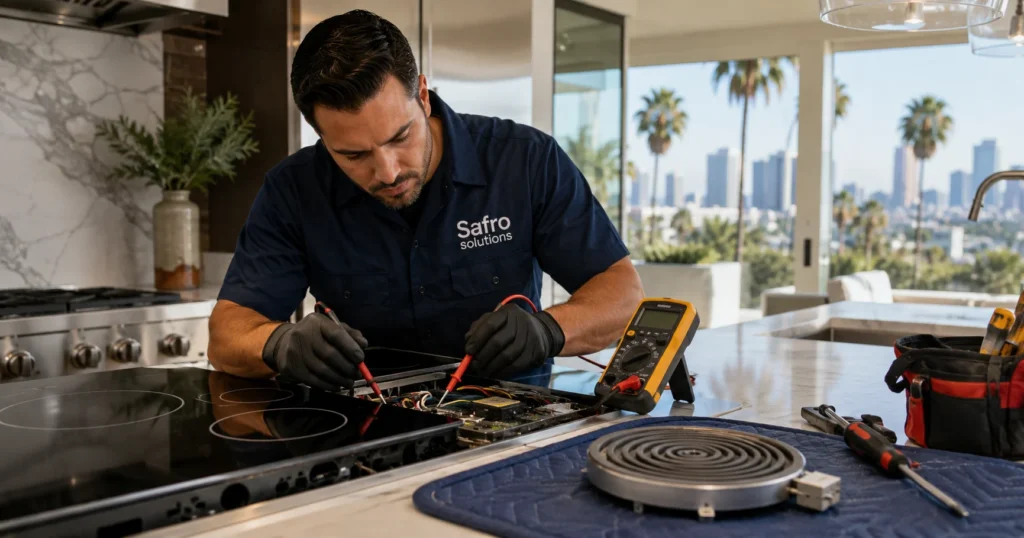
By the Safro Solutions Repair Team, Licensed Appliance Technicians (CA LIC# A 50901)
A cooktop not heating is usually caused by one of six things: no power reaching the unit, a burned-out heating element, a failing infinite switch, a damaged burner socket, a faulty surface element board, or an induction-specific fault like incompatible cookware or an active control lock. If every burner is dead, suspect power. If one burner is dead, suspect the element or switch. Here is how to tell the difference — and when to call a licensed Los Angeles technician.
Start Here — Is It One Burner or the Whole Cooktop?
Before you replace anything, narrow the problem down. This single step tells you where to look and saves most Los Angeles homeowners an unnecessary service call.
If all burners are not heating, the problem is almost always power related — a tripped breaker, a loose 240-volt connection, or an active control lock. The cooktop itself is rarely “dead.”
If one burner is not heating while the others work fine, the fault is local to that burner: a burned-out element, a worn infinite switch, or a damaged socket. So the answer to “why is my cooktop not heating” depends entirely on whether the failure is global or isolated. Keep that one-versus-all distinction in mind as you work through the six causes below.
Cause 1 — No Power Reaching the Cooktop
Electric and induction cooktops in Los Angeles run on a dedicated 240-volt circuit, typically 40 to 50 amps. A power surge or overload can trip that breaker and shut the whole unit down.
What you’ll notice
The display is blank, no burners respond, and knobs do nothing across the entire surface.
Try this yourself
Check your home’s electrical panel for a tripped double-pole breaker. Flip it fully to OFF, wait 30 seconds, then back ON to force a hard reset. Confirm the power cord is seated snugly in its receptacle. For gas models with electronic ignition, make sure the unit is still plugged into its 120-volt outlet.
When to call an LA technician
If the breaker trips again immediately, or you see scorching at the outlet, stop. Repeated tripping points to a wiring fault that needs a licensed technician — not another reset.
Cause 2 — A Burned-Out Heating Element or Coil
This is the number-one reason a single burner quits. Over years of heating and cooling, the element fatigues until the metal finally breaks the circuit. A cooktop heating element burned out is one of the most common repairs we complete same-day across Los Angeles.
What you’ll notice
One burner stays cold while the rest heat normally. On a coil top, you may see blistering, pitting, or a visible break in the coil.
Try this yourself (swap-burner test)
On a coil-top stove, turn off the power, pull the cold burner, and plug it into a working same-size receptacle. If it now heats, the element is dead and needs replacing. If it still won’t heat, the problem is the socket or switch instead. This swap test is the exact method GE Appliances recommends in its surface-burner troubleshooting guide.
When to call an LA technician
Smooth glass-top elements sit sealed under the glass and require a multimeter and disassembly to test and replace. That is a job for a pro.
Cause 3 — A Failing Infinite (Surface) Switch
The infinite switch is the component behind the knob that cycles power to the burner so you can set heat anywhere from low to high. When an infinite switch is not working, the cooktop loses proper temperature control.
What you’ll notice
The burner barely warms up, or it stays locked on high no matter where you set the knob, or it cycles on and off erratically.
Try this yourself
Confirm the element and socket are good first (use the swap test from Cause 2). If those check out but the heat still won’t regulate, the infinite switch is the likely culprit.
When to call an LA technician
Infinite switches carry multiple live wires and are easy to misconnect. Replacement should be left to a licensed technician for safety.
Cause 4 — A Damaged Burner Socket or Receptacle
The socket is the small metal connector under a coil burner that feeds power to the element. Heavy pots rocking on the burner can loosen it, and arcing slowly burns the contacts.
What you’ll notice
The burner heats intermittently, flickers, or only works when you wiggle the coil.
Try this yourself
With the power off, lift the burner and inspect the socket for black scorch marks or melted contacts. Charred contacts mean the socket can no longer carry current safely.
When to call an LA technician
A burnt socket is a fire risk and must be replaced, not cleaned and reused. Have a technician install a new one.
Cause 5 — A Faulty Surface Element Board (Glass & Ceramic Tops)
On smooth glass and ceramic cooktops, a surface element board (the relay board) controls how much power each zone receives. When it fails, one or more zones stop responding — a frequent reason for a glass top stove not heating.
What you’ll notice
One or several zones go dead at once, or the touch controls light up but no heat follows.
Try this yourself
Check the obvious first: confirm the surface is clean and dry, and look for visible cracks in the glass. A cracked glass top is a safety hazard and should not be used.
When to call an LA technician
Diagnosing a relay board means opening the sealed underside of the cooktop and testing voltage. Leave this to a licensed Los Angeles technician with the right meter and parts.
Cause 6 — Induction-Specific Problems
An induction cooktop not heating is usually not broken at all. Induction heats the pan directly through a magnetic field, so a few specific conditions can stop it cold.
The cookware (magnet) test
Stick a refrigerator magnet to the bottom of your pan. If it clings firmly, the pan is induction-compatible. If it slides off, the cookware is the problem — aluminum, copper, and most glass will never heat on induction. Most zones also need a pan at least 4 to 5 inches wide to register.
Control lock / child lock
Every induction cooktop ships with a control lock that disables the surface, and it is easily switched on by accident while wiping the panel. Press and hold the lock or key button for 3 to 5 seconds to release it. This is one of the single most common “my induction cooktop is dead” calls in Los Angeles.
Common error codes (E3 / U / F / E0)
A flashing U or F is a pan-detection error — center magnetic cookware on the zone. An E3 usually signals overheating from blocked cooling vents; clear any dust or obstruction and let the unit cool for 10 to 30 minutes. A persistent E0 often points to a voltage or sensor fault that needs professional diagnosis.
Quick Fixes by Cooktop Type
Different cooktops fail in different ways. Here are the fastest checks by type.
Gas — igniter clicks but no flame
A gas cooktop won’t light but clicks when the igniter is wet or coated in food debris. Let the cooktop cool, lift the burner cap, and gently clean the ceramic igniter with a dry toothbrush. Re-seat the cap so its tabs align perfectly.
Electric coil — reseat the burner
A loose coil is the simplest fix of all. Power off, pull the coil, and firmly reseat it into the socket — a wobbly connection alone can stop a burner from heating.
Smooth glass / ceramic top
Wipe the surface fully dry, then check for cracks. Residue or moisture on the glass can interrupt the touch controls.
Induction
Run the magnet test, release the control lock, and clear the cooling vents. These three checks resolve the large majority of induction no-heat complaints.
Brand-Specific Notes — Samsung, LG, Whirlpool, GE & KitchenAid
Brand | Common no-heat cause | Quick check |
| Samsung | Voltage-sensitive induction (E-1/E-2 codes) | Verify a dedicated 240V circuit; watch for breaker tripping |
| LG | Control lock engaged or element failure | Hold the lock button 3 sec; test the element |
| Whirlpool | Pan-detection “U” code on induction | Center magnetic cookware on the zone |
| GE | Coil element or power-cord wiring | Run the swap-burner test |
| KitchenAid | Surface element board on smooth tops | Professional board diagnosis needed |
Whatever the brand, the underlying cause still traces back to one of the six issues above.
Safe to DIY vs. When to Call a Licensed Technician
It is safe to reset a breaker, swap a coil burner, clean an igniter, run the magnet test, and release a control lock. These involve no live wiring and no gas.
Call a licensed technician immediately if you smell gas (shut the gas off first), if the glass top is cracked, if you see sparks or smell ozone from under the surface, or if the breaker keeps tripping. Gas and 240-volt repairs carry real fire and shock risk — California requires gas appliance work to be handled by a qualified, licensed professional, which is exactly what every Safro Solutions technician is.
Cooktop Repair Cost in Los Angeles
Knowing the typical numbers helps you decide quickly. A cooktop heating element replacement cost is one of the most common price questions we get from Los Angeles homeowners.
Typical part & repair prices
Most cooktop repairs in Los Angeles run between $80 and $400. Replacing an electric heating element generally costs $110 to $250 including labor. Glass-top repairs usually land between $100 and $350, while induction control-board work sits at the higher end. Safro Solutions charges a $69–$129 diagnostic service call that is waived when you approve the repair.
Repair vs. replace — which makes sense?
A widely used industry guideline is the 50% rule: repair when the cost is under half the price of a new unit, and replace when it exceeds it.
Cooktop age | Repair if | Replace if |
| Under 5 years | A single element, switch, or igniter failed | The glass is badly cracked or the main board died |
| 5–10 years | Repair cost is under ~$250 and the surface is good | Multiple parts failed or the board is discontinued |
| Over 10 years | It’s a minor, low-cost fix | Repair exceeds 50% of a new unit’s price |
Most cooktops last 15 to 20 years, so a unit under 10 with a single failed part is almost always worth repairing.
Why Los Angeles Homeowners Trust Safro Solutions
Safro Solutions is a licensed and insured, family-owned appliance repair company serving greater Los Angeles and the San Fernando Valley, with same-day service available when you call before noon. Every technician we send is licensed, background-checked, and trained to repair gas, electric, and induction cooktops — no subcontractors, no call centers. We back every job with upfront flat-rate pricing and a 60-day warranty on parts and labor.
Safro Solutions
Valley Village, Los Angeles, CA 91607
Call or text: (747) 250-6879
Find us on Google Maps: https://maps.app.goo.gl/Tdof4dD9BS5Tk1i2A
We cover Valley Village, Sherman Oaks, Studio City, Encino, Burbank, Van Nuys, and beyond — including Beverly Hills appliance repair and our home base in Valley Village. Need a related fix? Our stove and range repair team in Los Angeles and our oven repair specialists handle those too. Ready now? Schedule your same-day cooktop repair.
Frequently Asked Questions
Q1: Why is my cooktop not heating but the light or display is on?
Power is reaching the controls but not the element. On electric and glass tops this usually means a burned-out element, a failed infinite switch, or a faulty surface element board. On induction it often means the control lock is on or the cookware isn’t magnetic. Test one burner against another to isolate the fault.
Q2: Why is only one burner on my cooktop not heating?
A single dead burner points to a local fault — most often a burned-out element, a worn infinite switch, or a charred socket. Swap the burner with a working one of the same size: if it heats in the new spot, the element is bad; if it doesn’t, the socket or switch is the issue.
Q3: How do I know if my cooktop’s heating element is bad?
Look for visible blistering, pitting, or a break in a coil element. For a reliable test, swap the suspect burner into a working receptacle — if it stays cold, the element has failed. Sealed glass-top elements need a multimeter continuity test by a technician.
Q4: Why won’t my induction cooktop heat my pan?
Induction only heats magnetic cookware. Hold a magnet to the pan’s base — if it doesn’t stick firmly, the pan won’t work on induction. Also make sure the pan covers most of the zone, since pans that are too small won’t be detected.
Q5: How do I turn off the control lock on an induction cooktop?
Find the lock or key icon on the control panel and press and hold it for about 3 to 5 seconds until the lock indicator clears. An accidentally engaged control lock is one of the most common reasons an induction cooktop appears completely dead.
Q6: Can I replace a cooktop heating element myself?
On older coil-top stoves with plug-in burners, yes — many homeowners can swap a coil safely with the power off. Sealed glass-top elements, infinite switches, sockets, and any gas or 240-volt wiring should be left to a licensed technician for safety.
Q7: How much does cooktop repair cost in Los Angeles?
Most cooktop repairs in Los Angeles cost between $80 and $400. A heating-element replacement typically runs $110 to $250, and glass-top repairs $100 to $350. Safro Solutions provides a written estimate before any work begins, and the diagnostic fee is waived when you approve the repair.
Q8: Is it worth repairing my cooktop or should I replace it?
Follow the 50% rule: repair if the cost is under half the price of a new cooktop and the unit is under 10 years old. Replace if the glass is badly cracked, multiple parts have failed, or the repair exceeds 50% of replacement cost. Since cooktops last 15 to 20 years, newer units are usually worth fixing.