

Author: Safro Solutions Appliance Repair Team | Los Angeles, CA
Last updated: September 21, 2026
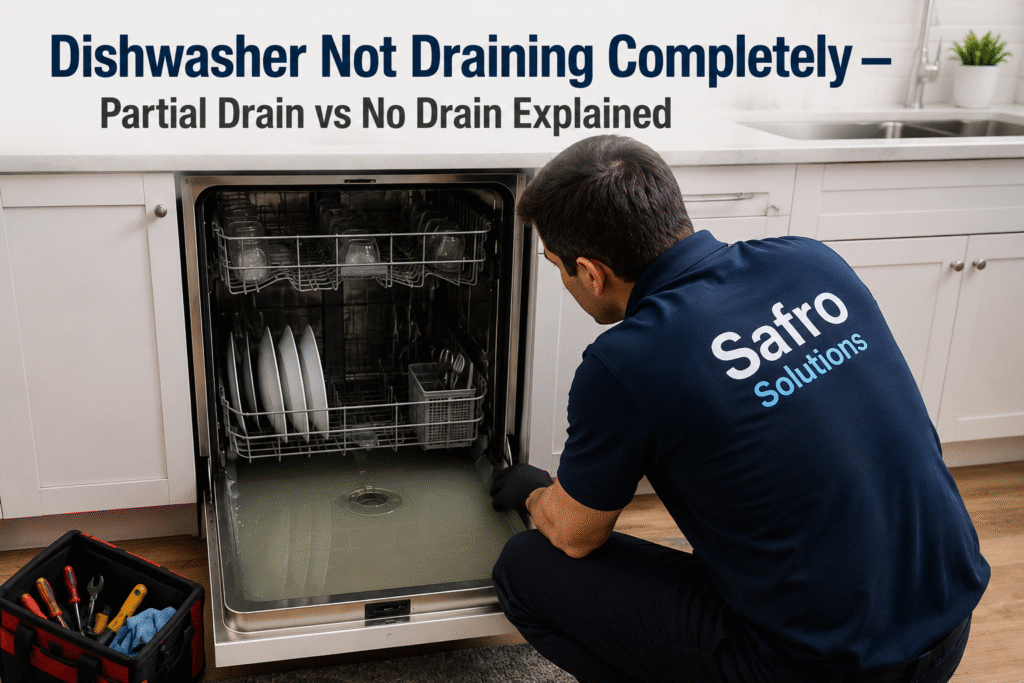
You open the dishwasher after a full cycle. Water is still sitting at the bottom.
Before you panic or start pulling things apart — this is one of the most common calls we get at Safro Solutions. And here’s what most guides skip: a dishwasher with a little water left behind is a completely different problem from one that won’t drain at all. Different causes. Different fix. Different urgency.
This guide tells you exactly which one you have and what to do next.
Quick Answer: Water ¼ inch or less after a cycle is normal — dishwashers keep a small amount by design to prevent seals from drying out. Water above ½ inch means something is blocking drainage. The #1 cause is a dirty filter, which takes 10 minutes to clean. If that doesn’t fix it, the drain pump likely needs a technician.
There’s Water at the Bottom of My Dishwasher — Is That Normal?
Yes, a small amount is completely normal. Dishwashers intentionally hold a thin film of residual water after every cycle to keep the door gasket and pump seals from drying out. The problem starts when that amount grows over time.
Water Level | What It Means | What to Do |
Film / barely visible | ✅ Normal | Nothing |
¼ inch (6 mm) | ✅ Normal | Nothing |
½ inch (12 mm) | ⚠️ Filter needs cleaning | Clean it this week |
1 inch (2.5 cm) | ❌ Drainage problem | Fix today |
2+ inches or full tub | 🚨 Serious blockage | Call a technician |
Quick test: After a completed cycle, touch the tub floor. If water doesn’t reach your first knuckle — you’re fine. If it does — something’s blocking drainage.
What’s the Difference Between “Some Water Left” and “Won’t Drain at All”?
Most guides treat these as the same problem. They’re not.
“Some water left” (Partial Drain) The cycle finishes normally. An inch or two of water sits at the bottom. Dishes are clean. No error code. This probably started weeks ago and slowly got worse.
→ Most likely a dirty filter or a slow drain hose. Usually DIY-fixable in 15 minutes. → Fix within 1–2 weeks — it won’t cause immediate damage, but standing water creates smell and speeds up wear.
“Won’t drain at all” (No Drain) The tub is nearly full. The cycle may have stopped partway through. An error code is showing. This probably happened suddenly.
→ Could be a fully blocked filter, kinked hose, failed pump, or a new garbage disposal with a plug that was never removed. → Fix today — running more cycles with a completely blocked drain risks burning out the pump motor.
Some Water Left | Won’t Drain at All | |
| Water level | ½ inch to 2 inches | 2+ inches or full tub |
| Cycle finished? | Yes | Often stopped early |
| Error code? | Usually no | Usually yes |
| How urgent? | This week | Today |
| DIY fixable? | Usually yes | Sometimes |
Why Is My Dishwasher Not Draining Completely?
The filter is dirty — and this fixes it most of the time
The filter catches food and debris before it reaches the pump. Over time, grease and food particles coat it until water can barely pass through. This is the most common cause of a partial drain.
You’ll know it’s the filter if: The problem builds up gradually, the cycle still finishes, and the water left behind looks slightly cloudy.
How to actually clean it (most people just rinse it — that’s not enough):
- Pull out the bottom rack
- Twist the cylindrical filter counterclockwise and lift it out — grab the flat mesh screen underneath too
- Scrub both under hot running water with an old toothbrush
- If there’s white chalky buildup, soak in 50/50 white vinegar and water for 15 minutes — that’s mineral scale from hard water
- Check the cavity where the filter sits and clear any debris sitting there
- Reinstall by twisting clockwise until it clicks
Run a test cycle. If it drains — you’re done.
Time: 10–15 minutes.
If you’re in the San Fernando Valley or anywhere in LA: Your water is very hard, which is why minerals build up fast. That’s why your filter gets gunky faster than the guides say it should. Most guides say clean monthly. In Encino, Sherman Oaks, Van Nuys, Woodland Hills — every two weeks is the right schedule.
Could the hose under my sink be the problem?
The drain hose runs from your dishwasher, loops up inside the cabinet (this arc is called the “high loop”), then connects down to your garbage disposal or sink drain. If it sags, kinks, or gets clogged internally, drainage slows or stops.
You’ll know it’s the hose if: The problem appeared after the dishwasher was moved, or after plumbing work. The pump sounds like it’s running but nothing’s happening.
What to check: Open the cabinet under your sink. Look for the hose. Is it kinked? Is it still looping upward before going down, or has it sagged? Straighten any bends and push the high loop back up if it’s dropped.
LA note: After 7–10 years in hard water, mineral scale builds up inside the hose walls even when it looks fine outside. If the dishwasher is that old and the hose has never been replaced, it may be narrowed internally. Disconnect it from the disposal and flush water through it to check flow.
Run a test cycle. If it drains — done.
Time: 5–10 minutes.
Does running my garbage disposal actually matter?
Yes, more than most people realize. In most LA kitchens, the dishwasher drain runs through the garbage disposal. A full or sluggish disposal creates backpressure that sends water back into the dishwasher instead of out.
Simple habit: Run the disposal for 30 seconds with cold water before you start every dishwasher cycle.
One specific thing to check on new installations: If your garbage disposal was recently replaced, there’s a knockout plug inside the drain inlet that has to be removed before the dishwasher connection works. Installers sometimes miss this. If drainage was completely fine until a new disposal went in — that plug is almost certainly the cause.
Time: 2 minutes.
What about that chrome thing next to my faucet?
That’s an air gap — not every kitchen has one, but if yours does, it can clog. Its job is to stop dirty water from siphoning back into the dishwasher. When it’s blocked, drainage gets restricted.
You’ll know it’s the air gap if: Water spurts out of that chrome cylinder during the drain phase of the cycle.
Fix: Unscrew or pop off the cap, remove the plastic inner piece, clear the small port with a toothpick or small brush, put it back, run a test cycle.
Time: 5 minutes.
Dishwasher Not Draining but No Blockage? Check These 4 Things
If the filter is clean and the hose is clear but the dishwasher still will not drain, the fault is usually a part you cannot see: the drain pump, the check valve, an unremoved knockout plug in the garbage disposal, or the control that tells the pump to run. Test them in this order, easiest first.
| Suspect | Sign | Who fixes it |
|---|---|---|
| Garbage disposal knockout plug | Never drained since a new disposal was installed | You, in 10 minutes |
| Check valve (one-way flap) | Water flows back in after draining, or drain is very slow | Technician |
| Drain pump | Hums but no water moves, or a grinding or rattling noise | Technician |
| Control board or wiring | Pump makes no sound at all during the drain phase | Technician |
1. Disposal knockout plug (easy to miss)
A new garbage disposal ships with a solid plastic plug inside the dishwasher inlet. It must be knocked out before the dishwasher can drain into the disposal. To check, unplug the disposal, remove the dishwasher drain hose from the inlet, and look inside with a flashlight. If you see a solid disc, tap it out with a screwdriver and a hammer, then fish the piece out of the disposal so it does not jam the blades. If the dishwasher never drained properly after a disposal was installed, start here.
2. Check valve
Many dishwashers have a one-way check valve on the drain outlet that stops dirty water from flowing back in. When it sticks, water either drains slowly or seeps back into the tub after the cycle. A stuck valve can be tested by a technician quickly.
3. Drain pump
Listen during the drain phase. A humming pump that moves no water, a grinding or rattling sound, or a pump that works some days and not others points to the pump or its impeller. A small piece of broken glass or a bone fragment can jam the impeller even when the filter looks clean.
4. Control board or wiring
If the drain phase is completely silent, the pump is not getting the signal or the power. That needs a multimeter and access to the board, so it is a technician job.
Cleaned the filter, checked the hose and the disposal plug and it still will not drain? Stop running cycles and call Safro Solutions at (747) 250-6879 for same-day dishwasher repair in Los Angeles.
Drain still not working after these checks? A jammed pump, a stuck check valve or a control fault needs testing tools to confirm. Safro Solutions finds the exact part and fixes it, with same-day dishwasher repair in Los Angeles. Call (747) 250-6879.
How do I know if my dishwasher’s drain pump is bad?
This is the part where DIY ends. The drain pump is the motor that pushes water out. When it fails, you’ll hear it humming during the drain cycle — but nothing moves. Or it works some days and not others, with no pattern.
Signs that point to the pump:
- Humming sound but no water draining
- Works fine sometimes, fails randomly
- You’ve cleaned the filter, checked the hose, run the disposal — still nothing
- Dishwasher is 7+ years old
⚠️ Don’t attempt the pump yourself. You need diagnostic tools to confirm it’s actually the pump and not the control board or wiring. Getting it wrong means buying the wrong part and still having a broken dishwasher. Hard water can shorten pump life.
My Dishwasher Is Showing a Code — What Does It Mean?
Error codes are a starting point, not a final diagnosis. The same code can come from three different causes. Always clean the filter and run a test cycle before assuming you need a part.
Brand | Code | What It Means | Check First |
LG | OE | Drain cycle timed out | Clean filter → check hose |
Samsung | 5E / 5C | Drain cycle failed | Check hose → clean filter |
Bosch | E24 | Pump or filter blocked | Clean filter → check pump area |
Whirlpool | F8E1 / F8E4 | Drain pump fault | Reset power → check hose |
GE | — | No code, visible standing water | Filter → run disposal |
KitchenAid | 6-2 / F6E2 | Drain motor fault | Clean filter first |
Maytag | F8E1 | Same as Whirlpool | Reset → hose check |
LG’s official drain guide and Samsung’s support page have brand-specific steps if the code keeps returning after filter cleaning.
If your dishwasher is not filling instead, see dishwasher not filling with water.
How Do I Actually Fix It? Start Here.
- Scoop out the standing water — Use a cup, absorb the rest with a towel. You need to see the tub floor. (5 min)
- Hold the Cancel button for 3 seconds — Most models trigger a drain-only cycle this way. Does the pump hum but nothing moves? That’s a pump warning sign. (2 min)
- Scrub the filter — Twist it out, scrub with a toothbrush under hot water, check the sump cavity below it, reinstall. Run a test cycle. → Water drained? Done. (10–15 min)
- Check the hose under the sink — Look for kinks, confirm the high loop is still arcing upward, straighten anything bent. Run a test cycle. → Water drained? Done. (5–10 min)
- Run the garbage disposal — 30 seconds with cold water. Run a test cycle. → Water drained? Done. (2 min)
- Clean the air gap if you have one — Remove cap, clear the port, reinstall. Run a test cycle. → Water drained? Done. (5 min)
- Check for a knockout plug and listen to the pump. If the disposal is new, make sure the knockout plug was removed. Then run a drain cycle and listen: a humming pump with no water movement means the pump needs a technician. (10 min)
- Still not draining? Stop running cycles and call a technician. Every cycle you run with a fully blocked drain adds stress to the pump motor.
I’ve Tried Everything — When Should I Just Call Someone?
Try the steps above if: Cycle finishes, 1–2 inches of water remaining, no error code, no leaking, gradual problem.
Call a technician now if:
- Pump hums but nothing drains
- Error code comes back right after filter cleaning
- Water is on the floor or inside the cabinet below
- Problem appeared overnight — not gradually
- Dishwasher is 8 years old or more
- Went through all 7 steps and it still won’t drain
See our dishwasher repair in Los Angeles page for what a same-day visit includes.
How Do I Stop This From Happening Again?
How often | What to do |
| Every week | Scrape plates before loading · Run disposal 30 sec before each cycle |
| Every 2 weeks (LA — not monthly) | Scrub the filter · Run a white vinegar rinse cycle |
| Every month | Run Affresh or Finish cleaner cycle · Check hose position under sink |
| Once a year | Professional descaling inspection if the dishwasher is 5+ years old |
LA’s hard water — defined as “very hard” by USGS standards for most of the San Fernando Valley — is the single biggest reason dishwashers in this area clog faster than anywhere else in the country. Calcium and magnesium deposits build up in your filter, hose walls, and pump much faster than in soft-water cities.
Still have standing water after trying everything?
Safro Solutions handles same-day dishwasher repair across Los Angeles for LG, Samsung, Whirlpool, GE, KitchenAid, Bosch, and Maytag.
📞 Call 747-250-6879 · 🌐 Schedule online
Serving Valley Village · Sherman Oaks · Studio City · Burbank · Encino · Beverly Hills · Tarzana · Woodland Hills · Van Nuys · Northridge
Written by the Safro Solutions technician team — licensed appliance repair specialists serving Los Angeles for 5+ years. See our dishwasher repair service
Frequently Asked Questions
Q1: Is some water in my dishwasher after a cycle normal?
Yes — ¼ inch or less is by design. Dishwashers hold a small amount to keep door seals moist. Water above ½ inch after a completed cycle means the drain path is restricted, almost always starting with a dirty filter.
Q2: Why is my dishwasher leaving water but still cleaning dishes?
A partially clogged filter restricts flow without stopping it completely — the cycle ends before all the water has drained through. Scrub the filter with a brush (not just rinse it) and run a test cycle. This fixes it most of the time.
Q3: My LG dishwasher shows OE — do I need a new pump?
Not necessarily. OE fires whenever the drain cycle takes too long — which can still be a dirty filter, not a pump. Clean the filter first. If the code comes back, check the drain hose. If it persists after both — then call a technician. Call Safro Solutions at 747-250-6879.
Q5: Can I just run another cycle to see if it clears itself?
If water is partially draining, one more cycle is unlikely to help and just adds wear. If the tub is completely full, don’t run another cycle at all — the pump is already working against a full blockage and can overheat.
Q6: Why is my dishwasher not draining but there is no blockage?
If the filter and hose are clear, the cause is usually the garbage disposal knockout plug, a stuck check valve, a jammed or failed drain pump, or a control fault. Check the disposal plug first, then listen to the pump during the drain phase. A pump that hums without moving water needs a technician.
Q7: What is a knockout plug in a garbage disposal?
It is a solid plastic disc inside the dishwasher inlet of a new disposal. It must be knocked out before the dishwasher can drain into the disposal. If your dishwasher stopped draining after a new disposal was installed, this is the first thing to check.
Q8: Can a dishwasher check valve stop it from draining?
Yes. A stuck check valve can slow the drain or let dirty water flow back into the tub. Confirming it is the cause usually needs a technician.