

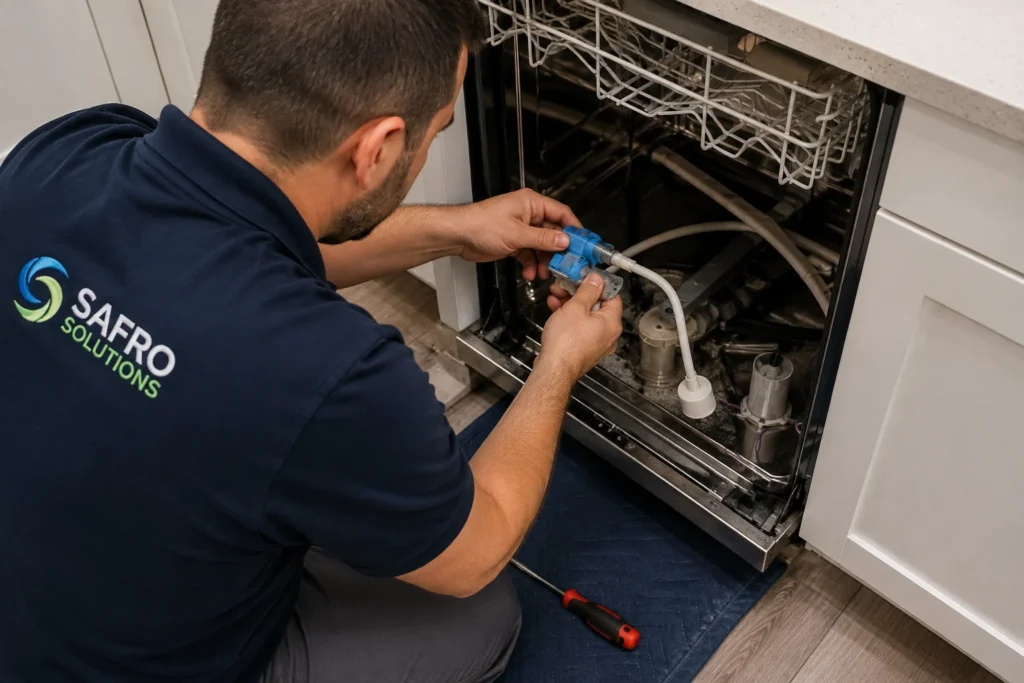
A dishwasher that won’t fill, fills slowly, leaks only when it’s off, or hums without water entering is almost always the water inlet valve. Before you test anything with a multimeter, three free checks rule out the non-valve causes in under two minutes. If those check out, the valve itself is the next step.
Jump to a section
- What does the water inlet valve do?
- What are the signs of a failing water inlet valve?
- Check these 3 things before testing the valve
- How do you test a dishwasher water inlet valve?
- Is Los Angeles hard water making this worse?
- How much does it cost to replace a dishwasher water inlet valve?
- When should you call a professional?
- FAQ
Key takeaways
- A dishwasher water inlet valve fails one of four ways: no water enters at all, water enters slowly, the machine leaks or puddles only when it’s off, or it hums but no water comes in.
- Before testing the valve, check three free things first: the water supply valve, the supply line, and the door latch. All three take under two minutes.
- The valve’s solenoid coil should read roughly 700 to 900 ohms on a multimeter, according to iFixit’s official repair guide, with the exact spec varying by brand.
- San Fernando Valley water measures 8.6 grains per gallon, officially classified as hard by the LA Department of Water and Power, which speeds up mineral buildup inside the valve.
- Nationally, replacing a dishwasher water inlet valve runs $80 to $170 total, with the part itself costing $10 to $40, per HomeGuide’s cost data.
- Testing the valve’s electrical side means working near a powered, water-connected appliance. If you’re not comfortable with that, it’s a call-a-pro moment, not a weekend project.
- Safro Solutions offers same-day dishwasher repair across Los Angeles and the San Fernando Valley, with a 90-day warranty on parts and labor. Call (747) 250-6879.
What does the water inlet valve do?
The water inlet valve is the single connection point between your home’s water supply line and the inside of the dishwasher tub. It’s an electrically controlled solenoid valve, which means it stays closed until the control board sends it power, then it opens to let water flow in for exactly as long as the cycle calls for.
Because it’s the only part standing between your plumbing and your dishwasher, there’s no backup path if it fails. A worn seal, a burned-out coil, or a mineral-clogged screen inside the valve body all show up the same way to you: water that doesn’t show up on time, or water that shows up when it shouldn’t.
That single point of failure is exactly why the signs below map so cleanly to specific causes. Once you know which sign you’re seeing, you already know roughly what’s wrong inside the valve.
What are the signs of a failing water inlet valve?
The specific way your dishwasher is misbehaving points to a specific cause inside the valve. Here’s how the signs map:
Sign | Most likely cause |
| No water enters at all | Solenoid coil burned out (open circuit) |
| Water enters very slowly | Clogged inlet screen or low supply pressure |
| Leaks or puddles when the dishwasher is off | Worn valve seal or a plunger stuck partway open |
| Humming sound, but no water enters | Valve is getting power but is mineral-clogged or stuck closed |
A machine that won’t fill at all almost always means the solenoid coil has failed completely, so no amount of power gets the valve to open. A slow fill points somewhere less final: a screen full of sediment or mineral scale that’s restricting flow rather than blocking it outright.
Leaking or puddling when the dishwasher isn’t even running is the sign homeowners tend to miss the connection on. It feels like a random leak, but a worn seal or a plunger that won’t fully seat lets water trickle through even with the valve de-energized.
Humming with no water is the most confusing one to diagnose by ear alone, because the valve is clearly getting power. That points to the solenoid trying to open against a clog or scale buildup rather than a dead coil, which is a meaningfully different repair than the others on this list.
Check these 3 things before testing the valve
Before you touch a multimeter, three free checks take about two minutes combined and rule out causes that have nothing to do with the valve itself.
- Confirm the water supply valve is fully open. This is usually a small shutoff valve under the sink or behind the dishwasher, and it’s easy to bump partially closed during other under-sink work.
- Check that the supply line isn’t kinked or pinched. A dishwasher pulled out for cleaning or a nearby repair can leave the flexible supply line crimped behind the unit.
- Make sure the door is fully latched. Most dishwashers won’t fill at all with the door ajar, and a latch that isn’t catching cleanly can mimic a fill problem that has nothing to do with the valve.
If all three of those check out and the dishwasher still isn’t filling correctly, the water inlet valve itself is the next place to look.
How do you test a dishwasher water inlet valve?
The most reliable at-home test is a multimeter resistance check across the valve’s solenoid terminals. With the dishwasher unplugged and the valve accessible, a working solenoid coil reads roughly 700 to 900 ohms of resistance, according to iFixit’s official dishwasher water inlet valve replacement guide, though the exact number varies by brand and model. A reading of infinite resistance (often shown as “OL” on the meter) means the coil has burned out and is open. A reading near zero, or any continuity to the metal valve body, means the coil is shorted to ground and the valve needs to be replaced.
That resistance test alone is safe and something most homeowners can run with the unit unplugged. Where this gets riskier is testing the valve under live power, which some repair guides walk through using a homemade AC test cord to energize the solenoid directly at the wall outlet while the water line is still connected.
We’d rather be straightforward about this than pretend it’s a simple weekend task: building a test cord and running live voltage near a water-connected appliance is exactly the kind of job that belongs to a licensed technician, not a multimeter tutorial. If the resistance test already points to a bad valve, there’s no reason to add electrical risk on top of a diagnosis you’ve already confirmed.
Is Los Angeles hard water making this worse?
Yes, and it’s not a generic claim. According to the LA Department of Water and Power’s own water quality data, water supplied to the San Fernando Valley measures 8.6 grains per gallon, which is officially classified as hard water. Areas served by Eastern LA and Harbor sources run even higher, up to 16.3 grains per gallon.
Hard water carries dissolved minerals, mostly calcium and magnesium, that don’t stay dissolved forever. Every time water passes through the inlet valve, a small amount of scale can deposit inside the valve body and on the screen that filters incoming water, and over months that buildup is exactly what causes the slow-fill and humming-but-not-filling symptoms described above.
This is also why a valve replaced once can fail again on the same timeline if the underlying water hardness never changes. It doesn’t mean replacement is pointless, but it does mean homeowners in Safro’s own San Fernando Valley service area should expect inlet valve wear to run on the faster side of normal.
How much does it cost to replace a dishwasher water inlet valve?
Nationally, replacing a dishwasher water inlet valve costs $80 to $170 total, with the replacement part itself typically running $10 to $40, according to HomeGuide’s dishwasher repair cost data. The rest of that range covers labor, which varies with how accessible the valve is on a given model.
For an accurate local number, Safro Solutions’ service call fee runs $69 to $129 and gets applied toward the repair cost if you move forward with the fix, so a diagnostic visit isn’t money spent on top of the repair. That fee covers the technician confirming it’s actually the inlet valve and not a related issue like the water supply line or the float switch.
Replacing the valve yourself is possible on some models, but the part has to match your dishwasher’s exact brand and configuration, and a mismatched valve either won’t fit the water line fitting or won’t regulate flow correctly once installed.
When should you call a professional?
Call a professional once the resistance test points to the valve, or as soon as testing means working with live power near a water line and you’re not fully comfortable doing that yourself. This isn’t a job that requires tearing the dishwasher apart. For most models it’s a same-day fix, not a multi-day repair.
Your dishwasher doesn’t have to sit broken while you second-guess a multimeter reading. Safro Solutions can confirm the inlet valve diagnosis and replace it same-day across Los Angeles and the San Fernando Valley, with a 90-day warranty on the part and the labor.
Safro Solutions
5331 Corteen Pl, Valley Village, CA 91607
Call: (747) 250-6879
Find us on Google Maps : https://share.google/x0w7LKq8nk9yGxPvk
Call (747) 250-6879 now or schedule your dishwasher repair online, and mention this article so your technician brings the right inlet valve for your brand.
FAQ
Q1: How much does it cost to replace a dishwasher water inlet valve?
Nationally, expect $80 to $170 total, with the part itself costing $10 to $40, according to HomeGuide’s cost data. Safro Solutions’ own diagnostic visit runs $69 to $129 and applies toward the repair if you go ahead with it.
Q2: How long do dishwasher water inlet valves last?
There’s no fixed lifespan since it depends on water hardness and usage, but valves in hard-water areas like the San Fernando Valley tend to wear faster because mineral scale builds up inside the valve body and screen over time.
Q3: How do you know if your water inlet valve is bad?
The clearest signs are a dishwasher that won’t fill or fills slowly, one that leaks or puddles when it’s off, or one that hums without water entering. A multimeter reading outside the roughly 700 to 900 ohm range for the solenoid coil confirms it.
Q4: What is the most common failure on a dishwasher?
Water inlet valve failure is one of the most common dishwasher repairs, alongside drain pump and drain hose issues that cause the opposite problem of a dishwasher not draining.
Q5: Why does my dishwasher run but no water comes in?
This usually means the valve is either fully clogged with mineral scale or the solenoid coil has burned out and stopped opening, even though the rest of the cycle is running normally.
Q6: How do I know if my dishwasher inlet valve is clogged?
A clogged valve typically causes a slow fill rather than no fill at all, since some water still gets through a partially restricted screen. A humming sound with little or no water entering is another strong sign of a clog rather than a dead coil.
Q7: Why is my dishwasher humming but not filling up with water?
The valve is getting electrical power, which is why you hear the hum, but something inside it (usually mineral buildup) is physically blocking it from opening fully. That’s a different repair than a burned-out coil, even though both stop water from entering.