

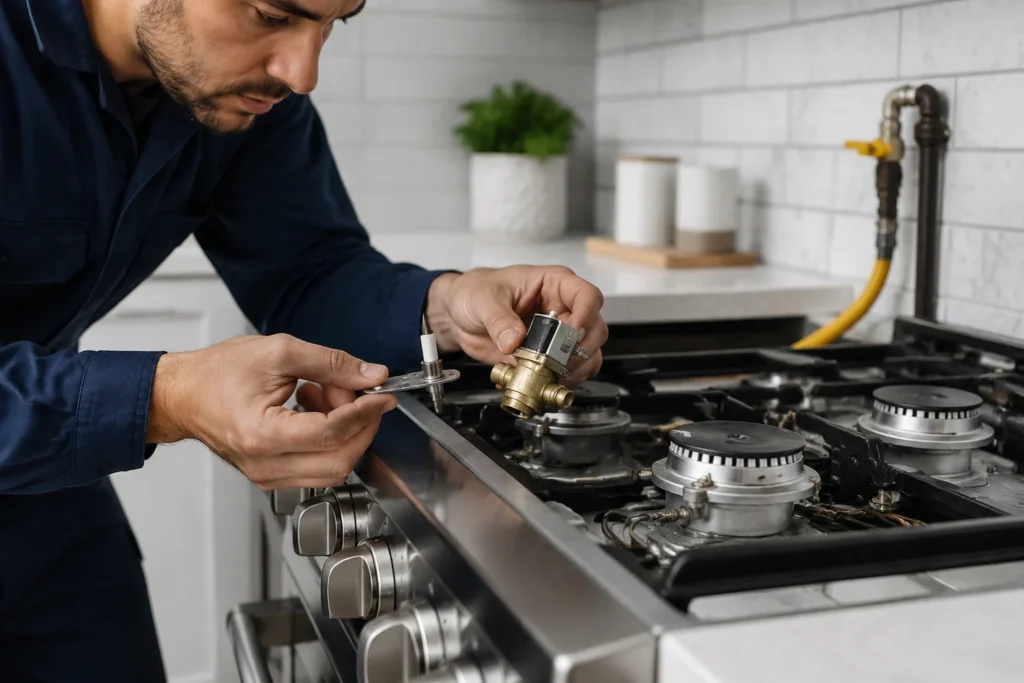
A gas range that won’t heat is caused by a weak glow bar igniter in the vast majority of cases, not the gas valve or the gas supply. The igniter must reach roughly 2,000 degrees before the safety valve releases gas, and a worn igniter never gets there. A quick burner test tells you which system failed in under two minutes.
TL;DR
- If your stovetop burners light but the oven stays cold, the oven igniter is the most likely culprit. The gas valve fails far less often than most homeowners assume.
- You can safely check the gas supply, the shut-off valve, and your breaker yourself. Leave valve testing and gas line work to a licensed technician.
- Need it fixed today? Safro Solutions offers same-day gas range repair across Los Angeles. Call or text (747) 250-6879 for a free estimate.
The 2-minute check: is your range getting gas at all?
Turn on a stovetop burner first. If it lights, gas is reaching your range and your problem sits inside the oven’s ignition system, not the gas supply. This one test rules out half the possible causes before you touch a single screw.
If no burners light, work backward through the supply. Look behind the range and confirm the shut-off valve handle sits parallel to the gas line. A handle turned crosswise means the valve is closed, which happens more often than you’d think after a kitchen deep clean or a move. Many gas ranges also have a service cut-off lever on the pressure regulator at the back of the unit. That lever shuts gas to the oven while leaving the surface burners running, so an oven that went cold right after the range was pulled out for cleaning often traces back to a bumped regulator lever.
Still nothing? Check another gas appliance, like your dryer or water heater. If the whole house is without gas, the issue is your main valve or your utility, and Los Angeles homeowners should contact SoCalGas rather than any repair company.
One safety rule overrides everything: if you smell gas at any point, stop troubleshooting. Shut the gas valve, open windows, leave the house, and call SoCalGas from outside. No blog checklist is worth staying in a kitchen with a suspected leak.
Once you’ve confirmed gas is flowing, the next question is why the burners work while the oven doesn’t.
Why your gas oven won’t heat but the burners work
Your stovetop and your oven share a gas line but use completely different ignition systems, which is why one can fail while the other works perfectly. The surface burners use spark igniters that click and light instantly. The oven uses a glow bar igniter wired in series with a safety valve, and that chain works in five steps:
- You set the oven temperature and the control board sends current through the igniter circuit.
- The glow bar igniter heats up and starts to glow orange.
- As it heats, its electrical resistance drops and more current flows through the circuit.
- When the igniter reaches ignition temperature, the current is finally strong enough to pull the safety valve open.
- Gas flows to the oven burner and the glowing igniter lights it.
The whole sequence should take about 30 to 90 seconds. The weak point is step 4. An aging igniter still glows, still looks like it’s working, but never draws enough current to open the valve. The result is a gas oven not heating while every burner on top lights without complaint. Understanding this sequence makes the next section, telling the three failure points apart, much easier.
Igniter vs gas valve vs gas supply: how to tell which one failed
Match your exact symptom to the table below and you’ll know which component failed before a technician ever arrives. This is the diagnosis Safro Solutions technicians run on every gas range service call in Los Angeles, condensed for homeowners.
What you observe | Most likely culprit | Why |
| Igniter glows 90+ seconds, no flame ever appears | Weak igniter | It glows but can’t draw enough amps to open the safety valve |
| Igniter doesn’t glow at all | Broken igniter, wiring, or control board | No current is reaching or passing through the igniter element |
| Stovetop burners are dead too | Gas supply | Closed shut-off valve, tripped regulator lever, or utility issue |
| Igniter glows bright and tests fine, still no gas | Safety valve | Rare, but the valve’s internal coil can fail open-circuit |
| Stovetop burner clicks endlessly but won’t light | Clogged port, moisture, or misaligned burner cap | Spark is firing but gas and spark aren’t meeting |
| Oven heats, then never reaches set temperature | Weak igniter or temperature sensor | Slow ignition cycles starve the oven of heat |
Two details help you read the table correctly. First, a glowing igniter is not a working igniter. The glow only proves current is flowing, not that enough current is flowing. Second, the clicking symptom on stovetop burners is usually the cheapest fix on this list. A toothbrush, a dry cloth, and a correctly seated burner cap solve most clicking problems in Los Angeles kitchens without a single part.
If your symptom points to the igniter, the next section shows you what a failing one looks like in daily use.
Signs of a failing oven igniter Los Angeles homeowners notice first
A dying igniter announces itself weeks before it quits, and slow preheating is almost always the first sign. Watch for these symptoms:
- Preheating takes noticeably longer than it used to, sometimes 20 minutes or more
- The igniter glows a dull orange instead of a bright, almost white-orange
- You hear a small boom or whoosh when the burner finally lights, caused by gas pooling before delayed ignition
- A faint gas smell during preheat, another sign of delayed ignition
- Baking comes out uneven because the burner cycles on too slowly to hold temperature
Published lifespan figures for glow bar igniters range from three to eight years, and the spread comes down to usage. A range that bakes daily in a busy Valley Village household cycles its igniter thousands of times more per year than one in a rarely used kitchen, and every heating cycle degrades the element a little more.
Oven heats but never reaches temperature? Weak igniter or sensor
An oven that gets warm but stalls below the set temperature is usually running a weak igniter that ignites the burner late in each cycle, shortening every burn. The oven’s temperature sensor is the other suspect. That thin probe on the back wall tells the control board when to call for heat, and a drifting sensor makes the oven undershoot even with a healthy igniter. A simple oven thermometer on the center rack settles it: if the dial says 375 and the thermometer says 330, your range needs professional oven repair in Los Angeles or at minimum a calibration check.
What about the gas valve itself? Here’s why it sits at the bottom of the suspect list.
Why the gas safety valve almost never fails (and why techs check it last)
The oven safety valve is deliberately engineered as the most conservative part in the ignition system, so genuine valve failures are uncommon. It has no motor and no moving electronics, just a bimetal element that bends open when the igniter circuit delivers full current. Fewer stress points mean fewer failures.
This is exactly why a weak igniter mimics a bad valve so convincingly. The valve stays shut, no gas flows, and the homeowner concludes the valve is stuck. In reality the valve is doing its job: it never received the current signal that a healthy igniter provides. Replacing a valve that was never broken is one of the most common wasted repairs in this appliance category.
A technician confirms the difference with a multimeter. The valve coil should read roughly 0 to 50 ohms of resistance; an open reading means a genuinely failed valve. Safro Solutions techs test the igniter’s amp draw first on every gas range call, because the numbers identify the true culprit in minutes and keep you from paying for the wrong part.
Knowing which repairs are testable at home and which aren’t brings us to the DIY question.
Testing at home vs calling a pro: what’s safe to DIY
Cleaning, drying, and resetting are safe for any homeowner; anything involving the safety valve or gas connections is not. Here’s the honest split.
Safe to do yourself: scrub clogged burner ports with a soft toothbrush, dry a wet igniter after cleaning (give it 30 to 40 minutes with the burner caps off), re-seat a misaligned burner cap, check the breaker panel, and confirm the shut-off valve is open. These steps fix a surprising share of gas stove clicking and lighting complaints.
Leave to a licensed technician: safety valve testing and replacement, any work on gas lines or the pressure regulator, control board diagnosis, and igniter replacement if you’re not fully confident working around the burner assembly. There’s also a paperwork reason to be careful. Many manufacturers void appliance warranties after unlicensed repairs, so a DIY attempt on a newer GE, Samsung, LG, or Whirlpool range can cost more than the service call it avoided. When in doubt, book licensed stove repair in Los Angeles and let a professional carry the risk.
If you do call a pro, here’s what the repair should cost.
Gas range repair cost in Los Angeles (2026)
Expect to pay between $150 and $325 for a professional gas oven igniter replacement in Los Angeles, with the part itself running $20 to $50, according to HomeGuide’s 2026 oven repair cost data. Typical ranges by repair:
Repair | Typical cost (parts + labor) |
| Igniter replacement | $150 to $325 |
| Safety valve replacement | $200 to $400 |
| Control board replacement | $400 to $600 |
| Burner port cleaning / cap realignment | Often under $150 |
| Diagnostic visit alone | $75 to $150 |
Angi’s oven repair pricing research shows labor rates of $50 to $125 per hour, and Los Angeles sits at the upper end of that band. Safro Solutions charges a $69 to $129 service call fee that is waived when you proceed with the repair, and every job comes with a written estimate before work begins, so the number you approve is the number you pay.
What a Safro Solutions gas range repair visit looks like
A typical gas range call in Los Angeles is a single-visit repair, because Safro Solutions trucks carry igniters and common parts for the major brands. The technician runs the same diagnosis you read above: burner test, igniter glow check, amp draw measurement, then valve resistance only if the igniter passes. You get a written estimate before any part is touched, and parts and labor carry a 60-day warranty. The company is licensed (LIC# A 50901), family-owned, and handles gas ranges alongside cooktop repair across Los Angeles, from Sherman Oaks and Studio City to Burbank and Pasadena.
When to call a Los Angeles gas range repair technician
Call a technician when the burner test points to anything beyond cleaning: an igniter that glows without lighting, no glow at all, an oven that can’t hold temperature, or any hint of a gas smell. Safro Solutions is a licensed, family-owned appliance repair company serving greater Los Angeles and the San Fernando Valley, with same-day service available when you call before noon. Every technician we send is licensed and background-checked, and we back every job with upfront pricing and a 60-day warranty on parts and labor.
Safro Solutions
Valley Village, Los Angeles, CA 91607
Call or text: (747) 250-6879
Find us on Google Maps: https://maps.app.goo.gl/Tdof4dD9BS5Tk1i2A
We cover Valley Village, Sherman Oaks, Studio City, Encino, Burbank, Van Nuys, and beyond, including Beverly Hills appliance repair and our home base in Valley Village. Need a related fix? Our stove and range repair team in Los Angeles and our oven repair specialists handle those too. Ready now? Schedule your same-day gas range repair.
Frequently asked questions
Q1: Why is my gas oven not heating but the burners work?
Because the oven and stovetop use separate ignition systems. The oven’s glow bar igniter has likely weakened to the point that it can’t open the safety valve, while the stovetop’s spark igniters are unaffected.
Q2: How do I know if my oven igniter or gas valve is bad?
Watch the igniter with the oven set to bake. If it glows for more than 90 seconds with no flame, the igniter is weak. If a tested, healthy igniter still produces no gas flow, the valve is the rare culprit. A multimeter reading settles it definitively.
Q3: Why does my igniter glow but the oven won’t light?
A glowing igniter can still be too weak to draw the current needed to open the safety valve. The glow proves power is flowing, not that the igniter is strong enough to do its job.
Q4: Can a tripped breaker stop a gas oven from heating?
Yes. Gas ovens need electricity for the igniter, control board, and display. Check your panel and reset any tripped breaker before booking a repair.
Q5: How much does it cost to replace a gas oven igniter in Los Angeles?
Typically $150 to $325 including parts and labor. Safro Solutions waives its service call fee when you proceed with the repair and provides a written estimate first.
Q6: How long do gas oven igniters last?
Most last somewhere between three and eight years. Heavy daily baking shortens the lifespan; light use extends it.
Q7: Is it safe to use the stovetop if the oven isn’t heating?
Usually yes, since the systems are independent. The exception is any gas smell. If you smell gas, stop using the range entirely and call SoCalGas.
Q8: Can I light my gas oven manually?
Some older ovens with standing pilots allow it, but modern glow bar ovens should never be lit manually. Bypassing the safety valve’s ignition sequence is dangerous.
Q9: Why does my oven not reach the set temperature?
A weak igniter that ignites late in each heating cycle, or a drifting temperature sensor. Test with an oven thermometer; a gap of 15 degrees or more means the range needs service or calibration.