

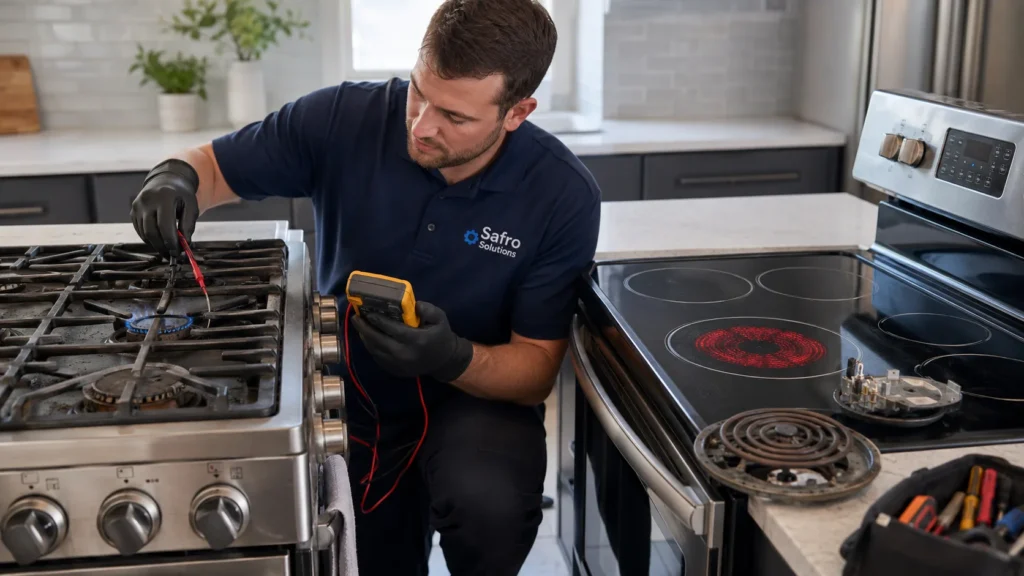
Written by the Safro Solutions repair team (Licensed, LIC# A 50901), Los Angeles, CA
Quick Answer: A gas stove that won’t heat is almost always an ignition or gas-flow problem — a dirty igniter, a misaligned burner cap, or a closed gas valve. An electric stove that won’t heat is almost always an electrical problem — a burned-out element, a loose receptacle, or a failed switch. Because the two heat differently, the causes and the fixes are completely different. Here’s how to tell them apart.
This guide walks through the gas causes, the electric causes, a side-by-side comparison, a step-by-step diagnosis, and when it’s safe to DIY versus call a Los Angeles stove repair pro.
Why Gas and Electric Stoves Heat Differently
The reason the failures differ comes down to how each stove makes heat. A gas stove burns natural gas or propane: when you turn the knob, gas flows to the burner and an electric igniter sparks it into a flame. Anything that blocks the gas or the spark stops the heat.
An electric stove makes heat through resistance instead. Electricity (120–240 volts) runs through a coil or a heating element, and the metal glows hot. Anything that breaks that electrical circuit — a bad element, a corroded connection, or a faulty switch — stops the heat.
This difference matters because efficiency and behavior differ too. According to the U.S. Department of Energy, induction cooktops are up to three times more efficient than gas stoves and up to 10% more efficient than conventional electric ranges — which is why diagnosing the right fuel type first saves you time and money. Burning gas also releases carbon monoxide and nitrogen oxides, so any gas problem is a safety issue, not just a cooking inconvenience.
Why Is My Gas Stove Not Heating?
A gas stove that won’t heat usually has one of six causes: the gas supply is off, the burner cap is misaligned, the burner ports are clogged, the igniter has failed, the control valve is weak, or only the cooktop or oven is affected. Work through them in this order.
• The Gas Supply Is Off or Interrupted
Before anything else, confirm gas is reaching the stove. If you recently moved the range or had work done, the shut-off valve behind it may still be closed. Test another gas appliance in your Los Angeles home — if nothing gas-powered works, the issue is your supply line or your gas meter, and SoCalGas (your local gas utility) should be contacted. If you smell gas, do not troubleshoot: leave the home and call 911 or SoCalGas immediately.
• A Misaligned or Dirty Burner Cap
The burner cap sits on top of the burner and spreads the flame evenly. If it’s knocked out of position — easy to do when cleaning — the burner may not light or may produce a weak, uneven flame. Lift the cap, make sure it’s dry and seated flat, and try again. This is one of the most common reasons a single gas burner won’t get hot enough.
• Clogged Burner Ports
The small holes around the burner head let gas escape to feed the flame. Grease, food spills, and debris clog them over time, choking the flame so the burner won’t reach full heat. Clean the ports with a straightened paperclip or a soft brush — never a toothpick that can snap off inside.
• A Faulty Igniter — Clicks but Won’t Light
If your gas stove clicks but won’t light, the igniter is the prime suspect. A weak or dirty igniter will spark but fail to ignite the gas, or click endlessly without a flame. Moisture from a recent cleaning is a common culprit; let it dry fully. If all burners click without lighting, the spark module or gas supply — not one igniter — is usually to blame, and that’s a job for a technician.
• A Weak Flame or Bad Control Valve
If the burner lights but the flame stays low no matter how high you turn the knob, the control valve that regulates gas pressure may be failing. Valve replacement involves opening the gas-carrying body of the stove, so this is where most homeowners should stop and book professional stove repair in Los Angeles.
• The Oven Heats but the Stovetop Doesn’t (or Reverse)
On a gas range, the cooktop and the oven often share a gas line but use separate igniters and valves. If your stovetop works but the gas oven won’t heat, the oven igniter or bake valve is usually the problem — not the gas supply. If the cooktop is dead but the oven bakes fine, look at the surface igniters. Our oven repair techs see this split failure constantly.
Why Is My Electric Stove Not Heating?
An electric stove that won’t heat usually traces to power, a bad element, a loose connection, a failed switch, internal wiring, or the control board. Note how none of these overlap with the gas causes above — that’s the whole point.
• No Power or a Tripped Breaker
If the entire electric stove is dead — no lights, no heat — start at the electrical panel. A tripped breaker or a partially pulled 240-volt plug will kill the stove. If the stove has power and the display works but a burner has no heat, the problem is downstream at the element or its connection, not the panel.
• A Burned-Out Heating Element or Coil
The element is the part that actually glows. On a coil stove, look for blisters, breaks, or dark spots. The fastest test: swap the suspect coil with a known-good one from another burner. If the good coil heats in that spot, your original coil is bad; if it stays cold, the problem is the receptacle or switch behind it.
• A Loose or Dirty Burner Receptacle
The receptacle is the socket the coil plugs into. Spills and grease drip into it and corrode the contacts, so the coil can’t draw full power. Pull the coil, inspect the socket for browning or arcing damage, and reseat it firmly. A burned receptacle needs replacement — running a burner through a damaged socket is a fire risk.
• A Faulty Infinite Switch — Burner Only Heats on High
If a burner only heats on high, or jumps straight to maximum regardless of the knob setting, the infinite switch that controls power to the element has failed. The switch, not the coil, regulates the heat level, so a good-looking coil that won’t simmer points straight here.
• Loose or Burnt Internal Wiring
The wires feeding the burners can loosen or scorch over time, especially near a heavily used front burner. This usually shows up as a burner that works intermittently or one that’s dead while everything else is fine. Inspecting and repairing wiring under the cooktop is a job for a licensed technician, not a DIY fix.
• A Failed Element Control Board
On glass-top and smooth-top ranges, a control board with relays sends power to each element. When a relay fails, that burner won’t heat even though the element and switch are fine. If you have a glass cooktop where one zone is dead, professional cooktop repair is the safe path, since the board sits under the bonded glass surface.
How to Prevent Burner Failure
Most electric burner failures start with spills seeping into receptacles and terminals. Wipe up boil-overs once the surface cools, avoid sliding heavy pots that crack glass tops, and don’t let grease bake onto coils. A few minutes of cleaning extends element and receptacle life by years.
Gas vs Electric Stove Not Heating: Side-by-Side Cause Comparison
This is the fastest way to tell which problem you have. Match your symptom, then read across.
Symptom | Likely gas cause | Likely electric cause | DIY or pro? |
| Nothing heats at all | Closed gas valve / supply outage | Tripped breaker / unplugged 240V | Check supply yourself; wiring = pro |
| One burner dead, others fine | Clogged port or bad igniter | Burned coil, receptacle, or switch | DIY clean/swap; replace = pro |
| Heats but too weak | Dirty ports / bad control valve | Failed infinite switch | Clean DIY; valve/switch = pro |
| Clicks but no flame | Wet or failed igniter | (Not applicable) | Dry it; persists = pro |
| Glows but no heat | (Not applicable) | Bad element or control board | Pro |
| Has power/gas but no heat | Control valve | Receptacle or switch | Pro |
| Cooktop works, oven doesn’t | Oven igniter or bake valve | Bake element | Pro |
How to Diagnose a Stove That Won’t Heat (Step by Step)
- Confirm your fuel type. Gas has burner grates and a flame; electric has coils or a flat glass top. This decides which list above applies.
- Check the supply. Gas: is the valve open and are other gas appliances working? Electric: is the breaker on and the plug fully seated?
- Isolate the failure. Is it one burner or all of them? One burner points to a part (coil, igniter, cap); all burners point to the supply, spark module, or control board.
- Gas path: reseat the burner cap, clean the ports, dry the igniter.
- Electric path: swap the coil to a known-good burner, inspect the receptacle, then suspect the switch.
- Decide: if the fix involves the gas valve, internal wiring, or a control board, stop and call a pro.
When to DIY vs Call a Los Angeles Stove Repair Pro
Cleaning burner caps and ports, drying an igniter, reseating a coil, and swapping a plug-in element are safe DIY tasks. Anything involving the gas valve, a suspected gas leak, internal wiring, or a control board should go to a licensed technician — both for safety and to protect your warranty.
For homeowners across Los Angeles, Sherman Oaks, Tarzana, Encino, Woodland Hills, and the San Fernando Valley, Safro Solutions provides same-day stove, cooktop, and oven repair by licensed technicians. We back every repair with a 90-day warranty on parts and labor.
What Stove Repair Costs in Los Angeles
Most stove repairs in Los Angeles are far cheaper than replacing the appliance. A new coil, receptacle, igniter, or burner cap is an inexpensive part, and labor is typically completed in a single visit. Safro Solutions charges a flat $69–$129 service call fee that is applied toward the repair when you proceed, with a written estimate before any work begins — full details are on our pricing page. As a rule of thumb, repair makes sense when the cost stays under half the price of a comparable new stove; beyond that, replacement is usually the smarter call.
Get Your Stove Fixed Today
If your gas or electric stove still won’t heat after these checks, our licensed Los Angeles technicians can diagnose and repair it the same day. Schedule your stove repair online or call (747) 250-6879 for an upfront estimate.
Valley Village, Los Angeles, CA 91607
Call or text (747) 250-6879 or schedule service online.
Find Us On Google Maps: https://maps.app.goo.gl/Tdof4dD9BS5Tk1i2A
Frequently Asked Questions
Q1: Why is my gas stove clicking but not lighting?
A clicking gas burner that won’t light usually means the igniter is wet, dirty, or weak, or the burner cap is misaligned. Dry the area fully, clean around the igniter, and reseat the cap level. If every burner clicks without lighting, the spark module or gas supply is the cause and needs a professional.
Q2: Why does my electric burner glow but not get hot, or only heat on high?
If the coil glows but stays weak, or jumps straight to high heat, the infinite switch behind the burner has failed. The switch — not the coil — regulates the heat level, so a healthy-looking element that won’t simmer points to the switch, which a technician should replace.
Q3: My stove has power but no heat — what’s wrong?
On an electric stove, power at the display but no heat at the burner means the problem is downstream: a burned element, a corroded receptacle, or a failed switch. On a gas stove, gas is reaching the unit but the igniter or control valve is failing. Either way, isolate one burner to narrow it down.
Q4: One burner works but the others don’t — is that gas or electric?
On both fuel types, one dead burner while others work points to a part specific to that burner — a clogged port or igniter on gas, or a coil, receptacle, or switch on electric. When all burners fail together, the shared supply, spark module, or control board is the cause.
Q5: Is it safe to use a stove that won’t heat properly?
A weak or failing gas burner can leak unburned gas, so it should not be used until fixed — and if you smell gas, leave and call 911 or SoCalGas. An electric burner with a scorched receptacle or wiring is a fire risk and should also be taken out of service until repaired.
Q6: How much does stove repair cost in Los Angeles?
Most Los Angeles stove repairs are completed in one visit, with affordable parts like coils, igniters, and switches. Safro Solutions applies a $69–$129 service call fee toward the repair and provides a written estimate upfront, so you know the full cost before any work starts.