
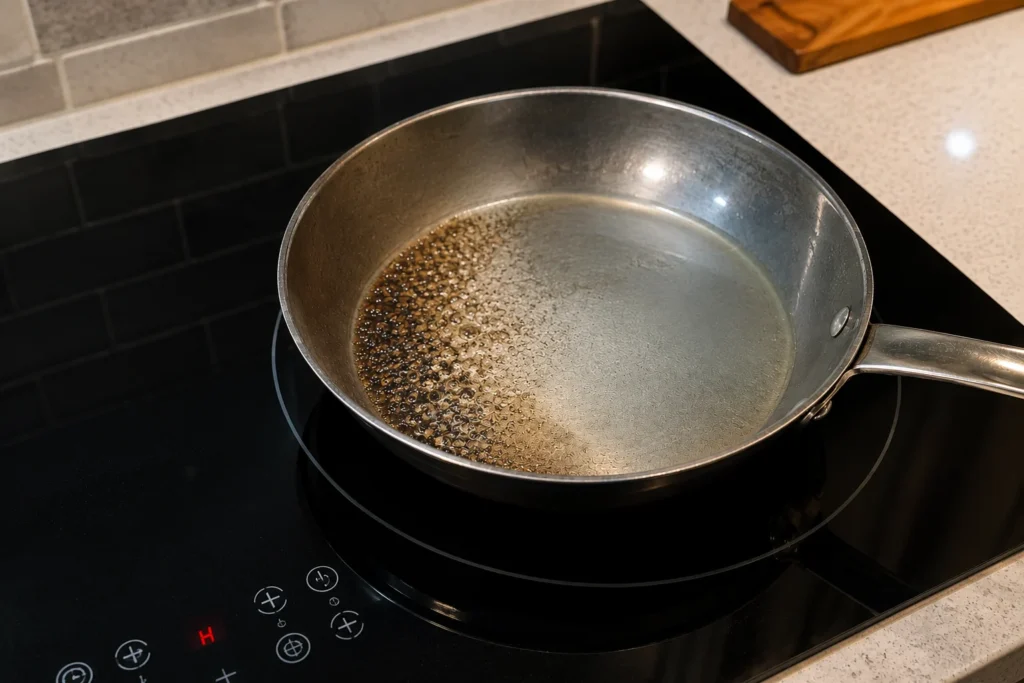
An induction cooktop that heats one part of a pan but leaves the rest cool is almost always about the pan, not the cooktop. Induction only generates heat in the metal sitting directly above the coil, so a warped base, a small magnetic footprint, or an off-center pan shows up as an uneven pattern. Swap the pan first. If the same spot stays hot no matter what you put on it, that’s a cooktop issue worth having looked at.
Jump to a section
- Why does my induction cooktop heat unevenly across the pan?
- What causes uneven heating on an induction cooktop?
- Is it your pan or your cooktop? Quick test
- How do you fix uneven heating on an induction cooktop?
- What if it’s actually the cooktop, not the pan?
- How much does it cost to fix an induction cooktop that’s heating unevenly?
- When should you call a professional?
- FAQ
Key takeaways
- Uneven heating across an induction pan is usually the pan, not the cooktop, because induction only heats the metal sitting directly above the coil.
- The free two-minute test that tells you which one is at fault: swap in a different pan and watch whether the hot spot moves with it.
- The three pan-side causes worth checking first are base flatness, magnetic footprint size, and whether the pan is centered on the zone.
- If the exact same spot stays hot no matter which pan you use, that points to the coil or a temperature sensor, not the cookware.
- Safro Solutions’ own repair data shows a median induction cooktop repair cost of $536, with general cooktop repairs running $80 to $400.
- A cooktop that cycles on and off while heating unevenly, or makes a new clicking or buzzing sound, is a stop-and-call moment rather than something to keep troubleshooting.
- Safro Solutions offers same-day cooktop repair across Los Angeles and the San Fernando Valley, with a 90-day warranty on parts and labor. Call (747) 250-6879.
Why does my induction cooktop heat unevenly across the pan?
Induction cooking doesn’t heat the glass surface directly. It generates an electromagnetic field that induces current straight into the metal of the pan, and that current is what produces the heat. According to the U.S. Department of Energy, “the heat is created from within the cookware itself; as soon as you remove it from a burner, the heating stops.”
That single fact explains most uneven heating complaints. If a pan’s base isn’t flat, isn’t fully magnetic, or isn’t centered over the coil, only part of it sits in the active field, and only that part heats. The cooktop itself is usually doing exactly what it’s supposed to do.
This is also why the fix is almost never a cooktop repair on the first pass. It’s a pan problem wearing a cooktop-shaped disguise, and the next section breaks down exactly which pan issues cause which patterns.
What causes uneven heating on an induction cooktop?
The specific pattern you see points to a specific cause, and whether that cause sits with the pan or the cooktop:
Pattern you see | Likely cause | Pan-side or cooktop-side |
| Center of the pan is hot, edges stay cool | Small magnetic footprint or thin base construction | Pan-side |
| One edge or corner runs hot | Warped or non-flat pan base | Pan-side |
| A ring-shaped hot zone that doesn’t match the pan’s center | Pan sitting off-center on the coil | Pan-side |
| The exact same hot spot appears no matter which pan you use | Coil or temperature sensor issue | Cooktop-side |
| Uneven heat plus clicking, buzzing, or the burner cycling off | Sensor fault or overheating protection engaging | Cooktop-side |
A pan with a thin or poorly bonded base won’t spread heat past the small area directly over the coil, which reads as a hot center and cool edges. A warped base does the opposite: it lifts part of the pan away from the field entirely, so that section barely heats while the rest cooks normally.
The cooktop-side causes are rarer, but they’re the ones worth taking seriously. A hot spot that follows the cooktop instead of the pan means something inside the unit, not the cookware, is the actual problem.
Is it your pan or your cooktop? Quick test
This test takes about two minutes and settles the question before you spend money on either new cookware or a repair call.
- Heat the pan you normally use until the uneven spot shows up clearly.
- Swap in a different pan of roughly the same size and repeat the same heat setting.
- Watch what happens to the hot spot. If it moves with the new pan, shrinks, or disappears, the pan was the problem. If the exact same spot on the cooktop runs hot again with a completely different pan, the cooktop itself is involved.
If the pattern followed the pan, the fixes below will solve it without a repair call. If the pattern stayed fixed on the cooktop, skip ahead to what that means for the coil or sensor.
How do you fix uneven heating on an induction cooktop?
If the swap test pointed to the pan, three changes fix most cases. Choose cookware with a full, flat magnetic base rather than one with only a thin magnetic disc bonded to the center, since a broader magnetic footprint spreads the induced current across more of the pan. Center the pan directly over the marked zone every time, since even a well-built pan heats unevenly if it’s sitting half off the coil.
Preheat at medium power instead of jumping straight to boost. A slower ramp gives the pan’s material time to conduct heat outward before the center overheats relative to the edges, which is often mistaken for a cooktop fault when it’s really a preheating habit.
If you’ve tried all three and the pattern hasn’t changed at all, that’s a sign the issue was never the pan to begin with.
What if it’s actually the cooktop, not the pan?
If the same spot stays hot regardless of which pan you use, the most likely causes are a failing section of the induction coil or a temperature sensor that’s misreading the surface. Both sit inside the unit and aren’t something to open up and inspect yourself.
A coil that’s degrading in one section will keep inducing current unevenly no matter what sits on top of it, which is exactly the pattern the swap test is designed to catch. A misreading sensor can cause the same visible symptom by triggering uneven power cycling in one zone while leaving others alone.
Neither of these is a common failure, which is part of why so few articles on this topic mention it. But it’s a real one, and it’s the reason the swap test matters: it tells you in two minutes whether you’re buying a new pan or scheduling a repair.
How much does it cost to fix an induction cooktop that’s heating unevenly?
According to Safro Solutions’ own cooktop repair pricing data, the median induction cooktop repair runs $536, while general cooktop repairs across all types typically fall between $80 and $400 depending on the failed component. Induction models carry more electronics than standard electric coil units, which is why induction-specific repairs tend to sit higher in that range.
A coil or sensor issue causing uneven heating falls into this same range rather than requiring a full cooktop replacement in most cases. Replacement only becomes the better option when the unit is older or the failure affects multiple components at once.
Every Safro Solutions repair starts with a diagnostic visit that’s waived if you move forward with the repair, so confirming whether it’s actually the cooktop doesn’t cost anything extra on top of the fix itself.
When should you call a professional?
Call a professional once the swap test points to the cooktop rather than the pan, or if the uneven heating shows up alongside clicking, buzzing, or the burner cycling off unexpectedly. Those combined symptoms usually mean a coil or sensor issue that a multimeter and a magnet swap can’t resolve on their own.
Get your induction cooktop diagnosed today
Your induction cooktop doesn’t need to be replaced just because one zone won’t heat evenly. Safro Solutions can confirm whether it’s the cookware or the cooktop and repair it same-day across Los Angeles and the San Fernando Valley, with a 90-day warranty on the part and the labor.
Call (747) 250-6879 now or schedule your cooktop repair online — mention this article and your technician will bring the right diagnostic tools for your brand.
Safro Solutions
5331 Corteen Pl, Valley Village, CA 91607
Call: (747) 250-6879
Find us on Google Maps : https://share.google/x0w7LKq8nk9yGxPvk
FAQ
Q1: Why is the center of my induction pan hotter than the edges?
This usually means the pan’s magnetic base doesn’t extend far enough outward, so only the center sits fully within the coil’s field. Switching to cookware with a broader, flatter magnetic footprint spreads the heat further toward the edges.
Q2: Can a warped pan cause uneven heating on induction?
Yes. A warped base lifts part of the pan away from the glass surface, and that lifted section sits outside the strongest part of the magnetic field, so it heats noticeably slower than the rest of the pan.
Q3: Is it normal for an induction cooktop to pulse or cycle on and off?
Some cycling at lower power settings is normal behavior, similar to how Samsung’s own support documentation describes radiant elements cycling on and off to hold a set temperature. Cycling paired with a fixed hot spot that doesn’t move between pans is the combination worth having checked.
Q4: Does a cracked induction cooktop also cause uneven heating?
It can, if the crack runs across or near the coil area, though cracking and uneven heating are usually separate issues. If your cooktop’s glass surface is visibly cracked, see our guide on why induction and glass cooktops crack for what causes it and when it’s safe to keep using.
Q5: Why is my induction cooktop not heating properly?
Uneven or weak heating both usually trace back to the same short list: an incompatible or poorly built pan, a pan that isn’t centered on the zone, or, less often, a coil or sensor issue inside the unit itself.
Q6: Should I use the boost setting to preheat a pan on induction?
It’s better not to for anything beyond a quick sear. Boost ramps power up faster than the pan’s material can spread it evenly, which often shows up as a hot center with the rest of the pan lagging behind, especially on thinner cookware.