

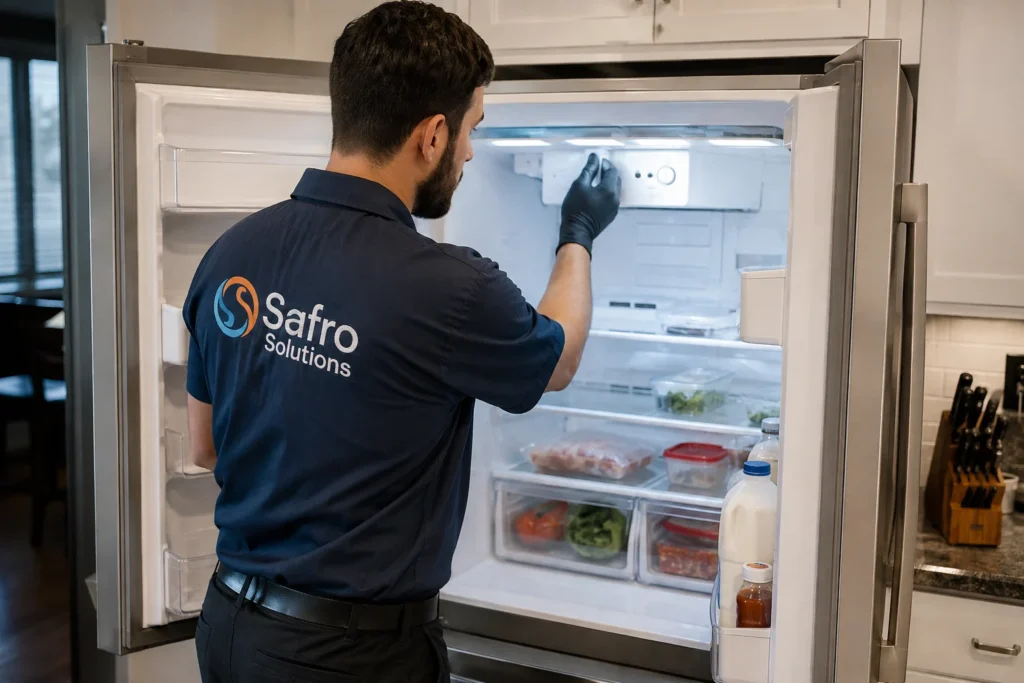
A refrigerator that freezes food is almost always caused by one of six things: the temperature set too low, a blocked air vent, an ice maker running with no water line connected, a leaky door seal, a faulty temperature sensor, or a clogged defrost drain. Most of these you can check yourself in a few minutes, starting with the easiest and most common cause first.
TL;DR
- Check the six causes in order, starting with the thermostat setting and the air vents before assuming a part has failed.
- If food freezes only at the back of the fridge or only in the crisper drawer, that narrows the cause fast.
- If you’ve worked through all six and food is still freezing, call Safro Solutions at (747) 250-6879 for same-day refrigerator repair in Los Angeles and the San Fernando Valley.
Why is my refrigerator suddenly freezing my food?
A refrigerator that starts freezing food out of nowhere usually means a setting got bumped, new groceries are blocking an air vent, or a part has failed, not that something is fundamentally wrong with the unit. Refrigerators are built to hold food a few degrees above freezing, typically in the high 30s Fahrenheit, so anything pushing the compartment colder than that will start icing over milk, produce, and anything sitting near an air vent.
The good news is that most causes have a clear fix, and checking them in order saves you from replacing a part that was never the problem. Work through the six causes below before assuming you need a repair.
Check these 6 causes in this order
Each cause below is listed in the order to check it, starting with what’s fastest to rule out and ending with what usually needs a technician.
1. Temperature set too low
The most common cause of a fridge freezing food is a temperature setting that’s colder than it needs to be. Refrigerators perform best for fresh food storage at around 37°F, according to Whirlpool’s own appliance guidance, and anything set noticeably colder than that pushes food toward the freezing point, especially items near the back wall or a vent.
Check your temperature dial or digital control panel and compare it against your owner’s manual’s recommended range. If it’s set colder than needed, adjust it up a notch and give the fridge 24 hours to stabilize before checking again, since refrigerators take time to reach a new setting evenly.
2. Blocked or overpacked air vent
Refrigerators have air vents, usually on the back wall, that circulate cold air from the freezer section into the fridge compartment to keep the temperature even. When food is packed tightly against that vent, it gets blasted with air that’s colder than the rest of the fridge and freezes first, even while the rest of the compartment reads normal.
The fix is straightforward: pull anything touching the vent forward a few inches and avoid stacking tall items directly in front of it. If you’ve recently reorganized your fridge or come back from a big grocery trip, this is often the actual trigger behind sudden freezing.
3. Ice maker running with no water line connected
An ice maker left in the “on” position without a connected water supply will keep trying and failing to make ice, and that repeated cycling can push extra cold air into the fridge compartment. This is easy to overlook because it’s not something most people think to check when food starts freezing.
If you don’t use your ice maker, or if it’s not hooked up to a water line, switch it to the off position. That alone resolves freezing in some fridges without touching any other setting.
4. Leaky or torn door seal
The rubber gasket around your refrigerator door keeps cold air inside the compartment. When it’s torn, warped, or coated in old food residue, it lets cold air leak out around the edges, which forces the compressor to run longer and colder to compensate, and that can freeze food near the vents.
Test it with a simple trick: close a piece of paper in the door and pull on it. If it slides out with little resistance, the seal isn’t gripping properly and needs cleaning or replacing. Check the full perimeter of the door, since a gasket can fail in just one section while looking fine everywhere else.
5. Faulty temperature sensor
The temperature sensor tells your fridge’s control board how cold the compartment actually is, and a sensor that’s reading wrong will cause the fridge to keep cooling well past where it should stop. This is harder to self-diagnose than the first four causes because the fridge can look like it’s working normally while quietly running too cold.
You can manually test it with the same method Whirlpool recommends: place a glass of water on the top shelf for 24 hours, then check its temperature with a cooking thermometer. If the water reads more than a couple degrees off from your fridge’s setting, the sensor is likely the problem, and that’s a part worth having a technician verify before replacing.
6. Clogged or frozen defrost drain
A clogged defrost drain lets meltwater from the automatic defrost cycle back up and refreeze inside the fridge compartment instead of draining away properly, and this shows up almost exclusively as ice buildup near the back wall or bottom of the fridge. It’s the least obvious cause on this list and the one most people don’t think to check.
This one usually needs a technician, since the drain access point and defrost heater are behind interior panels on most models. If you’ve ruled out the first five causes and you’re seeing ice specifically at the back or bottom of the compartment, a blocked defrost drain is the most likely remaining explanation.
Why is my fridge freezing food at the back but not in front?
Freezing that’s isolated to the back wall of the fridge points to the air vent or the defrost drain, not the thermostat. Both of those issues push extra cold air or trapped moisture into that one zone, while the rest of the compartment stays at a normal temperature because it’s farther from the source.
If you’ve confirmed food is only freezing within a few inches of the back wall, start with causes 2 and 6 above rather than working through the full list in order. That narrows the diagnosis considerably and can save you from unnecessarily adjusting the thermostat.
Why do my vegetables keep freezing in the crisper drawer?
Crisper drawers freeze vegetables when the humidity or vent setting on that specific drawer is set wrong for what’s inside it, not because of a problem with the main fridge temperature. Most crisper drawers have a slider that controls airflow into the drawer, and a setting meant for low-humidity produce can chill thin-skinned vegetables like lettuce or broccoli enough to frost them.
Check your crisper drawer’s humidity control and adjust it toward the higher-humidity or closed-vent setting for leafy greens and other delicate produce. If the crisper still freezes vegetables after that adjustment, it’s worth checking whether the main air vent (cause 2 above) is positioned too close to that drawer.
Is it safe to eat food that froze in the fridge?
Yes, food that accidentally froze in your refrigerator is safe to eat, though the texture and quality of some items will suffer. According to the USDA’s Food Safety and Inspection Service, frozen food remains safe indefinitely from a food-safety standpoint, since freezer storage time limits are about quality, not safety.
That said, some foods handle accidental freezing worse than others. Milk, lettuce, and other high-water-content items can turn watery or mushy once thawed, even though they’re still fine to consume. If anything in your fridge froze and then partially thawed while sitting at room temperature for an extended period, treat it the same way you would any food left in the danger zone and use your judgment on how long it was out.
Repair or replace? What an independent technician actually checks
Most causes of a fridge freezing food are inexpensive repairs, not a sign you need a new refrigerator. A misset thermostat costs nothing to fix, and even a failed temperature sensor, door seal, or defrost drain repair typically runs a fraction of what a new refrigerator costs.
Replacement starts to make more sense when the issue traces back to the sealed cooling system itself, meaning the compressor or refrigerant lines, especially on a fridge that’s already past the 10 to 15 year mark. An independent technician who isn’t trying to sell you a new unit can give you a straight answer on which category your fridge falls into before you spend money either way.
Safro Solutions has served Los Angeles and the San Fernando Valley, including Valley Village, Sherman Oaks, Studio City, Encino, Burbank, Van Nuys, and Northridge, with same-day appliance repair on all major refrigerator brands. Our technicians diagnose the actual cause on the spot instead of guessing, and you can see full details on our refrigerator repair Los Angeles page. If the issue turns out to be water-related rather than temperature-related, our guide on a water dispenser that’s slow or dripping covers that adjacent problem.
Ready to stop your fridge from freezing your food?
If you’ve worked through the causes above and your refrigerator is still freezing food, stop adjusting settings and get it diagnosed properly. A fridge running colder than it should puts extra strain on the compressor over time, and food that keeps freezing is food you’re losing money on. Safro Solutions sends a licensed technician to your door the same day in most cases, tests the actual cause instead of guessing, and gives you a straight answer on repair versus replacement before any work begins.
Safro Solutions
Valley Village, Los Angeles, CA 91607
Call or text: (747) 250-6879
Find us on Google Maps: https://maps.app.goo.gl/Tdof4dD9BS5Tk1i2A
Schedule your refrigerator repair online or see full coverage details on our refrigerator repair Los Angeles page.
Frequently asked questions
Q1: What are the signs of a failing fridge?
Look for the compressor running constantly without cycling off, condensation building up inside the compartment, food spoiling faster than usual, or unusual buzzing and rattling noises from the back panel. Any of these alongside freezing food is a sign it’s worth having a technician take a look rather than waiting.
Q2: How do I stop my fridge from freezing?
Work through the six causes in this guide in order, starting with the temperature setting and air vents, since those two account for most cases. If adjusting the thermostat and rearranging food near the vents doesn’t fix it within 24 hours, move on to checking the ice maker, door seal, sensor, and defrost drain.
Q3: Why is my fridge freezing food on the lowest setting?
A fridge that freezes food even on its warmest or lowest-cooling setting almost always means the temperature control itself isn’t working, whether that’s a faulty sensor, a stuck control board, or a mechanical thermostat that’s failed in the “always on” position. This isn’t something you can fix by adjusting a dial further, since the dial itself isn’t being obeyed.
Q4: Why is my fridge freezing food in the crisper drawers but nowhere else?
That’s almost always the crisper’s individual humidity or vent slider, not the main fridge temperature. See the crisper drawer section above for how to adjust it.
Q5: Is a refrigerator that’s freezing food covered under warranty?
Most new refrigerators carry at least a one-year manufacturer warranty on parts, and a fridge that’s freezing food within its first year is often either an installation issue or a defective part covered under that warranty. Check your warranty documentation and contact the manufacturer or retailer first if your unit is still new.