

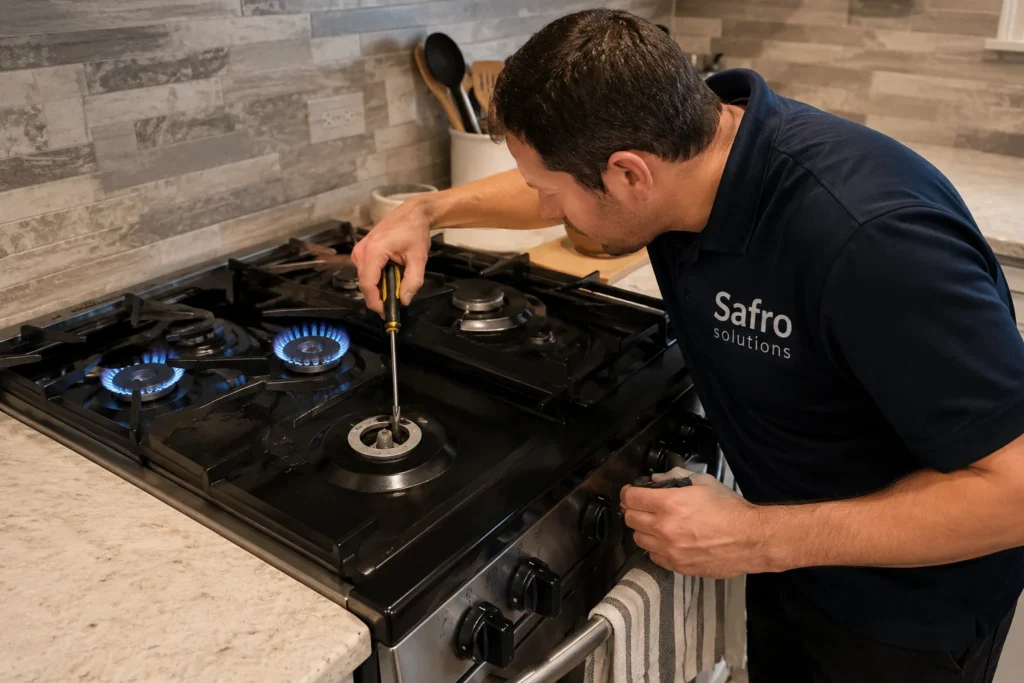
Most of the time, one or two dead burners on an otherwise working stove point to a single failed part, not a dying appliance. On electric ranges the usual cause is a burned-out coil, a loose receptacle, or a bad infinite switch. On gas ranges it’s almost always a clogged burner port or a misaligned burner cap restricting the flame on just that one burner.
TL;DR
- A stove that heats unevenly across burners is usually one bad part, not a full replacement. Electric ranges point to the coil, receptacle, or infinite switch. Gas ranges point to clogged ports or a shifted burner cap.
- This is a different problem from a burner that won’t light or click at all. If yours won’t ignite, see our gas cooktop ignition guide instead.
- Safro Solutions repairs stoves and cooktops across Los Angeles and the San Fernando Valley, most jobs $100 to $400. Call or text (747) 250-6879 for same-day diagnosis.
Is it electric or gas? Start here
Check what your dead burner does when you turn the knob: an electric burner that stays cold and dark is almost always a parts failure, while a gas burner that clicks or smells like gas but won’t produce a full flame is almost always a ports or cap issue. Electric and gas ranges fail through completely different systems, so the fix depends entirely on which type of stove you have.
If your burner clicks repeatedly and never lights at all, on any setting, that’s an ignition problem, not a heating problem, and it deserves its own diagnosis. Our gas cooktop ignition guide covers igniters, spark modules, and clicking-but-no-flame situations in detail. This article is for burners that turn on, or partially light, but don’t produce proper heat.
Electric stove: why one or two burners stay cold while others work
A single dead electric burner is almost always one of three things: a burned-out coil or radiant element, a loose or burnt receptacle, or a failed infinite switch. Each burner on an electric range runs through its own independent circuit, so a failure in one burner’s coil, socket, or switch has no effect on the others.
- Coil-style ranges. If you can unplug the burner, do a swap test: move the suspect burner to a socket where another burner works fine. If it heats up in the new spot, the coil element itself is fine and the problem is the original receptacle or switch. If it stays cold in both spots, the coil element has failed and needs replacement. Look for black soot, pitting, or melted plastic on the receptacle block itself. That kind of damage means the connection has been arcing, which is both a fire risk and the reason the burner isn’t getting full power.
- Glass and smooth top ranges. You can’t swap-test a radiant element the same way, since it’s fixed under the glass. A burner that stays cold usually means either the radiant element itself has failed, or the infinite switch behind the control knob has stopped sending power to it. A cracked or blistered element visible through the glass confirms the element is the problem. If the glass looks fine, the switch is the more likely culprit.
- Infinite switch failure. The infinite switch is the knob-controlled dial that regulates how much power reaches the burner. A common and confusing symptom: the “hot surface” indicator light stays on even though the burner itself is cold, because the light and the heating circuit run on separate paths inside the switch. A failed infinite switch can send zero power to the element while the light circuit still works normally, which is exactly why testing the burner directly, not just watching the indicator light, matters.
Gas stove: why one burner flame is weak while others burn strong
A gas burner that lights but produces a small, weak, or uneven flame while the others burn normally almost always comes down to something physically blocking gas flow to that one burner, not an ignition failure. The most common cause is food residue or grease clogging the small ports around the burner head, which restricts how much gas actually reaches the flame even though the burner is technically lit.
The second most common cause is a burner cap that’s sitting slightly off-center or was set back down on the wrong burner base after cleaning. Gas burner caps and rings are sized to specific burners, and a cap that’s even slightly misaligned changes how the flame distributes around the ring, producing a weak or lopsided flame on that burner only.
A quick visual check settles most of these cases: pull the burner cap and ring, and look for dark buildup in the small holes around the burner head. Clean them out gently with a soft brush or a toothpick, never a metal object that could enlarge or damage the ports, then reseat the cap so it sits flat and centered before testing again.
If the flame issue is paired with clicking, no ignition at all, or a burner that won’t light on any setting, that’s a different failure mode covered in our gas cooktop ignition guide, not this one.
Why does only one burner fail when the others are fine?
Each burner on your stove, whether gas or electric, runs on its own independent power or gas path, so a failure in one burner’s circuit or supply line has zero effect on the others. On an electric range, each burner has a dedicated receptacle, switch, and wiring run back to the control panel. On a gas range, each burner has its own valve and port set, even though they all draw from the same main gas line. That’s the mechanical reason a single burner can go out completely while the rest of the stove works normally, and it’s also good news: it means the fix is almost always isolated to one part, not the whole appliance.
Safe checks you can do before calling a technician
A few checks are safe to do yourself and can save you a diagnostic fee if the fix turns out to be simple.
- Swap test (electric coil burners only): move the dead burner to a working socket. If it heats there, the socket or switch is the problem, not the element.
- Visual inspection: look for scorch marks, melted plastic, or pitting on receptacles, and cracks or blistering on glass-top surfaces.
- Gas burner cap check: remove, clean, and correctly reseat the burner cap and ring, making sure it sits flat and centered.
- Circuit breaker check: confirm the breaker feeding the range hasn’t partially tripped, which can sometimes affect only part of a range’s circuits.
Always cut power at the breaker before touching any electric burner wiring or receptacle. Don’t attempt to open a sealed glass cooktop panel or work on gas valves and connections yourself. If any of these checks reveal burn marks, a persistent gas smell, or arcing, stop and call a professional rather than continuing to test it.
What burner repair costs in Los Angeles and the San Fernando Valley
Safro Solutions services Los Angeles and the San Fernando Valley, including Valley Village, Sherman Oaks, Studio City, Encino, Beverly Hills, Tarzana, Woodland Hills, Burbank, Van Nuys, Northridge, and Pasadena. Across these service areas, stove repairs typically run $100 to $400 total, and cooktop repairs run $80 to $400, with a glass cooktop surface replacement running higher, $400 to $1,500. Igniter and burner element replacements usually land under $200. The service call fee is $69 to $129 and is applied toward the repair cost when you move forward with the fix.
Repair | Typical cost range |
| Burner coil/element replacement | Under $200 |
Receptacle or infinite switch replacement | Under $200 |
| Gas burner cap/port cleaning | Included in service call in most cases |
Glass cooktop surface replacement | $400 to $1,500 |
| Full stove/range repair (average) | $100 to $400 |
Full cooktop repair (average) | $80 to $400 |
Diagnostic/service call fee | $69 to $129 (waived toward repair) |
When it’s time to call a professional
Stop troubleshooting and call a licensed technician if you notice burn marks, melted plastic, or arcing around an electric burner receptacle, since the Consumer Product Safety Commission’s guide to home wiring hazards notes that a receptacle that arcs when you remove a plug means current is still flowing through the connection, which is a fire and shock risk that needs a qualified electrician, not a DIY fix (CPSC Guide to Home Wiring Hazards).
On a gas range, stop immediately and evacuate if you smell gas at any point, even faintly, rather than continuing to troubleshoot the burner. SoCalGas is explicit on this: if you smell natural gas or suspect a leak, evacuate the area immediately, don’t operate any electrical switches or appliances, don’t light a flame, and call from a safe location rather than trying to locate or fix the leak yourself (SoCalGas natural gas leak safety information). SoCalGas can be reached at 1-800-427-2200 to report a suspected leak.
If your checks point to a bad coil, switch, receptacle, or persistent gas flow issue and you’d rather not open up the range yourself, Safro Solutions sends a licensed, insured technician same-day in most cases across Los Angeles and the San Fernando Valley, diagnoses the actual cause instead of guessing, and backs the repair with a 90-day warranty on parts and labor.
Ready to get your stove’s burners working again?
If you’ve worked through the checks above and one or more burners still won’t heat properly, stop testing and get it diagnosed properly. A burner running on a damaged receptacle or a partially blocked gas port doesn’t fix itself, and continuing to use it that way is both a safety risk and, on the electric side, a way to eventually damage the switch or wiring around it too. Safro Solutions sends a licensed technician to your door the same day in most cases, tests the actual cause instead of guessing, and gives you a straight answer on repair versus replacement before any work begins.
Safro Solutions
Valley Village, Los Angeles, CA 91607
Call or text: (747) 250-6879
Find us on Google Maps: https://maps.app.goo.gl/Tdof4dD9BS5Tk1i2A
Schedule your stove or cooktop repair online or see full coverage details on our stove repair Los Angeles page and cooktop repair Los Angeles page.
Frequently asked questions
Q1: Why are my stove burners getting warm but not hot?
A burner that gets warm but never reaches full heat usually points to a weakening element or a failing infinite switch that isn’t delivering full power, rather than a complete failure. On gas burners, the same “warm but not hot” symptom usually means partially clogged ports restricting gas flow rather than blocking it entirely.
Q2: Is it worth repairing an electric stove burner, or should I replace the whole stove?
In most cases, repairing a single burner is worth it. A coil, receptacle, or infinite switch replacement typically runs under $200, which is far less than replacing an entire range. Replacement usually only makes more financial sense if multiple systems are failing at once or the stove is already well past its typical service life.
Q3: How much does it cost to fix a stove burner in Los Angeles?
Most single-burner repairs in the Safro Solutions service area run under $200 for parts like a coil, receptacle, or infinite switch, with full stove repairs typically totaling $100 to $400 depending on the issue. Cooktop repairs run $80 to $400, and a full glass cooktop surface replacement runs $400 to $1,500.
Q4: Why does only one burner not heat while the rest of the stove works fine?
Each burner has its own independent electrical circuit or gas port set, so a failure is isolated to that one burner’s coil, switch, receptacle, or port rather than affecting the whole stove. This is also why a single-burner repair is usually inexpensive compared to a whole-appliance issue.
Q5: Can a burner be fixed without replacing the whole stove?
Yes, in nearly all cases. Burner coils, receptacles, infinite switches, and gas burner caps are all individually replaceable or serviceable parts, and replacing just the failed component is the standard repair rather than replacing the entire range.
Q6: Why is one burner not working on my glass top electric stove specifically?
On a glass or smooth-top range, a single dead burner usually means either the radiant element under the glass has failed, visible as cracking or blistering, or the infinite switch behind that burner’s control knob has stopped sending it power. Unlike coil burners, you can’t easily swap-test a glass-top element, so a technician typically checks the switch with a multimeter first since it’s the more common and less expensive fix.
Q7: How long do stove burner elements and infinite switches typically last?
Burner coils and infinite switches don’t have a fixed lifespan and tend to fail individually rather than on a schedule, often after years of normal use, though heavy daily cooking or repeated moisture exposure can shorten that. A single burner failing while the rest of the range works normally is common and doesn’t usually indicate the appliance is near the end of its life.