

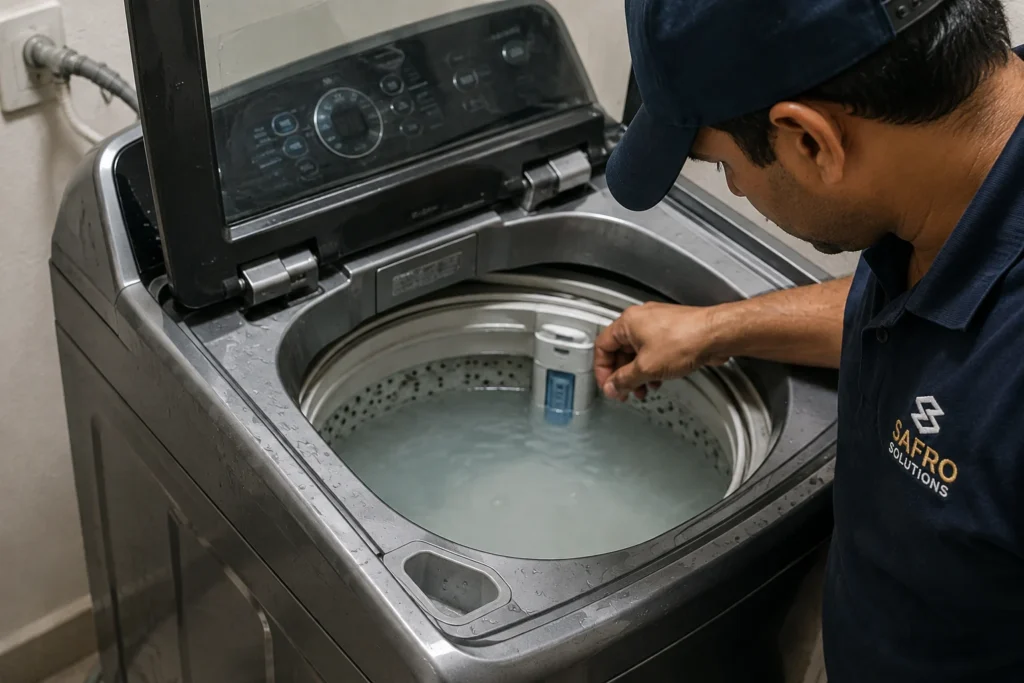
A top loader stuck with water is almost always one of four things, and they should be checked in this order: a lid switch that isn’t sensing the lid as closed, too many suds from the wrong detergent, a kinked or blocked drain hose, or a failed internal drain pump. Unlike front-load washers, top loaders don’t have an easy-access filter, so the fix usually starts outside the machine and only moves inside if the first three checks come up clean.
TL;DR
- Check the lid switch first. It’s the cheapest thing to rule out and the most common cause on top loaders.
- No accessible filter here. Top loaders trap debris inside the pump housing, not behind a panel you can open by hand.
- Still full after checking the switch, suds, and hose? The pump likely needs a professional look. Call Safro Solutions at (747) 250-6879 for same-day service in Los Angeles.
Why is my top load washer stuck full of water?
A top loader gets stuck full of water when the machine either can’t confirm it’s safe to drain, or the drain path itself is blocked. Those are two different problems, and telling them apart saves you from opening panels you don’t need to touch.
The “can’t confirm it’s safe” side comes down to the lid switch, a small sensor under the lid that tells the control board the lid is shut. If it fails, the washer behaves as if the lid is open and won’t advance to drain, even with a full drum sitting there. The “blocked path” side runs through the drain hose, out the back of the machine, into your home’s standpipe. A kink, a clog, or a dead pump anywhere along that path leaves the water exactly where you found it.
Here’s the detail that changes how you should troubleshoot a top loader versus a front-load washer: front-loaders have a coin trap filter behind a small panel you can open and clean yourself in fifteen minutes. Most top loaders don’t. The pump filter, where one exists, sits inside the machine’s housing, not behind an access door. That’s why the checklist below starts outside the machine and works inward, instead of sending you straight to a filter that likely isn’t there.
Step 1: Check the lid switch first
The lid switch is the first thing to test because it’s the cheapest to rule out and the most common reason a top loader won’t drain. Open the lid, then close it firmly and listen for a click. Some machines use a simple mechanical switch under the lid frame; others use a lid lock assembly that engages with a motor.
To test it: start a drain or spin cycle, then press down on the lid switch by hand while the lid is open. If the machine responds (the motor engages, the display changes, anything happens), the switch itself may just need realigning. If nothing happens no matter how firmly you close the lid, the switch has likely failed and needs replacement. This is a safety-rated part, so if the switch is confirmed bad, this is where DIY should stop and a technician should take over.
If the lid switch checks out and the washer still won’t move past this point, the next most common cause on a top loader isn’t a mechanical part at all. It’s what’s inside the water.
Step 2: Rule out oversudsing
Too many suds can stop a top loader from draining just as effectively as a broken part, and it’s worth ruling out before you touch anything mechanical. High-efficiency (HE) top loaders are built for low-suds HE detergent in small amounts. Regular detergent, or too much of either kind, creates a layer of foam the pump reads as a fault and simply stops rather than fight through it.
The quick test: skip the wash and run the machine’s Drain & Spin cycle on its own. If the washer drains fine once there’s no active sudsing happening, oversudsing was the cause, and the fix going forward is using less detergent, or switching to an HE formula if your machine calls for one. The U.S. Environmental Protection Agency’s ENERGY STAR clothes washer program specifically recommends HE detergent in HE-rated machines for this reason, since regular detergent is formulated for older, high-water machines and oversudses badly in low-water HE cycles. If it still won’t drain on that cycle, the problem is mechanical, and the next place to look is the hose.
Step 3: Check the drain hose for kinks or clogs
The drain hose is the physical link between your washer and your home’s plumbing, and it’s easy to check without any tools. Pull the machine away from the wall and look at the corrugated hose running from the back of the machine down into the standpipe. A sharp bend, a hose pinched behind the machine, or a hose pushed too far down into the standpipe can all stop water from leaving even when the pump is working fine.
Straighten any kinks you find and make sure the hose isn’t buried more than a few inches into the standpipe opening. If you want to confirm the hose itself is clear, disconnect it and lower the loose end into a bucket set below the level of the drum. If water flows freely by gravity alone, the hose is fine and the pump or the standpipe is the remaining suspect. If nothing comes out, the clog is inside the hose, and a plumber’s snake or a straightened wire hanger can usually clear it.
A hose that’s clear and still leaves you with standing water points to the one part on a top loader you can’t check with your hands.
Step 4: When it’s the internal drain pump
If the lid switch, suds, and hose all check out clean, the drain pump itself is the most likely remaining cause, and this is where a top loader differs from a front loader in a way that matters. A front-load washer’s pump filter sits behind an access panel you can open. A top loader’s pump is typically mounted underneath the tub, inside the cabinet, with no user-facing door. Reaching it means tipping the washer forward, disconnecting hoses, and removing a mounting bracket, which is exactly the kind of job where a wrong move can crack a hose fitting or strain the tub suspension.
This is the point in the process where most homeowners are better off calling a technician than continuing to disassemble the machine. A jammed impeller can sometimes be cleared, but a burned-out pump motor needs replacement, and neither is something you can diagnose from the outside.
How to safely drain a top loader manually right now
If you need the standing water out before you can troubleshoot further, or before you can safely move the machine, top loaders drain manually through the main hose rather than through a filter panel. Unplug the washer first. Lay towels around the base and have a bucket ready.
Pull the machine away from the wall far enough to reach the drain hose, then disconnect it from the standpipe. Keeping the open end above the water line until you’re ready, lower it into the bucket, positioned below the level of the tub so gravity pulls the water down. Expect to empty the bucket more than once for a full load. If water comes out slowly or not at all once the hose is lowered, the blockage is in the hose or the pump rather than the standpipe, which tells you where Step 3 or Step 4 above should pick up.
Which cause matches your symptoms
| Symptom | Likely cause | DIY or call a pro |
|---|---|---|
| Lid closes fine, nothing happens when you start a cycle | Failed lid switch | Call a pro (safety-rated part) |
| Water is foamy or bubbly when you open the lid | Oversudsing | DIY: run Drain & Spin, adjust detergent |
| Hose is visibly bent or pinched behind the machine | Kinked or clogged hose | DIY: straighten, clear, or replace hose |
| Hose is clear, water still won’t drain | Internal drain pump | Call a pro |
| Humming sound but no water movement | Jammed or failed pump | Call a pro |
| Washer won’t even start the cycle | Lid switch or power issue | Check breaker first, then call a pro |
What a top loader drain repair costs in Los Angeles
In the Los Angeles area, a top loader drain repair typically runs $160 to $340 in labor for a lid switch, hose, or straightforward pump service, with parts quoted separately after diagnosis. A full drain pump replacement generally lands around $300 to $400 for parts and labor combined, which lines up with the national pump-replacement figures reported by cost-data site Fixr. Most companies, including Safro Solutions, charge a diagnostic or service call fee in the $50 to $130 range that gets applied to the repair once you approve the work.
Whether repair makes sense depends on the machine’s age. If your top loader is under about eight years old, a lid switch, hose, or pump repair is almost always worth it against the cost of a new machine. Once a washer is past ten years old and the repair quote starts climbing toward half of what a replacement would cost, that’s the point worth a second look before committing.
When to call a professional instead of DIY-ing it
Call a technician once you’ve checked the lid switch, ruled out suds, and confirmed the hose is clear, and the washer still won’t drain. At that point the remaining cause is almost always the internal pump, a wiring issue, or a control board fault, all of which need the machine opened up and tested with the right tools. You should also call right away if you hear grinding or burning smells during a cycle, or if water is backing up from the standpipe itself, since that’s a plumbing problem rather than a washer problem.
Safro Solutions repairs top-load, front-load, and stackable washers across Los Angeles and the San Fernando Valley, with same-day appointments when you call before noon. If you’ve worked through the steps above and your top loader is still stuck full of water, our washer repair Los Angeles service page has full pricing and same-day booking, or you can see our washer full of water won’t drain guide for the front-load-specific version of this troubleshooting process.
Need a top loader repair in Los Angeles?
Worked through every step above and your top loader is still stuck full of water? That’s the point where guessing costs more than calling. Safro Solutions sends a licensed technician to your door the same day, anywhere across Los Angeles and the San Fernando Valley, and diagnoses the exact cause before any repair work starts.
Safro Solutions
Valley Village, Los Angeles, CA 91607
Call or text: (747) 250-6879
Find us on Google Maps: https://maps.app.goo.gl/Tdof4dD9BS5Tk1i2A
Frequently asked questions
Q1: Why is my top load washer full of water and won’t drain?
The most common causes, in order of likelihood, are a failed lid switch, too many suds from detergent, a kinked or blocked drain hose, or a failed internal drain pump. Top loaders don’t have an accessible filter the way front-load washers do, so the pump is harder to rule out yourself.
Q2: Is it safe to manually drain a top loader myself?
Yes, as long as you unplug the machine first. Disconnect the drain hose from the standpipe, lower the open end into a bucket set below the drum, and let gravity pull the water out. Avoid reaching into the tub or working on the machine while it’s still plugged in.
Q3: Can too much detergent cause a top loader not to drain?
Yes. Excess suds, especially from regular detergent used in an HE machine, can be read by the washer as a fault and stop the drain step. Running a Drain & Spin cycle on its own is the fastest way to confirm this before assuming a mechanical failure.
Q4: How do I know if it’s the lid switch and not the pump?
Press the lid switch by hand with the lid open while a cycle is running. If the machine responds at all, the switch may just need realignment. If nothing happens regardless of how the lid is closed, the switch has likely failed. A pump problem, by contrast, usually shows up as a humming sound or complete silence during the drain step, with the lid switch working normally.
Q5: Do top load washers have a filter I can clean myself?
Most don’t, unlike front-load washers. Front-loaders have a coin trap filter behind an access panel you can open by hand. On most top loaders, the pump and any filter sit inside the cabinet, which is why a suspected pump issue on a top loader more often needs a technician.
Q6: How much does it cost to fix a top loader that won’t drain in Los Angeles?
Typical labor runs $160 to $340 for a lid switch, hose, or pump service call in the Los Angeles area, with a full pump replacement around $300 to $400 for parts and labor. Safro Solutions quotes the exact price after diagnosis, before any repair work begins.