

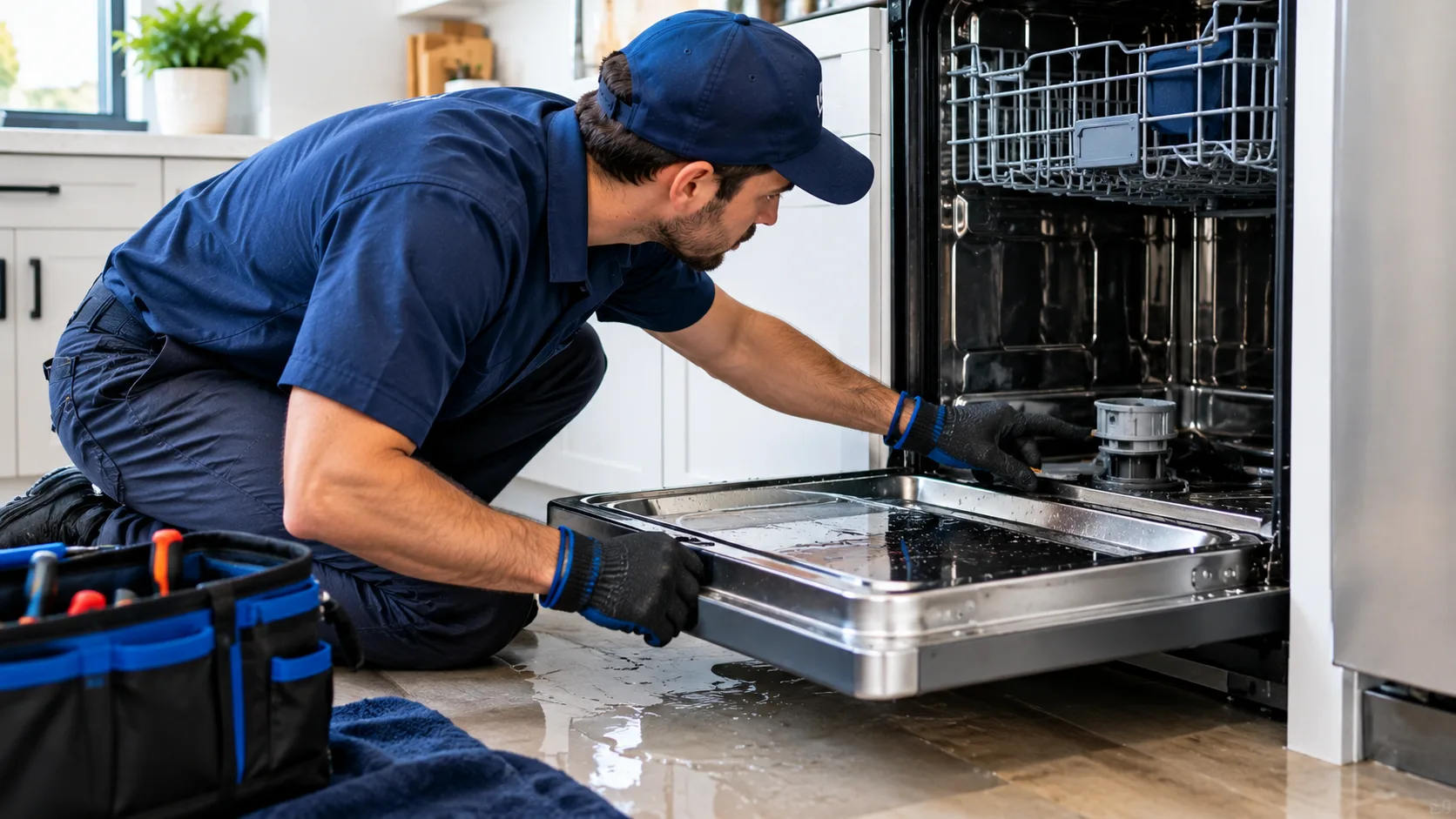
A dishwasher that overflows usually has either a float system that fails to stop the fill cycle or a water inlet valve that does not close fully. The fastest clue is timing: water entering while the dishwasher is idle points to the inlet valve, while overfilling during a running cycle often points to the float, switch, or the control system connected to it.
Key takeaways
- Clear water overflowing during a wash cycle can involve the float assembly, float switch, or water inlet valve. Foam pushing out from the door is usually a detergent or rinse-aid problem instead.
- If water keeps appearing in the tub after the dishwasher has been off for hours, the inlet valve may be stuck open or leaking internally.
- A float is designed to rise with the water level and trigger the float switch, which stops the flow of water into the dishwasher.
- On many Whirlpool dishwashers, an inlet-valve multimeter reading around 1,400 ohms is typical; infinite resistance indicates an electrically failed valve. Your model’s technical sheet may specify a different range.
- If water is spreading across the floor, turn off power and the water supply first. Then review what to do when a dishwasher floods the kitchen floor before restarting the appliance.
- For a diagnosis in Los Angeles or the San Fernando Valley, Safro Solutions provides dishwasher repair in Los Angeles. Call (747) 250-6879 to schedule help.
Is your dishwasher overflowing with water or with suds?
The first step is to tell whether you are dealing with clear water or with foam. If you open the door and see mostly bubbles or soap foam pushing out, the problem is usually detergent-related rather than a failed float or valve. GE Appliances explains that when excessive suds are present, you should turn off the dishwasher and allow the suds to dissipate before pumping out the remaining water.
If what you see is mostly clear water, then mechanical or control components are more likely. A stuck float, a failed float switch, or an inlet valve that will not close can all cause the tub to overfill with water. The float is meant to rise as the water level increases, and when it reaches a set height it triggers the float switch to stop the flow of water into the dishwasher.
Detergent type and amount matter here. Using regular dish soap or too much dishwasher detergent can create more suds than the system can handle, and those suds can push water out around the door gasket. GE specifically warns that using the wrong type or too much detergent can cause over-sudsing and leaks.
If your overflow is mostly foam, stop the cycle, remove as much suds as you can, and run a rinse cycle with no detergent. If it is mostly clear water, keep reading to separate float-related issues from inlet-valve-related issues.
Does it stop filling when you open the door?
Opening the door during a fill cycle is a quick diagnostic step. On most modern dishwashers, the door switch is a safety feature that should interrupt the fill cycle. If the water stops entering as soon as you open the door, that indicates the control system and door switch are responding as designed. If water keeps flowing in even with the door open, that points more strongly toward a mechanical failure in the inlet valve or its internal seal.
This test does not prove which part has failed, but it helps narrow the possibilities. A dishwasher that keeps filling with the door open is more suspicious for a stuck-open inlet valve. A unit that stops filling when the door opens, yet still overfills during normal cycles, is more consistent with a float or float-switch issue or a control board that is not honoring the float signal.
If you see water continuing to enter with the door open, shut off the water supply to the dishwasher and avoid running it again until it has been inspected.
How the float system and inlet valve work together
Understanding how these parts interact makes the symptoms easier to interpret. The float is a small plastic dome or cylinder that sits in the bottom of the tub. As water fills the dishwasher, the float rises. When it reaches a preset height, it actuates the float switch, which signals the control to stop sending power to the water inlet valve.
The water inlet valve is an electrically operated solenoid valve that regulates the flow of water from your home’s supply into the dishwasher tub. It opens precisely when the appliance requires water and should close tightly when the cycle is complete or when the float switch signals that the tub is full, according to technical explanations of how the water inlet valve works.
In normal operation, the float and float switch are the “brakes,” and the inlet valve is the “faucet.” If the brakes fail (stuck float or failed switch), the faucet may keep opening on command. If the faucet itself is damaged internally, it can leak or stay partially open even when the control tells it to close. That is why both sides of the system can lead to overflow, but in slightly different ways.
Whirlpool technical documents describe checking that the float moves freely and that you can hear the click of the switch contacts as part of diagnosing overfill problems.
Float switch failure vs inlet valve failure: symptom comparison
This side-by-side view focuses on how the two failure modes tend to look in real use. Individual models vary, but the patterns below are common across many brands.
Symptom or clue | More consistent with float / float switch issue | More consistent with inlet valve issue |
| When overflow happens | During a fill portion of a cycle, especially near the end of filling | Can happen during a cycle and also when the dishwasher has been off for hours |
| Water in tub after being off | Less common unless the float is mechanically stuck in the down position | More common if the valve’s internal seal or plunger does not close fully |
| Door-open test | Fill often stops when the door is opened, because the control still responds | Water may continue to seep or trickle in even with the door open if the valve is mechanically stuck |
| Sound clues | You may hear the fill stop, but the tub still reaches too high a level before stopping | You may hear a faint hiss or continuous water flow when the unit should be quiet |
| Relationship to detergent | Not directly related to suds; usually clear water overflow | Not directly related to suds; usually clear water overflow |
| Typical failure mode | Float stuck down, float switch contacts corroded or failed, or control ignoring the signal | Valve solenoid failed, debris holding the plunger open, or internal seal leaking |
If your symptoms line up more with the left column, the float system is the stronger suspect. If they line up more with the right column, the inlet valve deserves closer inspection.
How to test a float switch and inlet valve with a multimeter
Safety first: disconnect power to the dishwasher at the breaker or unplug it, and shut off the water supply before removing any panels or testing electrical components.
Testing the float switch
- Locate the float assembly in the bottom of the tub, usually on the right side near the front. Remove any debris that might prevent it from moving freely, as recommended in Whirlpool service guidance.
- Gain access to the float switch. On many models this requires removing the lower kick plate or inner access panel.
- Disconnect the wires from the float switch terminals. Set a digital multimeter to the continuity or resistance (ohms) setting.
- With the float in the down position, measure across the switch terminals. Many healthy switches show continuity or a low resistance reading in one position and open in the other.
- Manually raise the float and measure again. You should see the reading change as the switch toggles. If the reading never changes, the switch is likely failed and should be replaced.
Testing the water inlet valve
- Locate the inlet valve, usually at the front bottom of the unit where the water line connects.
- Disconnect the wire harness from the valve terminals.
- Set the multimeter to resistance (ohms). Place one probe on each terminal of the solenoid coil.
- Read the resistance. On many Whirlpool dishwashers, a typical healthy reading is in the range of roughly 1,200 to 1,600 ohms; a reading of infinite resistance (open circuit) indicates a failed solenoid.
- If the reading is far outside the expected range for your model, or if the valve shows signs of corrosion or leakage, replacement is usually the next step.
Always defer to your model’s technical sheet for exact specifications. The numbers above are common patterns, not universal rules.
Why a stuck-open inlet valve causes overflow, not just underfilling
Many guides focus on inlet valves that fail to open, causing a “not filling” problem. But the same part can also fail in the opposite direction. If the valve’s internal plunger or seal does not close completely, water can continue to seep into the tub even when the control is not calling for fill. Over time, this slow leak can raise the water level enough to trigger the float, cause the drain pump to run repeatedly, or eventually overflow onto the floor, as explained in technical discussions of inlet valve failure symptoms.
This is why a dishwasher that appears to be “overfilling” can sometimes trace back to the inlet valve rather than the float. The float may be doing its job, but the valve is allowing more water in than the system can manage.
If you have already read our guide on dishwasher not filling with water, you will notice the same part discussed from the opposite angle: there, the focus is on valves that do not open; here, the focus is on valves that do not close.
What drives the repair cost up or down
Exact costs vary by model, brand, and local labor rates, but a few factors consistently influence the final bill for overflow-related repairs.
- Which part is involved: Float and float-switch assemblies are generally smaller and quicker to access than inlet valves, which often require disconnecting and reconnecting the water line.
- Accessibility: Some models require removing the entire dishwasher from the cabinet to reach the inlet valve or float switch, which adds labor time.
- Brand and part type: Premium brands and specialty parts can cost more than standard models. OEM parts usually cost more than compatible aftermarket parts.
- Extent of water damage: If overflow has reached cabinets, flooring, or adjacent rooms, the job may expand from a simple parts replacement to a larger water-damage mitigation project. For context on that scenario, see what to do when a dishwasher floods the kitchen floor.
In the San Fernando Valley and greater Los Angeles area, float-related repairs tend to fall on the lower end of the cost spectrum, while inlet-valve replacements and jobs that involve water-line work tend to run somewhat higher due to the extra labor and shutoff steps.
DIY fix or call a Safro technician?
Some homeowners are comfortable testing a float switch or inlet valve with a multimeter and replacing the part if the readings are out of range. If you have experience with basic electrical safety, shutoff valves, and appliance panels, a float or switch replacement can be a reasonable DIY project.
Call a professional instead if:
- Water is still entering the tub with the dishwasher off.
- You are not comfortable working with water lines and electrical connections.
- The overflow has already caused visible water damage to cabinets or flooring.
- The unit is under warranty and you want to avoid voiding it.
Safro Solutions provides licensed dishwasher repair in Los Angeles and serves communities across the San Fernando Valley, including Valley Village. If you would rather have a technician diagnose the problem on site, you can contact Safro Solutions or call (747) 250-6879.
Contact Safro Solutions for dishwasher help
If your dishwasher is overflowing or you are unsure which part is at fault, a trained technician can diagnose the problem safely and efficiently. Safro Solutions provides licensed dishwasher repair in Los Angeles and serves neighborhoods throughout the San Fernando Valley, including Valley Village.
Safro Solutions
5331 Corteen Pl, Valley Village, CA 91607
Call: (747) 250-6879
Find us on Google Maps: https://share.google/x0w7LKq8nk9yGxPvk
For more on related issues, you can also read about dishwashers that won’t drain completely or review what to do when a dishwasher floods the kitchen floor.
Frequently asked questions
Q1: Can a dishwasher overflow even when it is turned off?
Yes. If the water inlet valve is stuck open or leaking internally, water can slowly fill the tub even when the dishwasher is off. This is different from a float issue, which usually shows up during a fill cycle, as noted in technical overviews of inlet valve failure modes.
Q2: Is a float switch the same as a water inlet valve?
No. The float and float switch sense the water level and signal the control to stop filling. The inlet valve is the mechanical gate that actually lets water into the tub. Both can cause overflow when they fail, but in different ways.
Q3: How do I know if my float switch is bad?
Common signs include the tub filling higher than usual before the fill stops, the float moving freely but the fill not stopping, or multimeter tests showing no change in continuity or resistance as the float moves, as described in Whirlpool service sheets.
Q4: What resistance should a dishwasher inlet valve read?
It depends on the model, but many Whirlpool dishwasher inlet valves read in the neighborhood of 1,200 to 1,600 ohms on a healthy solenoid coil. Infinite resistance usually means the coil is electrically open and the valve needs replacement. Always check your model’s technical documentation for exact specs.
Q5: Can too much detergent cause a dishwasher to overflow?
Excess detergent usually causes suds and foam that can push water out around the door, rather than a true mechanical overfill. GE notes that using the wrong type or too much detergent can cause over-sudsing and leaks.
Q6: Should I replace the float switch or the inlet valve first?
That depends on your symptoms and test results. If the multimeter shows a failed float switch, start there. If the valve reads out of spec or water enters with the unit off, the inlet valve is the stronger suspect. When in doubt, a professional diagnosis can prevent replacing the wrong part.