

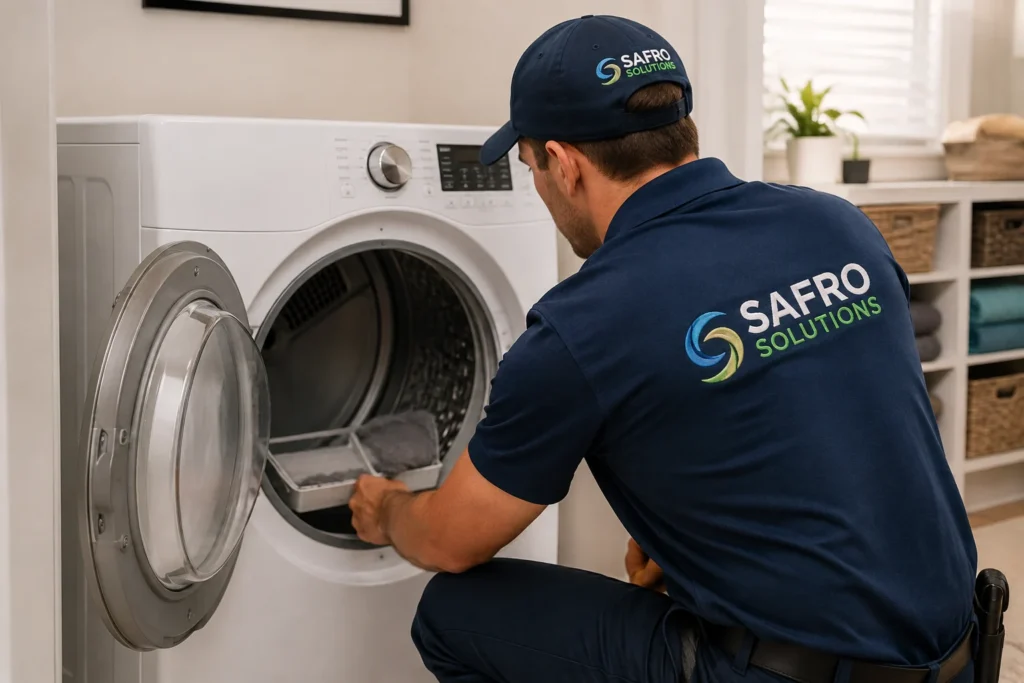
A dryer that needs 2 or 3 cycles to dry one load is almost always an airflow problem, not a failing dryer. In order of likelihood: a clogged exhaust vent, a filmed-over lint screen, an overloaded drum, a coated moisture sensor, or, least commonly, a worn heating element. A 5-step check in order tells you which one in a few minutes.
Key takeaways
- A dryer that needs 2 or 3 cycles to dry one load is almost always an airflow problem, not a dead dryer — a clogged exhaust vent is the single most common cause.
- Run a ranked 5-step check before calling anyone: outside vent airflow, lint screen film, load size, moisture sensor, then the heating element.
- Overloading the drum blocks airflow inside the dryer itself, separate from a clogged vent outside it.
- A dryer that’s hot to the touch but still leaves clothes damp points to airflow, not the heating element — a dryer that never gets warm points to the heating element instead.
- Gas dryers add one more possible cause: a weak igniter or gas valve, on top of everything electric dryers can have.
- Failure to clean the dryer (lint buildup) is the single leading cause of clothes dryer fires, responsible for 34% of them, according to the U.S. Fire Administration — this isn’t just a drying problem.
- If the 5-step check doesn’t fix it, or the dryer smells hot or feels hot on the outside, stop troubleshooting and call a technician.
- Safro Solutions offers same-day dryer diagnosis across the Los Angeles / San Fernando Valley area at (747) 250-6879.
Jump to a section
- Why does a dryer need 2 or 3 cycles to dry one load?
- What order should you check these causes in?
- How does a clogged vent cause a dryer to run multiple cycles?
- Could overloading the dryer be the real cause?
- Is it the heating element instead of airflow?
- Is a gas dryer different from an electric dryer for this problem?
- How long should a dryer cycle normally take?
- When should you call a professional?
- Frequently asked questions
Why does a dryer need 2 or 3 cycles to dry one load?
In the large majority of cases, it’s airflow, not a broken dryer. The dryer heats the air fine, but something is stopping that hot, moist air from leaving fast enough, so the load comes out of the first cycle still damp.
In order of how often each cause shows up: a clogged exhaust vent is by far the most common, followed by a lint screen coated in an invisible waxy film, an overloaded drum, a moisture sensor that’s stopped reading correctly, and, least commonly, a genuinely worn heating element.
Gas dryers add one more possibility on top of this list: a weak igniter or gas valve that’s heating inconsistently rather than failing outright.
What order should you check these causes in?
Most guides just list every possible cause with no order. Check these five in this exact sequence, since it goes from most common and easiest to check, to least common and hardest.
- Feel the airflow at the outside vent hood while the dryer runs. Weak or no airflow at the exterior vent means a blocked vent line — this is the cause in most cases.
- Run the water-bead test on the lint screen. Pour a few drops of water on the mesh; if the water sits on top instead of soaking through, a waxy film from dryer sheets or fabric softener is blocking airflow through the screen itself.
- Check the load size. The drum should be no more than about three-quarters full. A packed drum can’t tumble properly, which traps humid air against the clothes instead of moving it toward the vent.
- Wipe the moisture sensor bars (two small metal strips inside the drum) with a cloth and rubbing alcohol. A film-coated sensor can misread clothes as dry and end the cycle early, which looks identical to a drying failure from the outside.
- If none of the above fix it, suspect the heating element. This is the least common cause of the five, but it’s the next step once airflow and load size are ruled out.
How does a clogged vent cause a dryer to run multiple cycles?
A dryer works by pushing hot, moist air out through the exhaust vent while pulling in fresh air to keep heating. When the vent is restricted by lint, that moist air has nowhere to go, so it recirculates inside the drum instead of leaving.
This isn’t only a drying problem — it’s a real fire risk. According to the U.S. Fire Administration, failure to clean the dryer was the leading contributing factor in residential clothes dryer fires, responsible for 34% of them (U.S. Fire Administration, Clothes Dryer Fires in Residential Buildings). A dryer that suddenly needs two or three cycles is often an early warning sign of the exact buildup that leads to those fires.
For the full step-by-step vent test and cleaning walkthrough, see our clogged dryer vent guide, which also covers the difference between a vent clog and a lint-trap clog.
Could overloading the dryer be the real cause?
Yes, and it’s a different mechanism from a clogged vent. A packed drum can’t tumble clothes properly, so the hot air can’t reach and circulate around every item evenly. Clothes in the middle of the pile stay damp while the outer layers dry, and the dryer reads the load as unfinished.
This is easy to rule out: split the load into two smaller ones and see if each dries in a single cycle. If it does, overloading was the cause, not a mechanical fault.
We cover the full 2-minute overloading self-test in our clothes-wet-after-dryer guide, including how to tell overloading apart from a genuine mechanical problem.
Is it the heating element instead of airflow?
Usually not, but the symptom tells you which one it is. If the dryer runs hot to the touch and clothes come out damp anyway after a full cycle, that’s airflow — heat is being produced but not carried away fast enough. If the dryer barely gets warm at all, that points to the heating element instead.
This distinction matters because the fix is completely different. Airflow problems are a cleaning job. A failed heating element is a part replacement.
If your dryer isn’t heating properly at all, you can test the heating element yourself in about five minutes with a multimeter — see our dryer heating element test guide for the full walkthrough.
Is a gas dryer different from an electric dryer for this problem?
Mostly the same causes apply to both, but gas dryers have one extra failure point electric dryers don’t.
Electric dryer | Gas dryer | |
| Shared causes | Clogged vent, dirty lint screen, overloading, coated moisture sensor | Clogged vent, dirty lint screen, overloading, coated moisture sensor |
| Unique cause | Worn heating element coil | Weak igniter or gas valve issue |
| What it looks like | Dryer runs warm but not hot, heat cuts out early | Dryer smells faintly of gas, ignites inconsistently, or takes longer to reach full heat |
| Who should test it | You can test the heating element yourself with a multimeter | Leave igniter and gas valve testing to a licensed technician — this involves your gas line |
How long should a dryer cycle normally take?
A single normal cycle should fully dry most loads. How long that takes depends on what’s in the drum.
Load type | Typical single-cycle time |
| Light load (a few items) | 20–30 minutes |
| Mixed laundry (normal-size load) | 30–45 minutes |
| Towels or bedding | 45–60 minutes |
If a load that fits one of these categories is consistently needing a second full cycle, that’s the signal to run the 5-step check above rather than just running it again.
When should you call a professional?
Call a technician if the 5-step check doesn’t resolve it, if you smell anything burning, or if the dryer’s exterior feels unusually hot. None of those are things to keep testing on your own.
If you’re anywhere in the Los Angeles / San Fernando Valley area — Valley Village, Sherman Oaks, Studio City, Encino, Beverly Hills, Tarzana, Woodland Hills, Burbank, Van Nuys, Northridge, or Pasadena — Safro Solutions offers same-day dryer repair with a technician who can pinpoint the exact cause on-site.
Get your dryer diagnosed today
Guessing at a multi-cycle drying problem wastes electricity and time, and if the cause is a clogged vent, it’s also a fire-safety issue worth taking seriously. A Safro Solutions technician can pinpoint the exact cause on-site and fix it the same day in most cases.
Safro Solutions
5331 Corteen Pl, Valley Village, CA 91607
Call : (747) 250-6879
Find us on Google Maps : https://share.google/dJ7AMZKfYPZg5n9fC
Serving Valley Village, Sherman Oaks, Studio City, Encino, Beverly Hills, Tarzana, Woodland Hills, Burbank, Van Nuys, Northridge, and Pasadena.
Call (747) 250-6879 now or schedule your dryer repair online — mention this article and your technician will start with the vent and airflow check first.
Frequently asked questions
Q1: Why does my dryer take 2 or 3 cycles to dry one load?
It’s almost always airflow, not a broken dryer. In order of likelihood: a clogged exhaust vent, a filmed-over lint screen, an overloaded drum, a coated moisture sensor, or a worn heating element.
Q2: What are the signs my dryer is actually going bad, not just clogged?
A genuinely failing dryer usually shows a different pattern: it barely gets warm at all, makes a new grinding or squealing noise, or trips a breaker. A dryer that runs hot but still leaves clothes damp is an airflow issue, not a dying dryer.
Q3: Why does my Whirlpool (or other brand) dryer take 3 cycles specifically?
The cause isn’t brand-specific — Whirlpool, LG, Samsung, GE, and Maytag dryers all fail the same way for the same reasons. A clogged vent or overloaded drum affects every brand equally; brand only matters for parts availability if a repair is needed.
Q4: Is it a fire hazard to run a dryer for two back-to-back cycles?
Running two cycles isn’t dangerous by itself, but the underlying cause often is. According to the U.S. Fire Administration, failure to clean the dryer accounts for 34% of residential clothes dryer fires — if the reason you’re running extra cycles is a clogged vent, that’s the same buildup tied to dryer fires.
Q5: Do dryer sheets make drying take longer?
Yes, over time. Dryer sheets and liquid fabric softener leave a waxy residue on the lint screen and moisture sensor that isn’t visible but blocks airflow and sensor accuracy — the water-bead test in the 5-step check above catches this.
Q6: My dryer feels hot but clothes stay damp — what does that mean?
That points to airflow, not the heating element. Heat is being produced normally but can’t escape fast enough through a restricted vent, so it stays trapped with the moisture instead of carrying it out.