
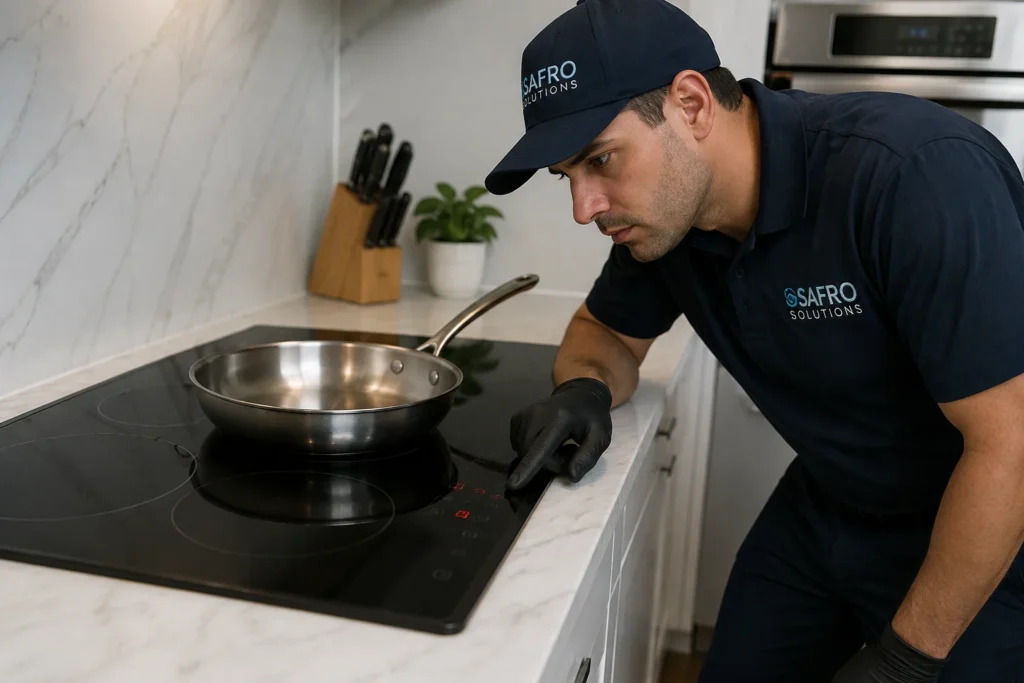
Most of the time, an induction cooktop that won’t detect a pan is a cookware problem, not a broken appliance. The cooktop uses a magnetic field to sense and heat cookware, so if your pan isn’t magnetic, is too small for the zone, or isn’t centered, the cooktop reads it as empty and stays cold even though the zone is turned on.
TL;DR
- Run the 30-second magnet test before assuming anything is broken: if a magnet doesn’t stick firmly to your pan’s base, that’s almost always the whole problem.
- A flashing U, F, or E0 on the display is a pan-detection code, not necessarily a hardware failure, but a persistent E0 that won’t clear can point to a sensor or control board fault.
- Safro Solutions repairs induction, gas, and electric cooktops across Los Angeles and the San Fernando Valley. Call or text (747) 250-6879 for same-day diagnosis.
In this article
- Is it your pan or your cooktop? The 30-second check
- Why your pan isn’t being detected (the 4 real causes)
- What the error code on your display actually means
- When it’s not the pan, it’s the cooktop
- What induction cooktop repair costs in Los Angeles
- When to call a professional vs. keep troubleshooting
- Frequently asked questions
Is it your pan or your cooktop? The 30-second check
Stick a refrigerator magnet to the bottom of the pan that won’t heat. If the magnet clings firmly, the pan is induction-compatible and the fault is almost certainly on the cooktop’s side, in the sensor or coil. If the magnet doesn’t stick at all, or only sticks weakly, the pan itself is the problem, and no repair will fix that. This lines up with the Department of Energy’s guidance on switching to induction cooktops, which confirms that any pot or pan with a flat, magnetic bottom will work on induction, the same mechanism behind detection whether it’s working or failing.
Before you go further, try the same pan on a different zone. If it heats there, the zone it originally failed on is the likely fault, not the pan or the whole cooktop. If it fails everywhere, move on to the causes below.
Why your pan isn’t being detected (the 4 real causes)
Four things account for nearly every pan-detection failure, and three of them have nothing to do with your cooktop being broken.
- Non-magnetic cookware. Aluminum, copper, glass, and most stainless steel without a magnetic base won’t register at all. This is by far the most common cause and the one worth ruling out first with the magnet test above.
- Pan too small for the zone. Induction zones need a minimum amount of magnetic surface area making contact, typically in the 4 to 5 inch diameter range depending on the burner and brand. A pan with a narrow magnetic base, even if it technically passes the magnet test, can still read as “no pan” if too little of it sits over the coil.
- Pan off-center. The magnetic field is strongest directly over the coil. A pan pushed to one side of the zone, especially on cooktops with oddly shaped or overlapping zones, can fall partly outside the field and get missed.
- Warped or uneven pan base. A base that’s bowed, dented, or no longer sits flat loses even contact with the surface, which weakens the signal the coil reads. This one is easy to miss because the pan still passes a basic magnet test.
What the error code on your display actually means
A flashing U or F code means the cooktop is actively telling you it can’t find compatible cookware on that zone, so center a magnetic pan on it and confirm the base isn’t too small before assuming a fault. An E3 code usually points to overheating, often from blocked cooling vents. Clear any dust or obstruction around the vents and let the unit cool for 10 to 30 minutes before trying again. A persistent E0 that keeps returning after you’ve confirmed the pan is compatible, correctly sized, and centered typically signals a voltage or sensor fault that needs professional diagnosis rather than another cookware swap.
Code | What it usually means | What to try first |
| U or F | No compatible cookware detected on that zone | Center a magnetic, properly sized pan on the zone |
| E3 | Overheating, often from blocked airflow | Clear vents, let the unit cool 10 to 30 minutes |
| E0 | Voltage or sensor fault if it persists after the above | Professional diagnosis |
Error code letters and numbers vary somewhat by brand, so if your display shows something outside this table, treat it as a starting point rather than a universal standard.
When it’s not the pan, it’s the cooktop
If a pan you’ve already confirmed is magnetic, correctly sized, and centered still won’t register on multiple zones, the fault has moved from the cookware to the appliance itself. The most common hardware causes are a failed induction coil on that specific zone, a power or control board fault, a touch panel that isn’t registering input correctly, or a cooling fan failure that’s triggering the cooktop’s safety shutdowns. A single dead zone while the others work fine usually points to that zone’s coil. Every zone failing at once, or the display glitching along with the detection failure, points more toward the control board or power supply.
None of these are something to open up and troubleshoot yourself. Induction cooktops carry both high voltage and a sealed glass surface over live electronics, and OEM boards are typically required since aftermarket parts are often incompatible with induction control systems.
What induction cooktop repair costs in Los Angeles
According to Consumer Reports’ 2022 survey on repairing versus replacing a broken cooktop, the median repair cost for an electric induction cooktop was $536, compared to $192 for an electric smoothtop and $153 for a gas cooktop. A new induction cooktop typically runs $1,000 to $2,500, so for a unit under about 10 years old, repairing is almost always the better financial call under the standard 50% rule: repair when the cost is under half the price of a new unit, replace when it exceeds it.
In the Safro Solutions service area across Los Angeles and the San Fernando Valley, typical costs break down like this:
Repair | Typical cost range |
| Sensor or coil fault (single zone) | Diagnostic-dependent, often under $536 median |
Heating element/coil replacement | $110 to $250 including labor |
| Control or power board replacement | Quoted after diagnosis, OEM parts required |
Glass-top surface replacement | $100 to $350 |
| Diagnostic/service call fee | $69 to $129 (waived toward the repair if you proceed) |
General cooktop repair range | $80 to $400 |
When to call a professional vs. keep troubleshooting
Keep troubleshooting on your own as long as you’re working with cookware: running the magnet test, trying a different pan, recentering it on the zone, or clearing debris and moisture from the glass surface. Stop and call a technician once you’ve confirmed the pan isn’t the issue and you’re seeing a persistent E0, a single zone that’s permanently dead while others work, or any burning smell, arcing, or visible damage to the glass or control panel. Our induction cooktop repair service in Los Angeles covers Bosch, Thermador, Miele, Samsung, LG, Café, and Frigidaire units across the San Fernando Valley, with a licensed technician on-site same-day in most cases and a 90-day warranty on parts and labor.
Ready to get your induction cooktop heating again?
If you’ve run the pan test, tried a different pan, and your cooktop still won’t detect cookware, stop swapping pans and get it diagnosed properly. A zone that’s actually faulty doesn’t fix itself, and continuing to use a cooktop with a control board or sensor issue risks the fault spreading to other zones over time. Safro Solutions sends a licensed technician to your door the same day in most cases, tests the actual cause instead of guessing, and gives you a straight answer on repair versus replacement before any work begins.
Safro Solutions
Valley Village, Los Angeles, CA 91607
Call or text: (747) 250-6879
Find us on Google Maps: https://maps.app.goo.gl/Tdof4dD9BS5Tk1i2A
Schedule your induction cooktop repair online, or if your cooktop isn’t heating at all rather than just failing to detect a pan, see our guide on Cooktop Not Heating in Los Angeles? 6 Most Common Causes and How to Fix Them for the broader diagnostic on gas and electric coil cooktops.
Frequently asked questions
Q1: Why is my induction cooktop not heating properly?
In most cases it’s cookware, not the appliance: a non-magnetic pan, one that’s too small for the zone, or one that’s off-center or warped will all cause a zone to read as empty and stay cold. Run the magnet test first before assuming a repair is needed.
Q2: Is it worth repairing an induction cooktop, or should I replace it?
Usually yes, if the unit is under about 10 years old. The median induction repair cost is $536 according to Consumer Reports, against $1,000 to $2,500 for a new unit, which keeps most repairs well under the 50% threshold that makes replacement the better option.
Q3: How do I reset my induction cooktop?
Turn off the zone or the cooktop entirely, and on most models holding the power button or cutting power at the breaker for about a minute clears a stuck error code or an accidentally engaged control lock. If the same code returns immediately after a reset with a confirmed compatible pan in place, that points to a hardware fault rather than something a reset can fix.
Q4: What is the average lifespan of an induction cooktop?
Most induction cooktops last around 10 years with normal use before a major component like the control board or coil starts to fail. A cooktop failing well before that age, or one already needing a second major repair, shifts the math toward replacement even though repair is usually cheaper up front.
Q5: Why is my frying pan not working on induction if it’s stainless steel?
Not all stainless steel is magnetic. Many stainless pans use a non-magnetic alloy in the base or are stainless-clad over aluminum, which won’t register on an induction zone even though the cookware is technically stainless. The magnet test settles this immediately: if a magnet doesn’t stick to the actual cooking surface, that pan won’t work on induction regardless of the material label.
Q6: How much does it cost to fix a “no pan detected” error in Los Angeles?
If the pan itself turns out to be the issue, there’s no repair cost at all. If it’s a genuine sensor or coil fault, costs in the Safro Solutions service area typically fall within the $80 to $400 general cooktop repair range, with the median for induction-specific repairs at $536 based on the Consumer Reports figure above, depending on which component has failed.
Q7: Why does my induction cooktop only fail to detect pans on one specific zone?
A single non-responsive zone while the rest of the cooktop works normally almost always isolates the fault to that zone’s individual coil rather than the whole unit’s power supply or control board, since each induction zone operates on its own coil and circuit.
Q8: Can I fix a persistent E0 or “no pan” error myself, or do I need a technician?
If you’ve already confirmed the pan is magnetic, properly sized, and centered and the error still won’t clear, this is a sensor, coil, or control board issue that requires professional diagnosis. Induction cooktops run on high voltage under a sealed glass surface, and OEM parts are typically required, which makes this a call-a-technician situation rather than a DIY repair.