

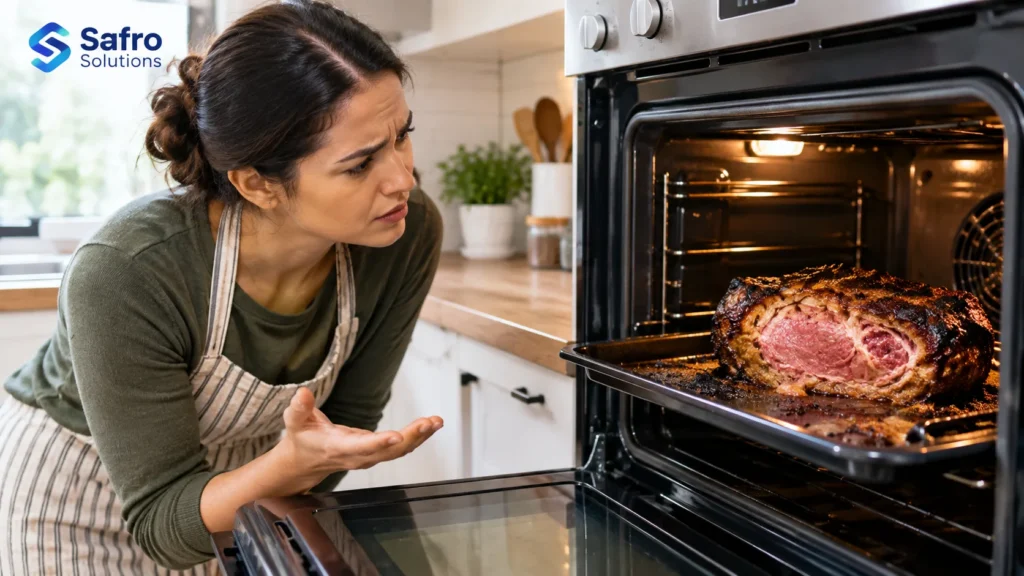
Food burns on top while the middle stays raw when heat isn’t reaching the dish evenly from top to bottom — usually because the rack sits too close to the top element, the oven is running in broil instead of bake, or the convection fan isn’t circulating air. Check rack position and mode first before assuming a part has failed.
Key takeaways
- Food burning on top while the middle stays raw is a vertical heat-distribution problem — a different pattern than food burning unevenly side to side.
- Check rack position and mode first: move the rack away from the top element, and confirm the oven is set to bake, not broil.
- If rack and mode both check out, the next most likely cause is a broil element that won’t shut off or a bake element running too hot.
- A convection fan that isn’t spinning can leave heat pooled at the top with nowhere to circulate, burning the top while the middle stays cold.
- If this started suddenly after months of normal baking, a drifted or failing temperature sensor is the usual explanation.
- Safro Solutions’ own repair data shows most oven fixes for this issue run $100 to $400, with the $69–$129 diagnostic fee waived if you move forward with the repair.
- Safro Solutions repairs ovens same-day across Los Angeles and the San Fernando Valley — call (747) 250-6879.
Why does my oven burn food on top while the middle stays raw?
Heat from the top of the oven — the broil element on most electric ovens — radiates directly onto whatever sits closest to it. The middle of a dish, meanwhile, cooks more slowly because it relies on convected, ambient heat working its way inward rather than direct radiant heat. When the top element runs too hot, cycles on when it shouldn’t, or the rack sits too high, the surface scorches long before the center ever reaches a safe, fully cooked temperature.
This is fundamentally a vertical heat problem: too much heat concentrated at the top of the cavity, not enough reaching the middle. It’s a different failure pattern from a dish that burns unevenly from side to side or corner to corner, which points to a different set of causes entirely — more on that distinction below.
KitchenAid’s own troubleshooting guidance backs up the mechanical side of this: worn or damaged bake and broil elements are a first place to check, since “examine your exposed bake and broil elements for visible signs of wear, like breaks or blisters” is the manufacturer’s own recommended first step.
What’s actually causing the top of my food to burn while the middle stays raw?
The table below matches what you’re seeing to the most likely cause, based on the components Safro’s technicians actually replace on oven service calls for this exact complaint.
What you notice | Likely cause | How common |
| Top burns fast, oven set to “bake” | Rack positioned too close to the top element | Very common |
| Top scorches, oven accidentally set to “broil” or “convect broil” | Wrong mode selected | Very common |
| Top burns even with rack lowered and mode confirmed correct | Broil element stuck on or cycling incorrectly | Common |
| Top burns, middle stays cold even after full cook time | Convection fan not running, or dead | Common |
| Started suddenly after months of normal baking | Miscalibrated or failing temperature sensor | Common |
| Top-burning plus other symptoms — smell, sparking, error codes | Control board issue | Rare |
On the broil-element cause specifically: GE Appliances’ own technical documentation on bake and broil element operation notes that when a door is shut during a normal broil cycle, “the Broil element will cycle off if the oven temperature reaches” its target — but “when the door is left open in the Broil position, the Broil element will stay on continuously.” A door that doesn’t seal or a switch that misreads the door as open can trick the element into running exactly like that during a bake cycle, which is exactly the kind of “top burns no matter what” pattern this table describes.
Which cause should I check first?
Check these in the order they’re actually most likely to be the problem:
- Rack position first. Move it to the middle or lower-middle slot, away from the top element. This takes ten seconds and solves the majority of cases.
- Mode and setting second. Confirm the oven is set to bake, not broil or convect-broil — an accidental setting change is more common than it sounds.
- Broil element third. If rack position and mode both check out, look for the broil element glowing when it shouldn’t, or staying lit into what should be a bake-only cycle.
- Convection fan fourth. If the middle is staying cold rather than just undercooked, listen for the fan running, or crack the door briefly during preheat to confirm it’s spinning.
- Temperature sensor or control board last. Sudden onset after months of normal use, or symptoms beyond just top-burning, point here — this is the rarest cause and the one that needs a technician rather than a DIY fix.
Is this different from an oven that just cooks unevenly side to side?
Yes — and the distinction matters for fixing it correctly. Food burning on top while the middle stays raw is a vertical problem: too much heat at the top of the cavity, not enough reaching the center. Food burning on one side, or at the edges while the center stays undercooked, is a lateral problem, usually tied to uneven convection airflow, an oven that isn’t level, or a warped rack letting heat escape unevenly from side to side.
These two patterns have different likely fixes, which is why they’re covered as two separate issues rather than combined into one article. If your oven is browning unevenly from side to side rather than top to bottom, see Why Is My Oven Cooking Unevenly? Causes and Solutions for that specific diagnosis.
How much does it cost to fix an oven that’s burning food on top?
Safro Solutions’ oven repair technicians in Los Angeles typically see repairs for this issue run $100 for minor fixes up to $400 or more for major component replacement, with the $69–$129 diagnostic fee waived if you move forward with the repair and a clear quote given before any work starts. A rack adjustment or a straightforward broil-element swap sits at the low end of that range; a control board replacement sits at the high end. A technician confirms the exact number at the diagnostic visit rather than quoting blind over the phone.
When should you call a professional oven repair technician?
If rack position and mode are both correct and the top is still burning, or if the middle stays cold no matter how long the dish bakes, that’s a component failure rather than something to keep working around. At that point, checking the broil element, convection fan, or sensor without the right tools risks making the problem worse — or missing a wiring issue that a visual check alone won’t catch.
The bottom line
Food burning on top while the middle stays raw is a vertical heat problem, and it’s almost always solved by checking rack position and mode before assuming a part has failed. If those check out clean, a broil element, convection fan, or temperature sensor is the next likely cause — and that’s a job for a technician rather than continued guessing.
If you’re in Los Angeles or the San Fernando Valley — Valley Village, Sherman Oaks, Studio City, Encino, Burbank, Van Nuys, or nearby — and want the exact cause confirmed rather than guessed at, Safro Solutions can get a technician out same-day.
Related reading: If your oven isn’t getting hot enough at all rather than burning food on top, that’s a different problem — see Why is my oven not getting hot enough? for that diagnosis.
Get your oven diagnosed today
Food burning on top while the middle stays raw usually means a simple fix — not a dying oven. Safro Solutions’ same-day oven repair service in Los Angeles can confirm exactly which part is causing it — rack position, broil element, fan, or sensor — and fix it same-day across Los Angeles and the San Fernando Valley, with a 90-day warranty on parts and labor.
Call (747) 250-6879 now or schedule your oven repair online — mention this article and your technician will bring the right diagnostic tools for your brand.
Safro Solutions
5331 Corteen Pl, Valley Village, CA 91607
Call: (747) 250-6879
Find us on Google Maps: https://share.google/x0w7LKq8nk9yGxPvk
Frequently asked questions
Q1: Can a bad temperature sensor make the top of food burn while the middle stays raw?
Yes. A sensor that’s drifted or failing can tell the oven it’s cooler than it actually is, which keeps the top element running longer and hotter than it should — especially noticeable if this started suddenly after months of the oven working normally.
Q2: Should I put foil over the top of my food to stop it from burning while I wait for a repair?
It’s a short-term workaround, not a fix — and it can backfire. KitchenAid’s own guidance warns that “covering baking racks or the bottom of your oven with tin foil…can restrict proper airflow inside your oven,” which can make an existing heat-distribution problem worse rather than better.
Q3: Do dark or nonstick pans make top-burning worse?
Yes, somewhat. Dark and nonstick pans absorb and hold heat faster than light-colored bakeware, so they can make a top-burning pattern look more severe even when the underlying cause is the oven itself, not the pan.
Q4: Why did this start suddenly after months of my oven working fine?
Sudden onset after normal use for months is one of the clearest signs of a temperature sensor drifting out of calibration, rather than a rack or mode issue — those tend to show up the first time you use the oven that way, not months in.
Q5: Is it safe to keep using an oven that’s burning food on top?
For occasional minor scorching, yes, while you troubleshoot rack position and mode. But if the top is burning severely, quickly, or alongside any smell, smoke, sparking, or error codes, stop using the oven and call a technician rather than continuing to test it yourself.
Q6: Can I fix this myself, or does it need a professional?
Rack position and mode are safe, quick DIY checks anyone can do. Testing or replacing a broil element, convection fan motor, or temperature sensor involves working inside a powered appliance and is where most homeowners are better off calling a technician.