

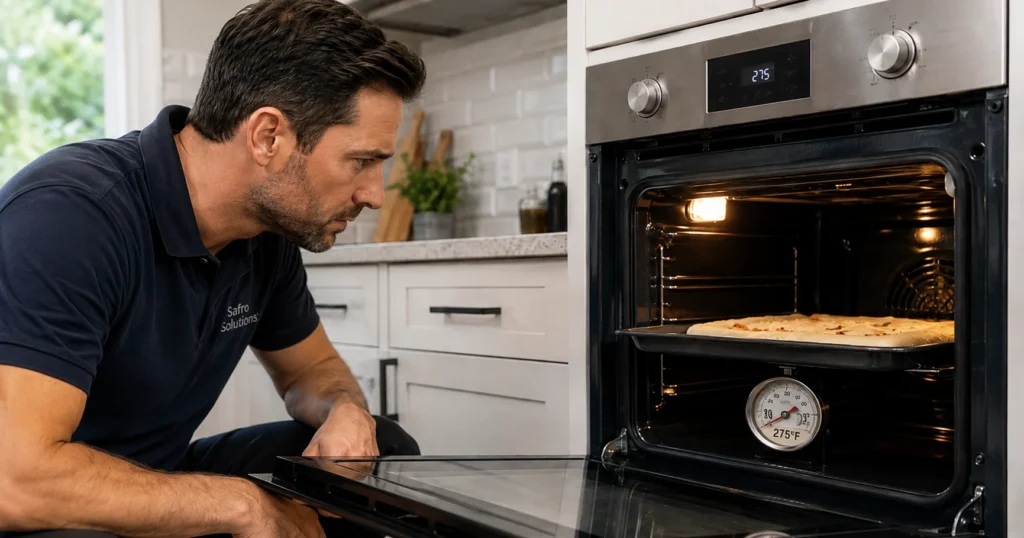
An oven that won’t get hot enough is almost always one of four things: a weak or failed igniter on a gas oven, a burned-out bake element on an electric oven, a drifted or faulty temperature sensor on either type, or a door seal that’s leaking heat out faster than the oven can replace it. Testing with a thermometer first tells you whether it’s a real fault or just running a little cool.
TL;DR
- Confirm it’s real before assuming a repair: a $10–15 oven thermometer and a 20-minute test rule out user error and pin down whether it’s calibration drift or a failed part.
- The four most common causes, in order of likelihood: igniter (gas), bake element (electric), temperature sensor (both), door seal (both).
- Most oven repairs in Los Angeles run $100–$400 and finish in a single visit — call or text Safro Solutions at (747) 250-6879 for same-day service anywhere in the San Fernando Valley or greater LA.
Test it first: is your oven actually not hot enough?
Before assuming a part has failed, confirm the oven is really running cold with a $10–15 oven thermometer — ovens naturally cycle a few degrees above and below the setpoint, and that’s normal, not a fault.
Here’s the test:
- Hang or place an oven thermometer on the center rack, away from the walls and the heating element.
- Set the oven to 350°F and let it fully preheat.
- Wait a full 20 minutes after the preheat signal before reading the thermometer — the display tone triggers as soon as the sensor first touches the target temperature, but the cavity itself needs more time to stabilize.
- Check the reading every 5 minutes for 15 minutes and note the range, then repeat the same test at 250°F and 450°F to see if the gap is consistent across the full range.
What the numbers mean: a reading within about 15°F of the setpoint is normal cycling behavior, not a problem. A consistent gap of 20–50°F points to calibration drift or a drifting temperature sensor. A gap beyond 50°F, or an oven that never gets past a certain point no matter how long you wait, points to a failed component — igniter, bake element, sensor, or control board.
If your test shows the oven running consistently hot or cold everywhere by roughly the same margin, that’s a whole-oven calibration issue — see our full oven temperature calibration guide for the DIY offset steps. If instead one side or rack runs hotter than another while the average is accurate, that’s a different problem — our oven cooking unevenly guide covers hot-spot testing and fixes. This guide covers the case where the whole oven simply isn’t producing enough heat, no matter where you measure.
The 4 most common causes of an oven not getting hot enough
1. Failed or weakening igniter (gas ovens)
A gas oven’s igniter has to draw enough electrical current to glow hot enough to open the gas valve — if it’s weakened by age, it glows but never gets hot enough to trigger the valve, so the burner never lights. Watch through the oven door during preheat: a healthy igniter glows bright orange and lights the burner within 30 to 90 seconds. If it takes longer than 90 seconds, glows weakly, or doesn’t light at all, the igniter has failed. Igniters typically last 5 to 8 years of daily use before they weaken enough to cause this.
2. Burned-out bake element (electric ovens)
The bake element is the coil along the bottom of an electric oven’s cavity, and it’s responsible for most of the heat during baking and roasting. Turn the oven to 400°F and watch it heat: a working element glows bright red evenly along its full length. If it doesn’t glow at all, glows only in patches, or you see a visible break, blister, or scorch mark, the element has failed and needs replacement.
3. Drifted or faulty temperature sensor (gas and electric)
The temperature sensor is a thin metal probe near the back of the oven cavity that reports the actual temperature to the control board, which then decides when to cycle the heat on and off. If the sensor has been bumped out of position — it should sit at a 90° angle to the back wall without touching it — or has simply drifted out of accuracy with age, the control board gets a false reading and either under-heats or shuts off the burner or element too early. This is the most commonly overlooked cause because the oven still turns on and still tries to heat — it just never gets there.
4. Door seal leaking heat
The gasket around the oven door keeps hot air inside the cavity. When it’s worn, cracked, flattened, or blocked by a rack that isn’t seated properly, heat escapes as fast as the oven produces it, so the cavity struggles to climb to temperature or never quite gets there. Run a hand along the seal when the oven is cool and check for visible gaps, flattening, or tears, and confirm no rack, tray, or trapped towel is holding the door slightly open.
Two less common but real causes worth ruling out: a control board that’s failing to send the heat command at all (more on this below), and an oven still cooling down from a recent self-clean cycle — the extreme heat of self-clean means most ovens need 3–4 hours, including an hour-long cooldown, before they’ll heat normally again.
Gas oven vs. electric oven: how the fix differs
Gas oven | Electric oven | |
| Most likely cause | Weak or failed igniter | Burned-out bake element |
| How to check | Watch igniter glow through the door — should light within 30–90 seconds | Watch element at 400°F — should glow evenly bright red |
| Shared cause | Temperature sensor drift or failure (both types use the same sensor design) | Temperature sensor drift or failure |
| DIY-friendly? | Igniter inspection yes, replacement involves gas — most homeowners call a licensed tech | Element inspection yes, replacement involves 240V wiring — most homeowners call a licensed tech |
| Safety note | If you ever smell gas, stop using the oven, shut the gas valve, open windows, and follow SoCalGas leak safety guidance before calling anyone | Bake element replacement involves live 240V connections — turn off the breaker before any inspection |
Why is one side of my oven hotter than the other?
This is a different problem from the whole oven not getting hot enough — it’s usually a failing convection fan, a partially worn heating element, or a rack that isn’t sitting level, not a total heat failure. A 15-minute bread test across every rack position will show you exactly where the hot and cold zones are. We cover the full diagnostic and fix in our oven cooking unevenly guide.
Why does my oven take forever to preheat?
A modern electric oven should reach 350°F in about 12 to 15 minutes, and a gas oven a bit faster, around 7 to 10 minutes — if yours is taking noticeably longer, the cause is usually a weakening heating element or igniter that still works but is losing efficiency, a worn door gasket letting heat escape during preheat, or a temperature sensor giving an inaccurate reading that keeps the system cycling longer than it should. Frequently opening the door during preheat, lining the oven floor with foil (which blocks airflow), and running the oven on a lower-voltage circuit than it’s rated for can all add real minutes too. If preheat time has crept up gradually over months, that pattern points to a part wearing down rather than a sudden full failure — worth testing with the thermometer method above before it stops heating altogether.
Common oven brands: heating issues by manufacturer
Brand | Common heating issue we see in LA | Typical cause |
| Samsung | Won’t heat past ~175°F, or oven is in Demo Mode | Faulty bake/broil element, or Demo Mode accidentally enabled in settings |
| Whirlpool | Oven heats but temperature reads inaccurate | Temperature sensor drift, correctable via control-panel offset |
| LG | Slow to heat or won’t reach set temperature | Igniter (gas) or element (electric) wear, or sensor calibration |
| GE | Oven on but no heat produced | Bake element or igniter failure, sometimes paired with an F-code |
| Maytag / KitchenAid | Oven not getting up to temperature | Igniter (gas) or element (electric), door seal, or sensor position |
Brand-specific recalibration menus (Settings → Oven Calibration on Samsung, holding Bake for 5 seconds on Whirlpool/Maytag/KitchenAid) only help with minor drift under about 25°F. If your brand’s oven won’t heat at all or is off by more than that, it’s a component failure, not a settings fix.
DIY vs. call a professional
Situation | DIY-safe? | Recommended action |
| Oven thermometer shows it’s within 15°F of setpoint | Yes | No repair needed — this is normal cycling |
| Door not closing fully due to a misaligned rack or trapped item | Yes | Reposition the rack, clear the obstruction |
| Minor calibration drift (20–25°F, consistent) | Yes | Use your model’s built-in offset calibration, retest the next day |
| Igniter glows weak or takes over 90 seconds to light | No | Involves gas components — call a licensed technician |
| Bake element doesn’t glow, or shows visible damage | No | Involves 240V wiring — call a licensed technician |
| Temperature sensor reading is off by more than 35°F, or error code (F1, F3, F9, etc.) is showing | No | Control board or sensor fault — call a licensed technician |
| You smell gas at any point | No | Stop use immediately, shut the gas valve, ventilate, then call |
What it costs to fix in Los Angeles
Most oven repairs across Los Angeles and the San Fernando Valley run $100–$400 depending on the failed part, and the majority finish in a single visit. Safro Solutions charges a $69–$129 service call fee that’s fully waived when you go ahead with the repair, with a written flat-rate quote given before any work starts, and every repair is backed by a 90-day parts and labor warranty.
Repair | Typical LA cost range |
Igniter replacement (gas) | Under $200 in most cases |
| Bake or broil element replacement (electric) | $150–$250 |
| Temperature sensor replacement | $100–$200 |
Door gasket/seal replacement | Under $150 |
Control board replacement | $250–$400 |
As a rule of thumb: repair makes sense if your oven is under 10 years old and the cost is well below half the price of a new one. A new oven in LA typically runs $500–$3,000, and most ovens last 15 to 17 years, so a single-component repair is almost always the better financial call over replacement.
Oven won’t heat? We fix it today.
If the thermometer test confirms your oven isn’t getting hot enough, don’t wait on a guess — a licensed technician can diagnose the exact part and quote you a flat rate before touching anything.
Safro Solutions
Valley Village, Los Angeles, CA 91607
Call or text: (747) 250-6879
Find us on Google Maps: https://maps.app.goo.gl/Tdof4dD9BS5Tk1i2A
Same-day service across Valley Village, Sherman Oaks, Studio City, Encino, Tarzana, Woodland Hills, Van Nuys, Northridge, Burbank, Beverly Hills, Pasadena, Glendale, West Hollywood, Brentwood, and Bel Air. Licensed & insured (LIC# A 50901) · 90-day parts and labor warranty · Schedule same-day service · See full oven repair Los Angeles pricing and service details.
Frequently asked questions
Q1: Why is my oven not heating up?
Almost always one of four things: a weak or failed igniter (gas), a burned-out bake element (electric), a drifted or faulty temperature sensor (either type), or a door seal leaking heat. Test with a thermometer first to confirm the gap before assuming which part has failed.
Q2: Why won’t my oven heat up past 200 degrees? This points to a temperature sensor or thermostat that’s misreading the cavity temperature and telling the control board to stop heating early, a bake element with a bad connection, or on digital ovens, a control board fault that never sends the command to raise heat further. Power off for 5 minutes to reset the controls, then retest — if it still won’t climb past 200°F, the sensor or element needs inspection.
Q3: Why is my gas oven not getting hot enough?
The igniter is the most likely cause — it glows but doesn’t draw enough current to fully open the gas valve, so the burner lights weakly or not at all. A temperature sensor issue or a partially closed gas supply valve are the next most likely causes.
Q4: My oven turns on but isn’t heating — what’s wrong?
If the stove burners work but the oven doesn’t heat, the igniter (gas) or bake element (electric) is the most likely failure, since the burners and oven use separate components. A faulty temperature sensor or a tripped internal thermal fuse are the next things to check.
Q5: Is it normal for an oven to run a little hot or cold?
Yes — up to about 15°F above or below the setpoint is normal cycling behavior for most residential ovens. A consistent gap beyond 25°F is worth calibrating, and beyond 50°F usually means a failed part, not just drift.
Q6: How do I know if it’s the igniter or the temperature sensor?
Watch the igniter during preheat — if it glows weakly or takes longer than 90 seconds to light the burner, that’s the igniter. If the igniter lights normally but the oven still won’t reach temperature, or takes an unusually long time even after lighting, the temperature sensor is the more likely cause.
Q7: Can a dirty oven cause it to not heat properly?
Grease and food debris on a gas igniter can weaken the spark or airflow needed to fully ignite the burner, and buildup on a temperature sensor can throw off its reading. Cleaning both (with the oven off and cool) is a safe first step before assuming a part has failed.
Q8: How much does it cost to fix an oven that’s not getting hot enough in Los Angeles?
Most repairs run $100–$400 depending on the part — igniter and door seal fixes tend to land under $200, while control board replacement runs $250–$400. Safro Solutions waives the $69–$129 diagnostic fee when you approve the repair.