

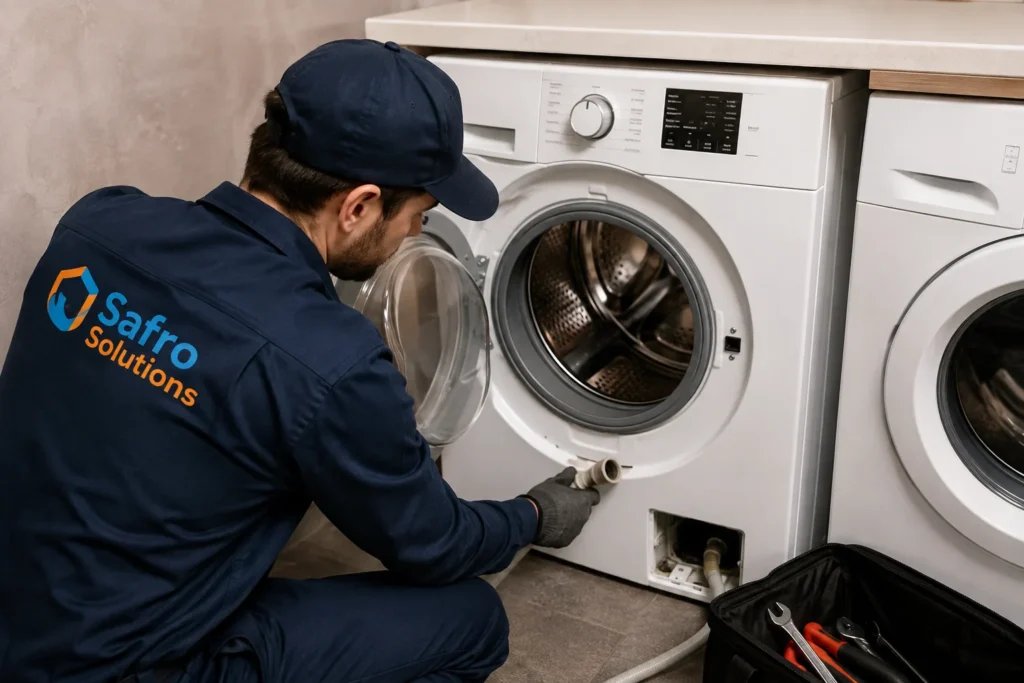
A washer that won’t fill with water is almost always caused by one of five things: a water supply that’s off or a kinked hose, a clogged inlet screen, a faulty water inlet valve, a lid or door switch that isn’t closing properly, or a bad water level switch. Most of these you can check yourself in under ten minutes before calling anyone.
TL;DR
- Start with the two free checks: are both faucets fully open, and is the lid or door closing all the way?
- The most common real cause is a clogged inlet screen, not a broken part. Cleaning it fixes the problem more often than replacing anything.
- If you’ve checked all five causes and your washer still won’t fill, call Safro Solutions at (747) 250-6879 for same-day washer repair in Los Angeles and the San Fernando Valley.
Check these two things before you troubleshoot anything
Before you open up your washer or call for repair, rule out the two causes that take thirty seconds each. Skipping this step is the most common reason people assume they need a new part when they don’t.
First, check both faucets behind the washer. Whirlpool’s own product support documentation confirms that both the hot and cold water supply lines need to be connected and turned on for the washer to fill correctly, even if you only plan to run cold-water loads. Many washers use pressure from both lines to operate the water valve, so leaving one faucet off can stop the fill cycle completely, not just cut off one temperature.
Second, check the lid or door. Top-load washers have a safety switch that blocks the fill cycle if the lid isn’t fully closed, and front-load washers do the same with the door latch. If the washer runs but the drum never fills, open the lid or door, press down firmly until you hear or feel it latch, and restart the cycle.
If both faucets are open and the lid or door is closing properly, move on to the five causes below.
5 reasons your washer won’t fill with water
Each of these causes has its own symptoms and its own fix. Work through them in order, since they’re listed from most common and easiest to fix, to least common and most likely to need a technician.
1. The water supply hose is off, kinked, or disconnected
This is the fastest one to rule out and the easiest to fix. Check that the faucet valves behind the washer are turned fully to the “on” position, and follow both the hot and cold hoses from the wall to the back of the machine to check for kinks, tight bends, or a hose that’s come loose. If you recently moved the washer, cleaned behind it, or had any plumbing work done, a knocked or twisted hose is the most likely culprit.
The fix: straighten any kinks, reconnect any loose fittings by hand-tightening them at the valve, and turn both faucets fully open. If the hoses look cracked, bulging, or more than five years old, Whirlpool recommends replacing fill hoses every five years regardless of whether they’re currently leaking, since rubber hoses degrade internally before they show visible damage.
2. Clogged inlet screen (the most common real cause)
Every washer has a small mesh filter screen where the hot and cold hoses attach to the back of the machine. Its job is to catch mineral buildup, rust flakes, and sediment from your home’s water supply before it reaches the internal valve. Over time, especially in areas with hard water, that screen clogs and restricts water flow enough that the washer either fills very slowly or doesn’t fill at all.
The fix: turn off both faucets, unscrew the hoses from the back of the washer, and look inside the connection ports where the hoses attach. You’ll see a small screen, sometimes cone-shaped. Whirlpool’s guidance is to clean the screen in place with a soft brush, an old toothbrush works fine, and mild soap and water rather than removing or bending it, since a damaged screen can let debris into the valve itself. Reattach the hoses, turn the water back on, and run a short cycle to test.
3. Faulty water inlet valve
The water inlet valve is the electrically controlled part that actually opens to let water into the drum when the washer’s control board tells it to. If the faucets are on, the hoses are clear, and the inlet screens are clean but the washer still won’t fill, the valve itself has likely failed, either from a worn solenoid, mineral buildup inside the valve, or a broken wire connection.
You can do a basic check yourself: unplug the washer, disconnect the inlet hoses, and look for any electrical burn marks or corrosion on the valve’s wire connectors. Testing the valve’s solenoids for continuity requires a multimeter and some comfort working around the machine’s electrical connections. If that’s outside your comfort zone, this is a reasonable point to call a technician, since a misdiagnosed valve replacement wastes both the part and the labor.
4. Faulty lid or door switch
Beyond simply not being closed, the lid or door switch itself can fail. On top-load washers, the plastic strike that the lid presses against can crack or break off, so the switch never registers as closed even when the lid looks shut. On front-load washers, the door latch sensor can wear out or the door seal can prevent a full, flush close.
The fix for a broken strike or misaligned latch is usually a straightforward part replacement, and it’s one of the more affordable repairs on this list. If your washer starts the cycle but stops right at the fill stage every time, and you’ve confirmed the lid or door is physically closing, this switch is the next thing to check.
5. Faulty water level (pressure) switch or control board
This is the least common cause but the one most likely to need a professional. The water level switch, also called a pressure switch, monitors how much water is in the drum and signals the washer to stop filling once it reaches the selected level. When this switch malfunctions, it can send a false “full” signal to the control board before any water has actually entered, which stops the fill cycle almost immediately.
A failing control board can cause the same symptom by sending the wrong signal to the inlet valve in the first place. Both of these repairs involve diagnosing which component is actually at fault, since the symptoms look identical from the outside, which makes this the point where a technician’s diagnostic tools save you from replacing the wrong part.
Does it matter if you have a top-load or front-load washer?
Yes, the two designs fail differently even though the underlying causes overlap. Top-load washers rely on a lid switch and strike plate that physically breaks or misaligns over time, which is the single most common top-load-specific fill issue Safro Solutions technicians see. Front-load washers instead depend on a door latch sensor and a rubber door boot seal, so a torn or dirty door seal that prevents a fully flush close is the front-load equivalent problem.
Both machine types share causes 1 through 3 and cause 5 above equally. If you have a front-load washer and it won’t fill, check the door seal for trapped debris or detergent buildup around the rim in addition to the five causes already covered.
Washer filling but not draining? That’s a different problem
A washer that fills with water and then won’t drain has a different root cause than one that won’t fill in the first place, even though both leave you staring at a machine full of water. A washer that won’t fill has a blocked or failed path getting water in. A washer that won’t drain has a blocked or failed path getting water out, usually a clogged drain pump, a kinked drain hose, or a clogged coin trap.
If your washer fills normally but then sits full of water at the end of the cycle, or drains only partway, that’s a drain-side issue, not a fill-side one. Safro Solutions covers that exact problem, including how to tell a partial drain from a full stoppage, in Washer not draining completely: partial drain vs no drain explained. If you have a top-load washer specifically stuck full of water, Top loader stuck with water? Here’s how to fix it, step by step walks through the four most common causes in the order to check them.
When a Safro Solutions technician should take over
Call a technician once you’ve ruled out the free checks and the two easiest fixes and the washer still won’t fill, or as soon as the diagnosis involves testing electrical components you’re not comfortable handling. Trying the same cycle repeatedly without narrowing down the cause risks flooding your laundry area or straining a part that’s already failing.
Safro Solutions has served Los Angeles and the San Fernando Valley, including Valley Village, Sherman Oaks, Studio City, Encino, Burbank, Van Nuys, and Northridge, with same-day appliance repair on all major washer brands. Our technicians carry the diagnostic tools to test an inlet valve or water level switch on the spot instead of guessing, and the service call fee is waived when you go ahead with the repair. You can see full details on our washer repair Los Angeles page or call us directly at (747) 250-6879.
Ready to get your washer filling again?
If you’ve worked through the checks above and your washer still won’t fill, stop testing it and call us. Guessing at parts wastes money, and a machine that keeps trying to run a cycle it can’t complete puts extra strain on the parts that are already struggling. Safro Solutions sends a licensed technician to your door the same day in most cases, diagnoses the exact cause on the spot with real testing equipment instead of guesswork, and waives the service call fee when you go ahead with the repair.
Safro Solutions
Valley Village, Los Angeles, CA 91607
Call or text: (747) 250-6879
Find us on Google Maps: https://maps.app.goo.gl/Tdof4dD9BS5Tk1i2A
Schedule your washer repair online or see full coverage details on our washer repair Los Angeles page.
Frequently asked questions
Q1: Why is my washer suddenly not filling with water?
A washer that filled normally yesterday and won’t today usually points to a sudden blockage rather than a worn-out part, most often a faucet that got bumped closed, a hose that got kinked when something was moved nearby, or an inlet screen that finally clogged enough to cut off flow. Start with the faucets and hoses before assuming a part has failed.
Q2: How do I reset a washer that won’t fill?
Unplug the washer for about one minute, or switch off its breaker if it’s hardwired, then plug it back in and start a new cycle from scratch rather than resuming a stuck one. This clears a control board that’s stuck mid-cycle, but it won’t fix a physical blockage or a failed valve, so pair it with the checks above.
Q3: Why is my washing machine filling up with water but not draining?
That’s a drain-side problem, not a fill-side one, usually a clogged drain pump, a kinked drain hose, or a blocked coin trap. See our full breakdown in Washer not draining completely: partial drain vs no drain explained.
Q4: Can I trick my washer into filling with more water?
Most modern washers use sensors, not a fixed water line, to decide how much to fill, so there’s no reliable manual trick that works across brands and won’t risk overflow or damage. If your washer is filling with less water than it used to for the same load size, that’s usually a sign of a failing water level switch, not a setting you can override safely.
Q5: Why will my washing machine not stop filling with water?
This is the opposite problem and it points to the same water level switch mentioned above, just failing in the other direction. If the switch can’t sense that the drum is full, the washer keeps adding water past the normal level, and you should shut off the water supply and unplug the machine until it’s diagnosed.
Q6: How much does it cost to fix a washer that won’t fill?
Cost depends on which of the five causes is behind it. A clogged inlet screen or a kinked hose is typically the least expensive fix since no parts need replacing, while a water inlet valve or water level switch replacement costs more in parts and labor. Safro Solutions provides a clear estimate before any repair begins, and the service call fee is waived when you move forward with the repair.
Q7: Is a new washer not filling with water still covered under warranty?
Most new washers carry at least a one-year manufacturer warranty on parts, and installation errors like an unopened faucet or a kinked hose from delivery are the most common cause of fill problems on a machine that’s only a few weeks old. Check your installation first, then contact the manufacturer or your retailer if the problem persists on a unit still under warranty.